
The Multitasking Myth: Why Feeling Productive Is the Real Trap

You answer emails during meetings. You jump between tabs. You reply to Slack while drafting a strategy doc. It feels fast. Efficient. Even impressive.
But here’s the uncomfortable truth: the multitasking myth is not just wrong—it’s expensive.
The more you feel productive while multitasking, the more likely your cognitive performance is to decline beneath the surface.
The 10-Point IQ Drop Nobody Talks About
Research in productivity science shows that heavy multitasking can temporarily reduce your effective IQ by up to 10 points. That’s comparable to losing a full night’s sleep.
Yet paradoxically, multitaskers often feel sharper. Why?
Because the brain confuses activity with progress. Each “quick win” (replying to a message, switching tasks) triggers a small dopamine release, creating a false sense of momentum.
The Illusion of Progress vs Real Output
Multitasking gives you:
- More visible activity
- Faster task turnover
- Constant stimulation
But it takes away:
- Depth of thinking
- Accuracy
- Long-term output quality
You’re not doing more—you’re fragmenting your attention into pieces too small to produce meaningful work.
A New Definition: Multitasking as Attention Fragmentation
Let’s redefine it properly:
Multitasking is not doing multiple things at once. It is rapid attention fragmentation under cognitive constraints.
And your brain was never designed for that.
Your Brain Doesn’t Multitask—It Pays a Switching Tax

At the neurological level, multitasking is a myth. What actually happens is rapid task switching, and every switch comes with a cost.
The Prefrontal Cortex Bottleneck Explained
Your prefrontal cortex (PFC)—the part of your brain responsible for decision-making and focus—can only process one high-level task at a time.
When you switch:
- It unloads Task A
- Loads Task B
- Reconfigures neural rules
This creates a delay known as the psychological refractory period—a 100–400 millisecond gap where your brain is effectively “offline.”
Task Switching Cost: Time, Errors, and Fatigue
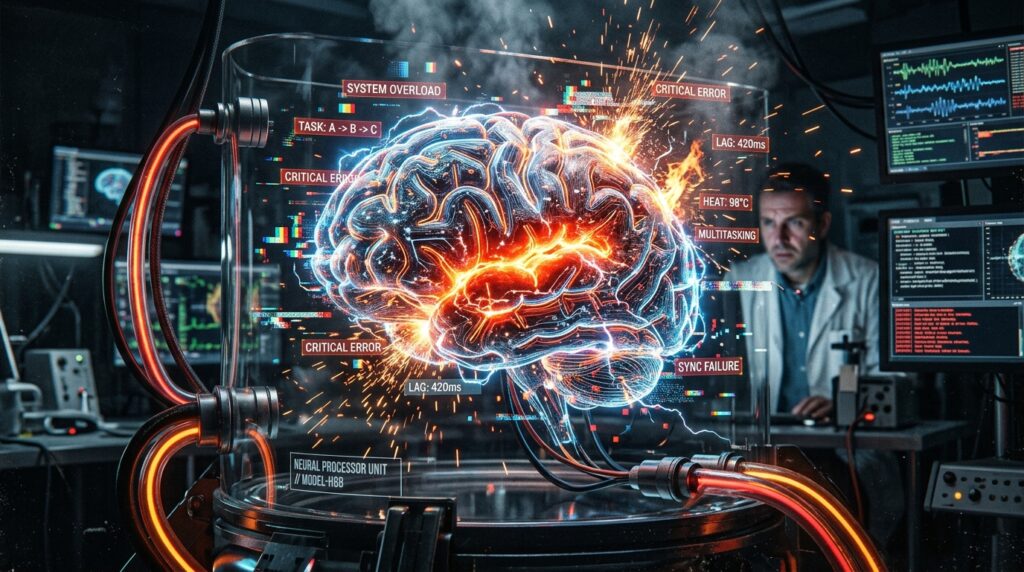
The task switching cost is not just time—it’s a triple penalty:
- Time Loss: Reorientation takes seconds, but full recovery can take ~23 minutes
- Error Increase: Accuracy drops by up to 20%
- Cognitive Fatigue: Energy drains faster due to repeated reconfiguration
Over a full workday, this adds up to a 40% productivity loss.
Neural Competition: Why Two Tasks Cancel Each Other Out
Your brain operates on a “winner-takes-all” system.
When two tasks compete:
- Neural networks overlap
- Signals interfere
- Output becomes diluted
Instead of doing two things at 100%, you do both at 60%—and often worse.
Attention Residue: Why Your Brain Never Fully Switches
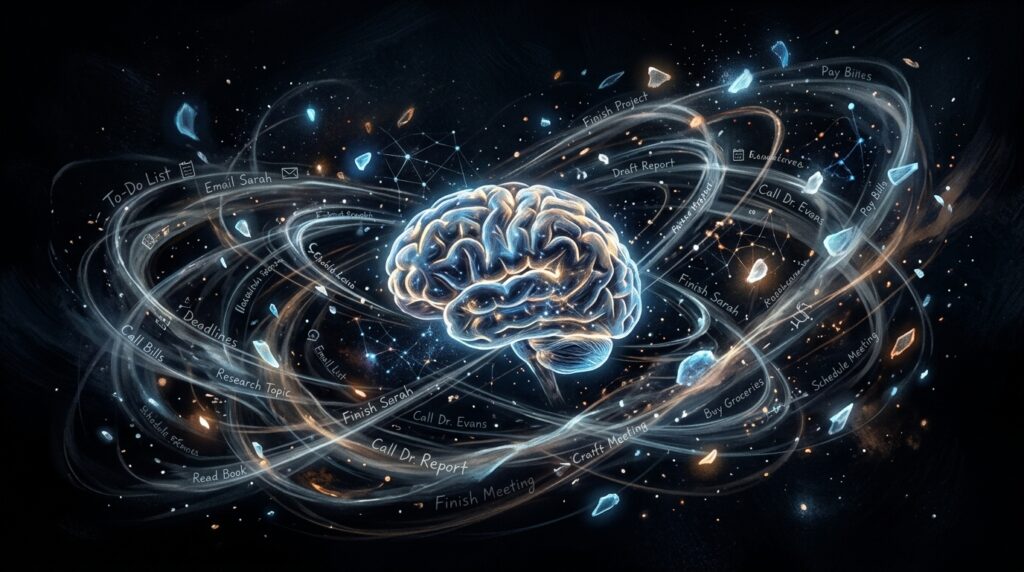
Even after you switch tasks, your brain doesn’t fully let go of the previous one.
This is called attention residue, and it’s one of the most disruptive effects of the multitasking myth.
Neural Persistence & Incomplete Deactivation
When you leave a task, its neural patterns don’t shut off instantly. They linger.
This creates proactive interference, where old information disrupts new processing.
The Zeigarnik Effect: Open Loops That Hijack Focus
Your brain hates unfinished tasks.
When you leave something incomplete:
- It stays active in working memory
- It creates psychological tension
- It keeps pulling your attention back
These “open loops” act like background noise.
Output Gating Failure: When Your Brain Leaks Tasks
Your brain uses gating systems to decide what thoughts become actions.
Under multitasking:
- This system becomes “leaky.”
- Old task fragments slip into new tasks
- Focus becomes unstable
Why You Feel Busy but Produce Nothing Meaningful
Because part of your brain is always somewhere else.
You’re never fully present in any task—just partially engaged in all of them.
Why Your Brain Is Conditioned to Multitasking

If multitasking is so harmful, why do we keep doing it?
Because your brain is wired to want it.
Dopamine vs Acetylcholine: The Focus Tug-of-War
- Dopamine drives novelty and seeking behavior
- Acetylcholine drives sustained focus
Multitasking keeps you in a dopamine loop—constantly seeking new stimuli.
Deep work requires shifting into an acetylcholine-dominant state, which feels slower at first.
The Progress Illusion: Micro-Wins That Reduce Deep Focus
Every small task completion gives you a dopamine hit.
Replying to messages feels productive—but it’s just micro-reward cycling.
You’re chasing the feeling of progress, not actual results.
Novelty Seeking & Digital Triggers
Notifications exploit your brain’s attention-monitoring system.
A ping feels urgent. Important. Hard to ignore.
But most of the time, it’s neither.
The Avoidance Loop: Multitasking as Emotional Escape
Multitasking also helps you avoid discomfort:
- Hard thinking
- Fear of failure
- Boredom
Instead of facing difficulty, you switch tasks.
It feels productive—but it’s actually avoidance.
Cognitive Overload: It’s Not Too Much Work—It’s Too Many Contexts
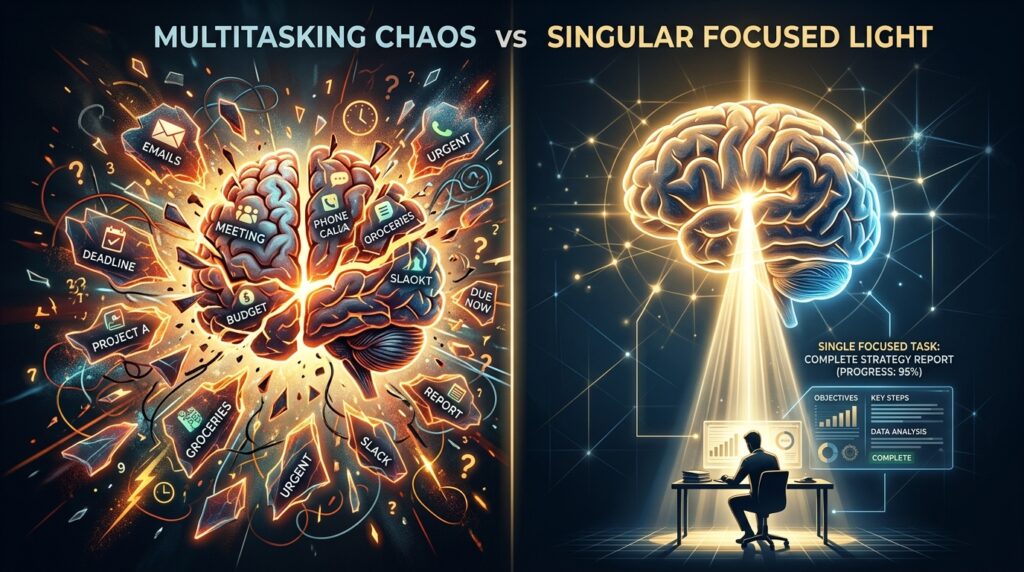
Most people think they’re overwhelmed because they have too much to do.
That’s only half true.
The Fragmentation Problem Explained
The real issue is context switching, not workload.
Each switch requires:
- Rebuilding context
- Reloading rules
- Re-engaging memory
Metadata Load & Context Rebuilding
Every task has “metadata”:
- Goals
- Rules
- Emotional state
- Recent progress
Switching tasks means reloading all of this.
That’s where the real fatigue comes from.
Why Shallow Work Feels Exhausting
Ironically, shallow work (emails, messages) feels more tiring than deep work.
Why?
Because it involves constant switching—high energy, low output.
The “Resolution Decline” Effect
Your attention loses clarity.
Instead of high-resolution thinking, everything becomes blurry and surface-level.
How Multitasking Destroys Decision Quality
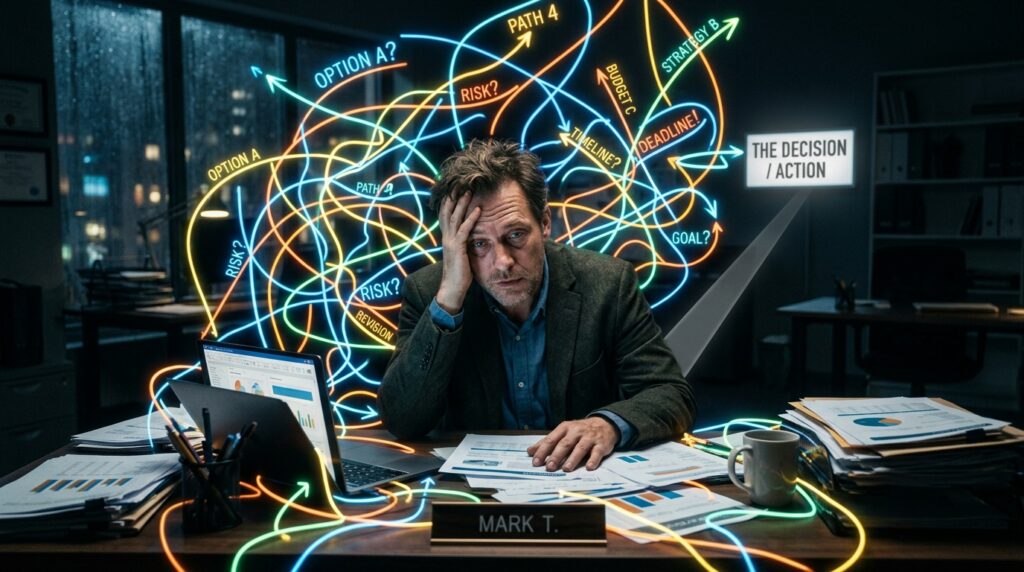
Multitasking doesn’t just slow you down—it makes you worse at thinking.
From Analytical Thinking to Heuristic Shortcuts
As your brain fatigues:
- It abandons deep analysis
- It relies on shortcuts (heuristics)
You stop thinking—you start guessing.
Risk Blindness & Error Amplification
Your ability to detect risk drops.
You miss:
- Subtle problems
- Long-term consequences
- Critical details
The Shift from Control to Impulse
As the prefrontal cortex weakens:
- Impulse systems take over
- You choose easy over correct
Why You Choose “Easy” Over “Correct”
Because your brain is conserving energy.
Multitasking pushes you toward decisions that feel good, not the right ones.
The 20-Minute Wall: Where Real Productivity Begins

Most people never reach true focus.
They quit too early.
The Battle Between Brain Networks
At the start:
- Your mind wanders (Default Mode Network)
- Focus struggles to stabilize
After ~20 minutes:
- Focus locks in (Frontoparietal Network)
- Distractions fade
Dopamine Volatility → Acetylcholine Stability
You shift from:
- Seeking stimulation → Sustained attention
Entering Flow: The Brain’s Efficiency Mode
Once you cross the “20-minute wall”:
- Focus becomes effortless
- Productivity increases dramatically
Why Most People Quit Too Early
Because the first 20 minutes feel uncomfortable:
- Boredom
- Restlessness
- Urge to check something
But that discomfort is the gateway to real performance.
Why Smart People Believe the Multitasking Myth

This isn’t just a habit—it’s a psychological trap.
Overconfidence Bias & the Competence Illusion
High performers assume:
“If I’m smart, I can handle more.”
They can’t. The brain’s limits are universal.
Confirmation Bias & Selective Memory
You remember the few times multitasking worked—and ignore the many times it didn’t.
Identity Traps: “Busy = Valuable.”
Many professionals equate:
- Being busy → Being important
The Chaos Performer Archetype
Some people believe they “thrive in chaos.”
In reality:
They’re Conditioned to stimulation, not producing better results.
Where Multitasking Breaks Performance the Most
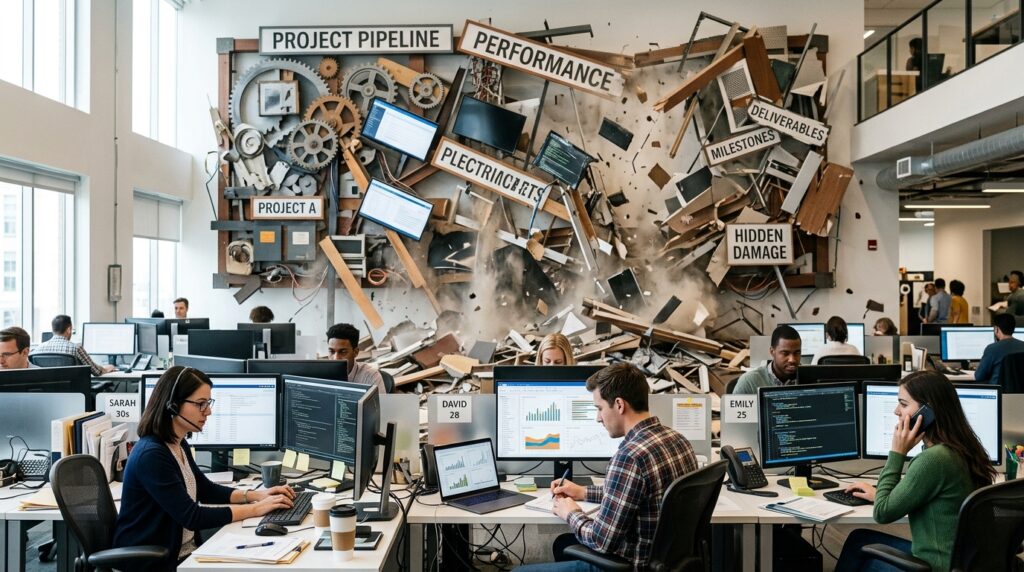
The damage isn’t equal across tasks.
It’s worst where thinking matters most.
Strategic Thinking Decline
You can’t build complex mental models while switching tasks.
So strategy becomes shallow.
High-Stakes Communication Failures
You miss nuance, tone, and intent.
This leads to misalignment and costly mistakes.
Creativity & Innovation Breakdown
Creativity requires deep focus.
Multitasking keeps you stuck in safe, predictable thinking.
Technical Errors & Precision Loss
Error rates spike—especially in detail-heavy work.
When Companies Reward Multitasking, They Kill Intelligence

Multitasking isn’t just an individual problem—it’s an organizational one.
When a company rewards responsiveness over depth, it silently rewires how people think, decide, and create. Over time, this leads to what can only be described as a systemic intelligence Decline.
Strategic Blindness & Tactical Overload
In high-interruption environments, employees operate in a constant state of reaction.
They answer:
- Messages
- Requests
- Notifications
But they rarely ask:
- Where are we going?
- What actually matters?
Strategic thinking requires uninterrupted cognitive space. Without it, organizations become excellent at handling the present—and terrible at anticipating the future.
They move fast, but without direction.
Innovation Decline & Derivative Thinking
Innovation is not born from speed. It’s born from depth.
But when employees are constantly switching:
- They stay in shallow thinking modes
- They rely on familiar patterns
- They avoid cognitive risk
The result?
Incremental improvements instead of breakthroughs.
The company doesn’t stop producing—it just stops evolving.
Institutional Memory Loss
Multitasking environments destroy learning.
Because:
- Decisions are made in fragmented attention states
- Context is never fully processed
- Insights are never deeply encoded
Organizations end up repeating the same mistakes.
Not because they lack intelligence—but because they lack retention.
Burnout as a Structural Feature
Burnout isn’t caused by too much work.
It’s caused by:
- High effort
- Low meaningful output
Multitasking creates exactly that.
Employees feel exhausted—but unfulfilled. Busy—but unproductive.
And eventually, the best performers leave.
The Line Between Multitasking and Smart Switching
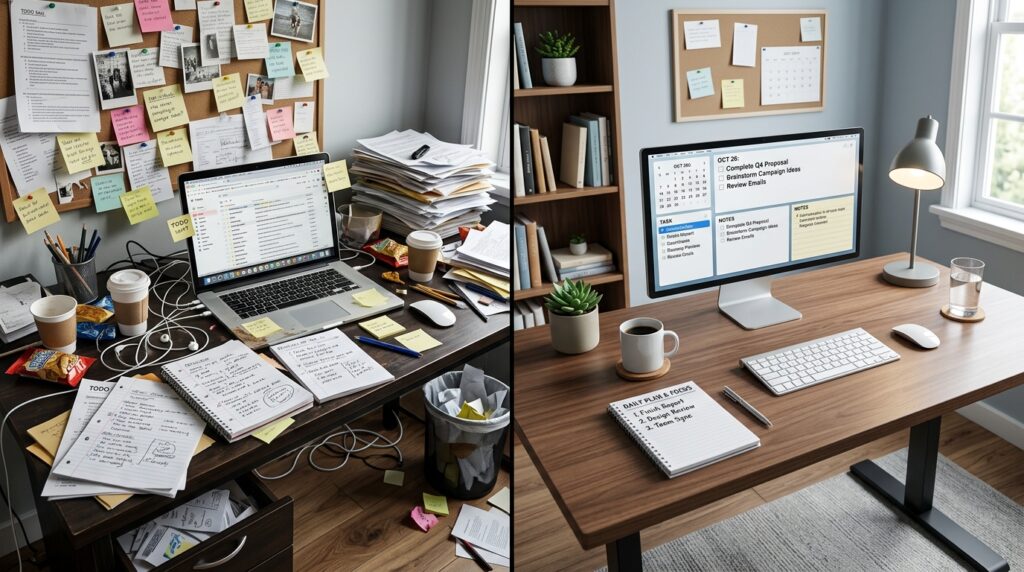
Not all switching is bad.
The problem isn’t switching—it’s how you switch.
The “Clean Handover” Principle
There’s a critical difference between:
- Leaky switching (harmful)
- Clean switching (strategic)
Leaky Switching: The Default Mode
This happens when you:
- Leave tasks unfinished
- Don’t define a stopping point
- Jump due to discomfort
Your brain carries unresolved fragments into the next task.
That’s attention residue.
Clean Switching: The High-Performance Mode
This happens when you:
- Reach a logical checkpoint
- Externalize the next step
- Close the mental loop
A simple method:
Write down:
- Where you stopped
- What is the next action
This signals your brain that the task is “safe to release.”
The One Question That Decides Everything
Before switching, ask:
“Am I switching because I’m finished—or because it got hard?”
If it’s discomfort, stay.
If it’s completion, switch.
That one question can transform your entire workday.
How High Performers Actually Manage Attention

The biggest difference between average and elite performers isn’t intelligence.
It’s attention protection.
From Responsiveness to Control
Average professionals:
- React to inputs
- Prioritize speed
- Stay available
High performers:
- Control inputs
- Prioritize output
- Protect focus
Predictable Non-Responsiveness
This is the first visible shift.
Instead of instant replies, they:
- Respond in batches
- Set expectations
- Communicate boundaries
They are not “slow.”
They are intentional.
Environment Design vs Willpower
Average performers rely on discipline.
High performers redesign their environment:
- Notifications off
- Devices separated
- Clear focus signals
They don’t fight distraction—they remove it.
Attention as a Strategic Asset
Time is fixed.
Attention is not.
High performers treat attention like capital:
- Invested deliberately
- Protected aggressively
- Measured by output
Practical Systems to Replace Multitasking
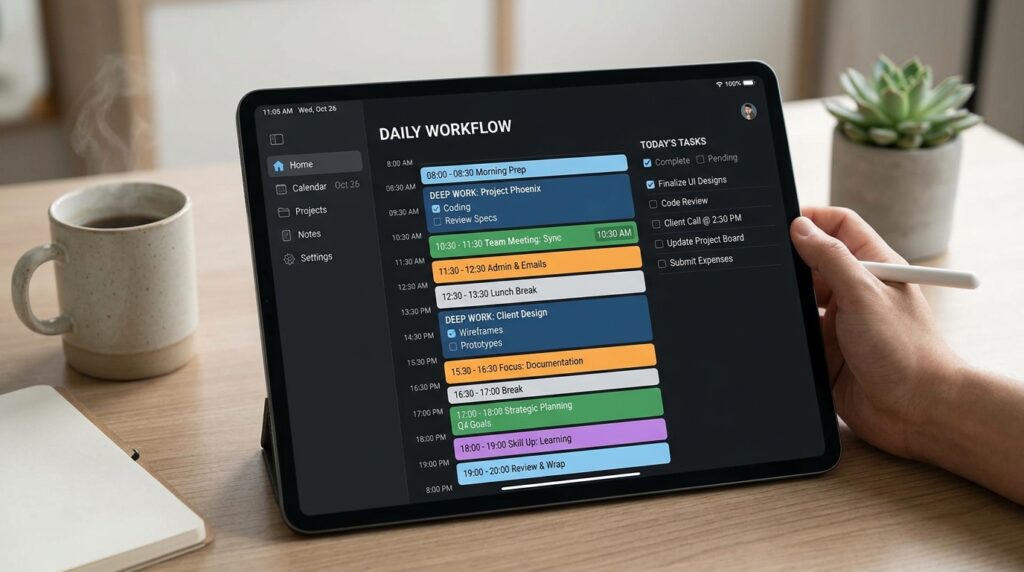
Understanding the problem isn’t enough.
You need systems that work in real life.
Time Blocking & Deep Work
Schedule your most important work like a meeting.
- 60–90 minute focus blocks
- No interruptions
- One task only
This is where high-value work happens.
Task Batching & Cognitive Modes
Group similar tasks together:
- Emails
- Calls
- Admin work
This reduces context switching and preserves energy.
The Parking Lot Technique
When distractions arise:
- Don’t switch
- Write them down
This clears working memory without breaking focus.
Implementation Intentions (If–Then Rules)
Pre-decide your behavior:
- “If I get a notification, I will ignore it until 11 AM.”
- “If I feel the urge to switch, I will wait 5 minutes.”
This removes decision fatigue.
The 50/25 Meeting Reset Rule
End meetings early:
- 50 minutes instead of 60
- 25 minutes instead of 30
Use the gap to reset your brain.
The 60-Minute Digital Blackout Rule

If you implement only one change, make it this.
Why the First Hour Defines Your Day
Most people start their day reactively:
- Slack
- Notifications
This hands control of their brain to others.
The Rule
For the first 60 minutes:
- No email
- No messaging
- No notifications
Focus only on your highest-value task.
Winning the 20-Minute Wall Daily
This forces you to:
- Push through initial resistance
- Enter deep focus
- Produce meaningful output
Most people never reach this state.
You will—every day.
Rewiring Your Brain for Focus
Over time, this builds:
- Stronger attention control
- Reduced distraction cravings
- Higher cognitive endurance
How to Start Tomorrow
- Choose one priority task
- Turn on airplane mode
- Set a 60-minute timer
- Do nothing else
That’s it.
When Multitasking Is Actually Safe (And Even Useful)

Multitasking isn’t always bad.
It depends on the type of tasks.
Automatic vs Cognitive Tasks
You can combine:
- Walking + listening
- Cleaning + podcast
Because one task is automatic.
Complementary Processing
Some tasks don’t compete:
- Music + writing
- Note-taking + listening
They use different neural systems.
The “No Cognitive Competition” Rule
If both tasks require:
- Thinking
- Decision-making
- Language processing
Don’t combine them.
That’s where performance decline.
Frequently Asked Questions About the Multitasking Myth
Is multitasking ever productive?
Only when one task is automatic, and the other requires minimal cognitive effort. Otherwise, it reduces performance.
Why do I feel more productive when multitasking?
Because of dopamine-driven micro-rewards. Your brain mistakes activity for progress.
How long does it take to regain focus after an interruption?
On average, about 20–25 minutes to fully return to deep focus.
Can multitasking damage the brain?
Chronic multitasking is linked to reduced cognitive control and increased distractibility over time.
What is attention residue?
It’s the leftover mental activity from a previous task that interferes with your current one.
How can I stop multitasking at work?
Start with structured systems:
- Time blocking
- Notification control
- Task batching
And implement the 60-minute digital blackout.
The Truth About the Multitasking Myth: Depth Beats Speed

For a quick breakdown, see our guide on the multitasking myth and its shocking effects
The multitasking myth promises more output.
But delivers:
- Fragmentation
- Fatigue
- Shallow work
Real productivity comes from:
- Sustained attention
- Deep thinking
- Focused execution
The shift is simple—but not easy:
Stop managing time. Start managing attention.
Because in a world full of distractions, the ability to focus is no longer normal.
It’s a competitive advantage.

