Emotional intelligence at work has become one of the strongest predictors of leadership success in modern organizations.
The leaders who rise fastest are not always the smartest people in the room. They are the people who can regulate pressure, influence emotion, maintain clarity under stress, and create trust inside complex human systems.
Introduction — The Leadership Ceiling Most Smart People Never See
In nearly every industry, there’s a pattern executives quietly observe but rarely explain openly.
The technically brilliant employee often does not become the most influential leader.
The engineer with the highest IQ gets overlooked for promotion. The founder with extraordinary vision burns through teams. The manager with flawless analytics creates dysfunction wherever they lead.
Meanwhile, another professional — often less technically gifted — steadily climbs the hierarchy, earns trust, commands rooms, and builds high-performing teams with surprising consistency.
Why?
Because leadership is not purely cognitive.
It is biological. It is emotional. It is social.
And that is precisely why emotional intelligence at work has become one of the strongest predictors of leadership success in modern organizations.
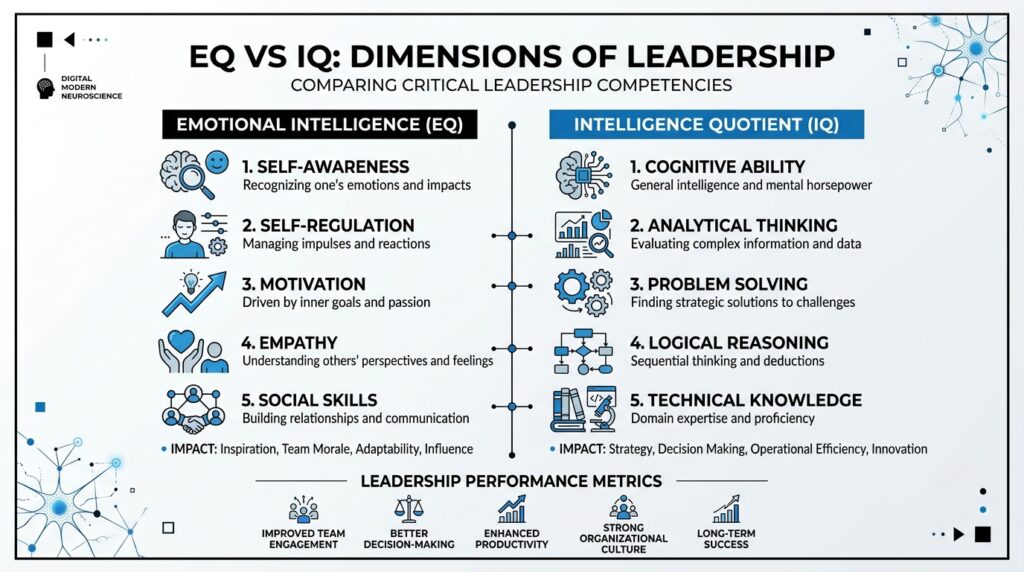
For decades, workplaces rewarded technical expertise above all else. Intelligence Quotient (IQ) was treated as the gold standard of professional capability. But at the executive level, the rules change dramatically.
Once competence becomes baseline, emotional regulation becomes the differentiator.
Research from psychologist Daniel Goleman famously suggested that emotional intelligence accounts for nearly 90% of what distinguishes top performers from peers with similar technical skills. But the modern neuroscience behind leadership goes even deeper than Goleman’s early frameworks.
Leadership is fundamentally the management of nervous systems.
Every meeting, negotiation, conflict, presentation, hiring decision, or crisis activates emotional circuitry inside the brain — both in the leader and in everyone around them.
The leader who can regulate that circuitry gains an extraordinary advantage.
Not because they are “nicer.” Not because they are more charismatic. But because they remain cognitively functional, while others become biologically reactive.
That distinction changes everything.
This article will explore the psychology and neuroscience behind executive emotional intelligence, including:
Why IQ stops predicting leadership success
The neuroscience of emotional regulation under pressure
How emotionally intelligent leaders influence teams
Why reactive leaders reduce innovation
The hidden biological mechanics of executive presence
Practical frameworks to improve emotional intelligence at work
How elite leaders use emotional regulation as strategic leverage
Most importantly, we’ll challenge one of the biggest misconceptions in business culture:
Emotional intelligence is not a soft skill.
It is a performance system.
And in high-pressure leadership environments, it may be the single most important system a professional can develop.
Emotional Intelligence Is Not a Soft Skill. It’s a Leadership Operating System
The phrase “emotional intelligence” has suffered from years of weak framing.
In many professional environments, it gets interpreted as:
being agreeable,
avoiding conflict,
excessive empathy,
emotional sensitivity,
or simply “being nice.”
That interpretation is not only inaccurate — it’s strategically dangerous.
Because it causes ambitious professionals to underestimate one of the most powerful leadership capabilities in modern organizational psychology.
Real emotional intelligence is not emotional fragility.
It is emotional regulation under pressure.
It is the ability to:
maintain cognitive clarity during conflict,
interpret social dynamics accurately,
regulate biological stress responses,
communicate strategically,
and influence emotional environments without becoming emotionally consumed by them.
At elite levels of leadership, this becomes a competitive advantage.
The Dangerous Misunderstanding About EQ
One of the most damaging workplace myths is the belief that emotions interfere with rationality.
Many high performers unconsciously adopt this worldview early in their careers:
Logic equals strength
Emotion equals weakness
Detachment equals professionalism
The result?
They attempt to lead through pure cognition.
But humans are not spreadsheets.
Organizations are not machines. Teams are not purely logical systems. Decision-making is never fully rational.
In reality, every workplace interaction contains emotional data:
status signals,
perceived threats,
trust calculations,
social uncertainty,
ego protection,
and psychological safety assessments.
Ignoring these forces does not eliminate them.
It simply makes a leader blind to them.
This is why many technically brilliant professionals eventually hit what MOSU MIND calls The Leadership Ceiling of Logic.
Their intelligence solves operational problems.
But their lack of emotional calibration creates:
communication friction,
defensive teams,
low trust,
political isolation,
and poor influence.
They become intellectually respected but socially ineffective.
Why “Being Rational” Is Neurologically Impossible
Modern neuroscience has fundamentally dismantled the myth of purely rational leadership.
One of the most important researchers in this field was neuroscientist Antonio Damasio.
His groundbreaking work on patients with damage to emotional-processing regions of the brain revealed something astonishing:
People who lost emotional processing abilities also lost the ability to make effective decisions.
Even simple choices became overwhelming.
Why?
Because emotions function as prioritization signals for the brain.
Without emotional markers, the mind struggles to determine:
what matters,
what deserves attention,
what feels risky,
and what action should come next.
This directly challenges the traditional executive myth that great leaders suppress emotion entirely.
They don’t.
Elite leaders interpret emotional information without becoming controlled by it.
That distinction matters enormously.
Antonio Damasio and the Biology of Decision-Making
Damasio’s Somatic Marker Hypothesis changed how psychologists understand decision-making.
The theory proposes that emotions act as biological guidance systems.
Your brain continuously uses emotional signals to:
evaluate risk,
predict outcomes,
assess social safety,
and prioritize action.
In leadership environments, this process becomes highly visible.
Consider a tense executive meeting.
A reactive leader experiences:
elevated cortisol,
narrowed attention,
defensive communication,
impulsive responses,
and cognitive rigidity.
An emotionally intelligent leader experiences the same biological activation — but regulates it differently.
They:
pause strategically,
maintain prefrontal cortex control,
assess emotional dynamics,
gather social information,
and respond deliberately rather than reflexively.
This is the real foundation of executive emotional intelligence.
Not emotional suppression.
Biological regulation.
Key Insight
Emotional intelligence at work is not the absence of emotion.
It is the ability to remain strategically functional while emotions are active.
Leadership becomes psychologically visible under pressure.
Almost anyone can appear composed during stable conditions. The real test emerges during:
uncertainty,
conflict,
criticism,
crisis,
public failure,
or high-stakes decision-making.
This is where executive emotional intelligence separates performative leadership from genuine leadership capacity.
Because stress changes the brain.
And when the brain changes under stress, leadership behavior changes with it.
The executive who appeared strategic on Monday can become reactive, defensive, impulsive, or socially blind by Friday afternoon under enough pressure.
This transformation is not simply emotional weakness.
It is neurobiology.
The Amygdala Hijack Explained
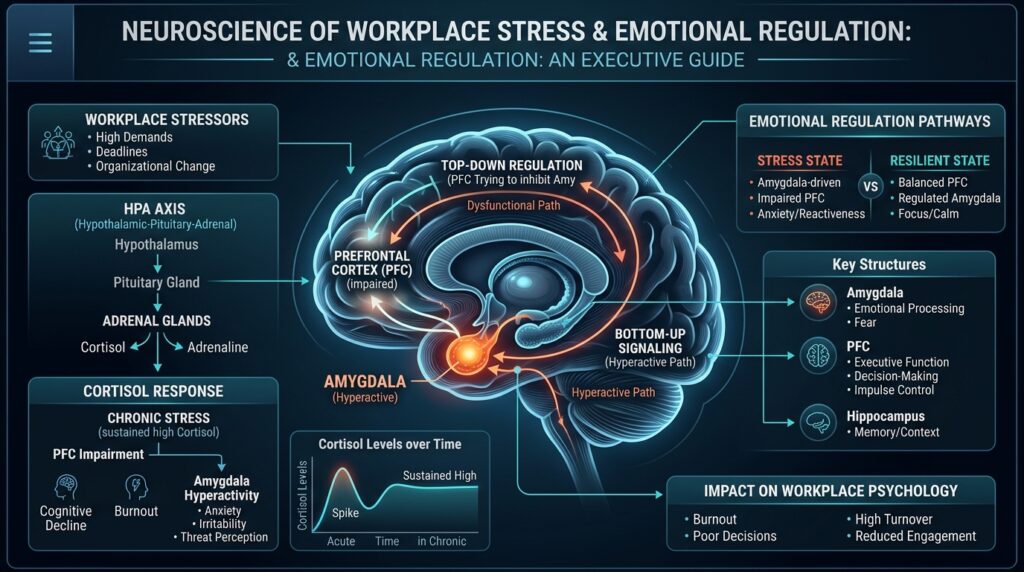
At the center of emotional reactivity sits a small almond-shaped structure in the brain called the amygdala.
Its primary function is survival detection.
The amygdala constantly scans environments for:
danger,
uncertainty,
social threats,
rejection,
status loss,
conflict,
and unpredictability.
In prehistoric environments, this system protected humans from predators.
In modern workplaces, the same circuitry activates during:
executive criticism,
tense meetings,
public disagreement,
layoffs,
failed presentations,
difficult negotiations,
or political conflict.
The brain interprets these experiences as threats to status, security, and social belonging.
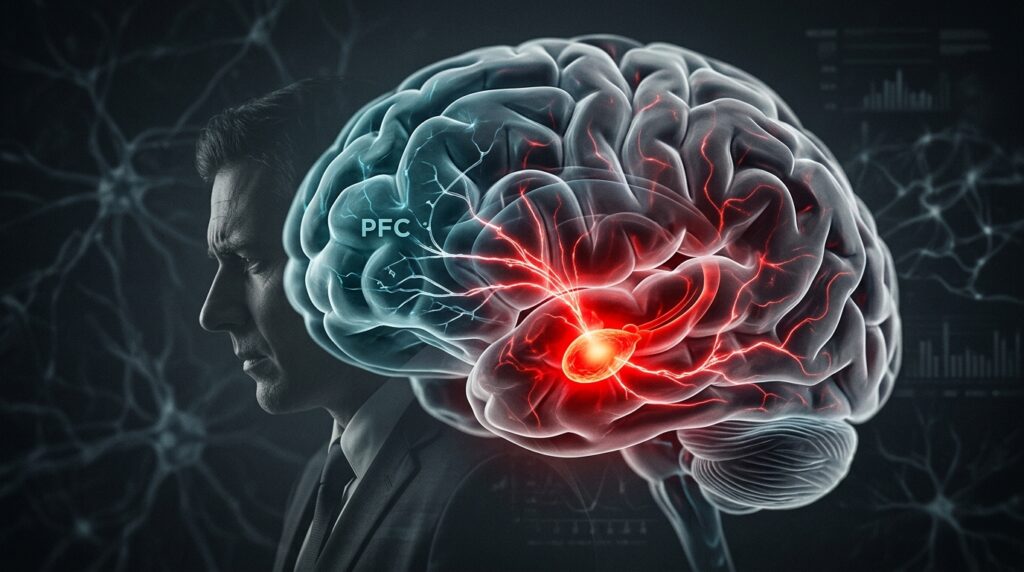
When this occurs, the amygdala can override higher cognitive systems in what psychologists call an amygdala hijack.
Symptoms include:
impulsive communication,
defensive behavior,
narrowed thinking,
emotional overreaction,
poor listening,
rigid decision-making,
and aggressive tone shifts.
Most leadership failures are not intelligence failures.
They are regulation failures.
Prefrontal Cortex: The Executive Brain
The prefrontal cortex (PFC) is responsible for:
strategic thinking,
impulse control,
long-term planning,
emotional regulation,
social judgment,
and executive function.
In many ways, it functions as the CEO of the brain.
Under manageable stress, the PFC performs effectively.
But under intense emotional activation, the brain reallocates energy toward survival systems.
The result?
Strategic thinking declines.
This explains why emotionally reactive leaders often:
interrupt constantly,
escalate conflict,
become obsessed with being “right,”
lose social awareness,
or make short-term decisions that damage long-term trust.
Their biology has shifted from strategic mode into defensive mode.
Key Insight
Under pressure, leadership becomes less about intelligence and more about nervous system management.
High EQ leaders are not people who never experience stress.
They are people who can maintain prefrontal cortex access while stress is occurring.
That distinction changes organizational outcomes dramatically.
Emotional Contagion and Team Performance
Human nervous systems are deeply social.
Research on emotional contagion shows that emotional states spread rapidly through groups via unconscious mimicry, tone matching, facial expressions, posture, and behavioral synchronization.
This means leaders do not merely influence teams through instructions.
They influence teams biologically.
A reactive executive creates:
anxiety,
vigilance,
cognitive fatigue,
and social defensiveness.
A regulated executive creates:
focus,
clarity,
confidence,
and psychological stability.
This phenomenon becomes especially powerful during uncertainty.
When employees lack information, they instinctively monitor the emotional state of leadership.
Why?
Because the brain uses emotional cues to estimate danger levels.
If leadership appears dysregulated, the organization unconsciously interprets:
Innovation decreases. Communication narrows. Creativity collapses.
This is why emotionally volatile leaders often create cultures of silence without realizing it.
People stop contributing honestly because the nervous system prioritizes safety over creativity.
Polyvagal Theory and Executive Presence
One of the most valuable modern frameworks for understanding leadership psychology is Polyvagal Theory, developed by Dr. Stephen Porges.
The theory explains how the nervous system continuously shifts between states of:
safety,
mobilization,
and shutdown.
In leadership environments, these states become highly visible.
A regulated leader projects:
calm facial expression,
vocal steadiness,
emotional containment,
social openness,
and psychological safety.
A dysregulated leader projects:
tension,
unpredictability,
urgency,
emotional volatility,
or threat.
People instinctively respond to these signals long before processing words consciously.
This is the hidden biology behind executive presence.
Executive presence is not merely confidence.
It is regulated physiology communicated socially.
Emotional Contagion: Why Leaders Set the Emotional Temperature of Teams
Most professionals underestimate how much emotional influence leadership actually carries.
A leader’s emotional state becomes the emotional architecture of the workplace.
Not symbolically.
Neurologically.
Teams unconsciously calibrate themselves around the emotional signals of authority figures.
This process happens automatically.
And it explains why some organizations feel:
energized,
psychologically safe,
focused,
and innovative,
while others feel:
tense,
politically defensive,
emotionally exhausted,
and cognitively restricted.
Culture is often the downstream effect of leadership nervous systems.
Mirror Neurons and Social Synchronization
Neuroscientists discovered specialized cells known as mirror neurons that help humans interpret and synchronize with the behavior of others.
These systems contribute to:
empathy,
emotional mimicry,
social learning,
and group cohesion.
In leadership environments, this creates a powerful dynamic: people unconsciously “mirror” the emotional behavior of high-status individuals.
If a leader:
panics,
becomes hostile,
or reacts impulsively,
The team’s nervous systems often follow.
Conversely, calm leadership creates social stability.
This is why emotionally intelligent leaders can stabilize organizations during a crisis without saying very much at all.
Their regulation becomes contagious.
The Biological Thermostat Effect
At MOSU MIND, we describe emotionally intelligent leaders as Biological Thermostats.
Reactive leaders absorb the emotional temperature of the room.
Integrated leaders set it.
This distinction matters enormously in executive environments.
When a leader enters a tense meeting emotionally grounded:
speaking slowly,
listening carefully,
and remaining cognitively flexible,
They lower collective threat perception.
The room becomes more intelligent.
Literally.
Reduced threat activation allows the prefrontal cortex to function more effectively across the group.
This creates:
better collaboration,
higher-quality discussion,
improved strategic thinking,
and stronger decision-making.
Leadership is therefore not just informational influence.
It is a neurobiological influence.
How Anxiety Becomes Organizational Culture
Many workplace cultures are actually emotional ecosystems created unintentionally by leadership behavior.
A chronically anxious leader often creates:
urgency addiction,
hypervigilance,
excessive meetings,
communication confusion,
emotional exhaustion,
and burnout contagion.
Employees begin optimizing for emotional survival rather than organizational excellence.
This creates what psychologists call threat-based performance environments.
Performance may temporarily rise through fear.
But long-term creativity, trust, and innovation collapse.
This is precisely why emotionally intelligent leadership is becoming increasingly valuable in high-performance organizations.
As industries become more cognitively demanding, psychological regulation becomes a competitive advantage.
The Psychology of Executive Presence
Executive presence is one of the most misunderstood concepts in business culture.
Many professionals interpret it superficially:
posture,
confidence,
charisma,
appearance,
vocal tone.
But genuine executive presence emerges from something deeper.
It emerges from regulated internal states.
People trust calm leaders because the nervous system interprets calmness as competence under uncertainty.
This explains why emotionally intelligent leaders often appear more powerful than emotionally reactive leaders — even when both possess equal intelligence.
Affective Presence and Command Psychology
Researchers use the term affective presence to describe the emotional impact a person consistently leaves on others.
Some leaders consistently make people feel:
anxious,
diminished,
defensive,
or intimidated.
Others consistently create:
clarity,
confidence,
focus,
and psychological steadiness.
That emotional footprint becomes part of leadership identity.
High EQ leaders intentionally manage this effect.
Not through manipulation.
Through regulation.
Why Calm Leaders Feel More Powerful
In high-stakes environments, calmness signals:
cognitive control,
strategic capacity,
emotional resilience,
and environmental mastery.
Emotional volatility signals the opposite.
This is why elite negotiators, military leaders, championship coaches, and experienced executives often communicate with extraordinary calm under pressure.
Their nervous systems remain online.
And because they remain regulated, they maintain access to:
perspective,
empathy,
strategic reasoning,
and social awareness.
Reactive leaders lose access to these systems rapidly.
Strategic Pauses and Nervous System Control
One of the most underrated emotional intelligence skills is the strategic pause.
High EQ leaders understand something critical:
The first emotional impulse is often biologically compromised.
Instead of reacting immediately, they create space between stimulus and response.
This small behavioral gap allows:
cortisol levels to stabilize,
the prefrontal cortex to re-engage,
and strategic thinking to recover.
This is why emotionally intelligent leaders often appear:
thoughtful,
measured,
composed,
and difficult to destabilize.
They are not suppressing emotion.
They are regulating processing speed.
The Difference Between Suppression and Regulation
Many professionals confuse emotional suppression with emotional intelligence.
They are radically different.
Suppression means:
denying emotion,
masking reactions,
or pretending emotional activation does not exist.
Regulation means:
recognizing emotion,
understanding its biological impact,
and responding strategically rather than impulsively.
Suppression creates cognitive leakage.
The brain burns enormous energy trying to maintain emotional concealment.
Over time, this contributes to:
burnout,
irritability,
passive aggression,
emotional rigidity,
and executive fatigue.
Regulation, however, preserves cognitive flexibility.
And flexibility is one of the defining characteristics of elite leadership psychology.
Key Insight
Suppression creates brittle leaders.
Regulation creates adaptive leaders.
Why Smart Leaders Fail Despite High Intelligence
One of the most uncomfortable truths in leadership psychology is this:
Many highly intelligent professionals fail not because they lack capabilit,— but because they cannot regulate themselves under pressure.
The modern workplace is filled with executives who are:
analytically exceptional,
strategically brilliant,
technically elite,
Yet psychologically expensive to work with.
And over time, that cost compounds.
Ego Defensiveness and Status Threat
The higher professionals rise, the more identity becomes attached to competence.
This creates vulnerability.
Criticism no longer feels informational. It feels existential.
The brain interprets disagreement as a status threat.
Once this occurs, leaders often enter defensive loops:
interrupting,
overexplaining,
dominating conversations,
dismissing dissent,
or punishing disagreement indirectly.
The irony is brutal:
The smarter the leader, the better they often become at rationalizing emotional reactivity.
And that makes self-awareness harder — not easier.
The Reactivity Tax
Every emotionally reactive moment carries organizational cost.
MOSU MIND calls this the Reactivity Tax.
Examples include:
loss of trust,
reduced openness,
increased political behavior,
communication hesitation,
slower innovation,
and emotional withdrawal from teams.
Reactive leaders may still achieve short-term output.
But they quietly destroy the social infrastructure required for long-term scale.
That is why many high-IQ executives eventually become isolated.
People comply publicly while disengaging privately.
Cognitive Biases That Destroy Leadership
Emotionally unintelligent leadership often amplifies dangerous cognitive biases, including:
Confirmation Bias
Leaders seek evidence supporting existing beliefs while ignoring contradictory data.
Fundamental Attribution Error
Leaders judge others harshly while excusing their own behavior contextually.
Overconfidence Bias
High performers assume intelligence protects them from blind spots.
Emotional Reasoning
Leaders mistake emotional reactions for objective truth.
Without emotional self-awareness in leadership, these biases intensify dramatically under stress.
And that creates strategic distortion across entire organizations.
Low EQ leaders destroy trust through unpredictability.
People cannot relax cognitively around emotionally volatile authority figures.
And without cognitive safety, organizational intelligence contracts.
Influence Through Emotional Calibration
High EQ leaders understand emotional calibration intuitively.
They adapt communication based on:
context,
emotional climate,
power dynamics,
stress levels,
and psychological readiness.
This is not manipulation.
It is adaptive leadership communication psychology.
For example:
a burned-out employee requires different communication than a highly confident executiveA
a crisis environment requires different emotional pacing than a growth environme.t,
and difficultlt feedback requires different framing than strategic brainstorming.
Emotionally intelligent leaders recognize these distinctions rapidly.
Reactive leaders communicate the same way regardless of psychological conditions.
That rigidity creates friction.
Leadership Communication Psychology
Communication quality depends heavily on emotional regulation.
A dysregulated leader:
speaks reactively,
interrupts impulsively,
escalates tension,
and communicates from stress physiology.
A regulated leader:
slows conversations down,
listens strategically,
reads emotional cues,
and responds intentionally.
This creates dramatically different outcomes.
Because leadership communication is not simply verbal.
It ia s nervous system transmission.
People react not only to:
words,
but tone,
pacing,
facial expression,
emotional steadiness,
and perceived safety.
This is why emotionally intelligent executives often feel more persuasive without speaking more aggressively.
Their communication lowers resistance rather than triggering it.
How Leaders Improve Emotional Intelligence at Work
One of the biggest myths surrounding emotional intelligence is the belief that it is fixed.
It isn’t.
Emotional intelligence is trainable because the brain itself remains adaptable throughout life.
This adaptability is known as neuroplasticity.
Just as physical training changes muscular systems, emotional training changes behavioral and neurological patterns over time.
This is important for ambitious professionals because it means:
executive presence can be developed,
emotional regulation can improve,
communication patterns can evolve,
And leadership psychology can become more sophisticated intentionally.
High EQ leaders are rarely born fully formed.
Most become emotionally intelligent through repeated self-awareness, stress exposure, behavioral reflection, and psychological recalibration.
Self-Awareness as Performance Data
Emotionally unintelligent leaders often treat emotion as interference.
High EQ leaders treat emotion as information.
This shift changes everything.
Instead of asking:
“Why am I emotional?”
they ask:
“What is this emotional reaction revealing?”
For example:
Frustration may reveal control issues,
defensivenessss may reveal ego attachment,
anxietyty may reveal uncertainty,
Anger may reveal perceived status threat.
Emotionally intelligent professionals study these reactions rather than denying them.
This transforms emotional self-awareness in leadership into strategic self-diagnosis.
The Emotional Triggers Inventory
One of the most effective executive exercises is identifying recurring emotional triggers.
Common workplace triggers include:
being interrupted,
public criticism,
loss of authority,
uncertainty,
lack of recognition,
disagreement,
or perceived disrespect.
Most reactive behavior follows predictable patterns.
But professionals often remain unconscious of those patterns.
Creating a personal trigger inventory increases awareness dramatically.
A simple framework:
Trigger
Emotional Reaction
Behavioral Pattern
Better Response
Public disagreement
Defensiveness
Interrupting
Pause + clarify
Uncertainty
Anxiety
Micromanagement
Increase communication
Criticism
Anger
Overexplaining
Ask questions first
This transforms emotional regulation at work from abstraction into measurable behavioral change.
360-Degree Social Feedback
One reason emotionally unintelligent leaders struggle to improve is that authority distorts feedback.
As professionals rise:
employees filter honesty,
disagreement decreases,
and executives become socially insulated.
This creates dangerous blind spots.
High EQ leaders actively seek:
upward feedback,
peer feedback,
communication audits,
and behavioral insight.
Because they understand something critical:
Self-perception is often incomplete.
The most emotionally intelligent executives regularly ask:
“How do people experience me under pressure?”
“What emotional effect do I create in meetings?”
“Where does my communication create friction?”
This level of introspection separates adaptive leaders from stagnant ones.
Nervous System Regulation Habits
Executive emotional intelligence is deeply physiological.
Which means regulation practices matter enormously.
High-performing leaders often prioritize:
sleep quality,
exercise,
breathing regulation,
cognitive recovery,
stress management,
and emotional decompression.
Why?
Because exhausted nervous systems become reactive nervous systems.
And reactive nervous systems produce poor leadership outcomes.
The future of leadership development will likely become increasingly biological rather than purely motivational.
The SCARF Audit Framework
One of the most practical leadership psychology frameworks comes from David Rock’s SCARF model.
The model identifies five social domains that strongly influence threat and reward perception:
SCARF Domain
Workplace Meaning
Status
Importance and respect
Certainty
Predictability and clarity
Autonomy
Sense of control
Relatedness
Social belonging
Fairness
Perceived justice
Emotionally intelligent leaders instinctively manage these domains.
For example:
Unclear communication threatens certainty,
Public humiliation threatens status,
Micromanagement threatens autonomy,
Exclusion threatens relatedness,
Inconsistency threatens fairness.
High EQ leadership, therefor,e reduces unnecessary social threat activation.
And that dramatically improves workplace communication and trust.
Daily Executive EQ Practices
Emotional intelligence improves through repetition.
Some of the most effective daily practices include:
1. The Strategic Pause
Delay emotionally charged responses temporarily.
2. Emotional Labeling
Name emotional states internally:
frustration,
insecurity,
stress,
uncertainty.
Research shows emotional labeling reduces amygdala activation.
3. Curiosity Before Defense
Ask questions before reacting emotionally.
4. End-of-Day Reflection
Review moments of:
reactivity,
emotional leakage,
communication friction,
or missed empathy.
5. Physiological Regulation
Prioritize sleep, breathing, recovery, and stress reduction consistently.
These practices appear simple.
But over time, they fundamentally reshape leadership behavior.
The Future of Leadership Belongs to Emotionally Intelligent Executives
The workplace is changing rapidly.
Artificial intelligence is automating:
technical processing,
data analysis,
repetitive workflows,
and information retrieval.
As this happens, uniquely human leadership capabilities become more valuable.
And emotional intelligence sits near the center of those capabilities.
Because AI can process information.
But it cannot fully replicate:
emotional regulation,
social calibration,
trust-building,
nervous system stability,
or psychologically intelligent leadership.
The future executive will not simply manage workflows.
They will manage complexity.
And complexity is deeply emotional.
AI Will Increase the Value of Human Regulation
As workplaces become faster and more cognitively demanding, emotional regulation will become increasingly rare — and increasingly valuable.
Why?
Because constant stimulation creates:
stress overload,
attention fragmentation,
emotional fatigue,
and nervous system exhaustion.
The leaders capable of maintaining:
calmness,
clarity,
empathy,
and strategic thinking
underr those conditions will become extraordinarily influential.
The Rise of Behavioral Leadership
Leadership is evolving from authority management into behavioral architecture.
Modern executives increasingly shape:
emotional environments,
psychological safety,
communication dynamics,
and cognitive culture.
This requires emotional intelligence at work at a much deeper level than previous generations of leadership demanded.
The emotionally intelligent leader of the future will function less like a commander and more like a systems regulator.
Why Emotional Intelligence Will Become Executive Currency
In high-pressure industries, emotional regulation is becoming a form of competitive advantage.
Because the ability to:
think clearly under stress,
stabilize teams,
maintain trust,
and communicate effectively during uncertainty
directly affects organizational performance.
This is why emotional intelligence is no longer optional for serious leadership development.
It is executive infrastructure.
Frequently Asked Questions (FAQ)
What is emotional intelligence at work?
Emotional intelligence at work refers to the ability to recognize, regulate, and strategically manage emotions in professional environments. It includes self-awareness, emotional regulation, empathy, social intelligence, and effective workplace communication.
Why is emotional intelligence important for leadership?
Leadership involves managing people under pressure. Emotional intelligence helps leaders maintain composure, build trust, reduce conflict, improve communication, and create psychologically safe environments where teams perform more effectively.
Can emotional intelligence be learned?
Yes. Emotional intelligence is highly trainable through self-awareness, behavioral reflection, stress regulation practices, communication improvement, and repeated emotional regulation exercises.
EQ vs IQ: which matters more in leadership?
IQ helps professionals solve technical problems, but EQ becomes increasingly important at executive levels where leadership depends on influence, communication, emotional regulation, and social dynamics.
What are signs of high emotional intelligence in leaders?
Common signs include:
calmness under pressure,
strong listening skills,
strategic communication,
emotional self-awareness,
empathy,
conflict management ability,
and emotional consistency.
How does emotional regulation improve workplace communication?
Emotion regulation reduces defensiveness, impulsive reactions, and communication friction. Regulated leaders communicate with greater clarity, empathy, patience, and strategic effectiveness.
Does emotional intelligence reduce burnout?
Yes. High emotional intelligence helps professionals regulate stress responses, reduce chronic emotional reactivity, improve recovery habits, and create healthier emotional environments within teams.
How do leaders improve emotional intelligence quickly?
Leaders can improve emotional intelligence through:
emotional reflection,
stress management,
feedback collection,
active listening,
empathy exercises,
nervous system regulation,
and practicing strategic pauses during emotionally charged situations.
Conclusion — Leadership Is Ultimately Emotional Regulation Under Pressure
For decades, leadership development focused heavily on:
intelligence,
expertise,
credentials,
and strategic thinking.
Those qualities still matter.
But modern leadership increasingly operates inside emotionally complex environments defined by:
uncertainty,
information overload,
rapid change,
social tension,
and chronic stress.
Under those conditions, emotional intelligence becomes the stabilizing force behind effective leadership.
Because leadership is not merely the transfer of information.
It is the regulation of human systems.
The leaders who thrive in the future will not necessarily be:
the loudest,
the most aggressive,
or even the most intellectually gifted.
They will be the people capable of:
remaining calm under pressure,
maintaining cognitive clarity,
understanding emotional dynamics,
creating trust,
and regulating environments without collapsing into reactivity.
That is the true power of emotional intelligence at work.
And increasingly, it is the skill that predicts leadership success more accurately than almost anything else.