
Introduction — Your Brain Is facing constant interruptions (And You Don’t Even Notice)
You sit down to work with full intention. Laptop open. Coffee ready. A clear task in mind.
Then it happens.
A Slack ping.
A WhatsApp buzz.
An email notification.
“Just a quick check,” you tell yourself.
Twenty minutes later, you’re scrolling, switching tabs, and wondering what you were doing in the first place.
This isn’t a discipline problem. It’s not laziness. And it’s definitely not a lack of motivation.
It’s biology.
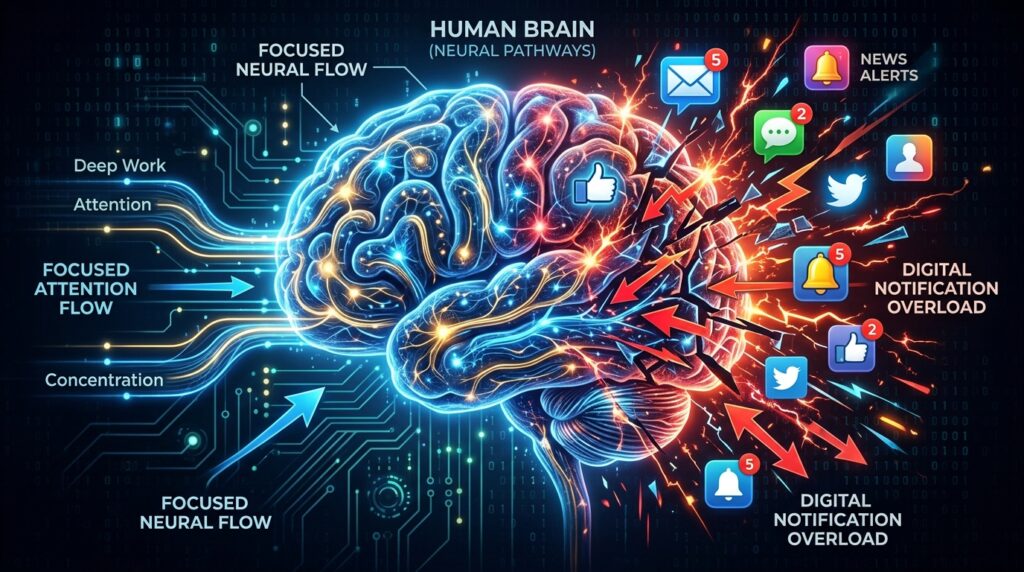
Welcome to the world of deep work neuroscience, where modern research shows that constant notifications are not just distractions—they are neurological disruptions that influence attention patterns away from focus.
The Modern Focus Crisis: Why Your Focus Feels Fragmented
The Attention Span Decline — A Symptom, Not the Cause
You haven’t lost your ability to focus.
You’ve trained your brain not to.
Every notification reinforces a loop:
Focus → Interrupt → Switch → Repeat
Over time, your brain adapts to this pattern. It becomes better at scanning and worse at sustained thinking. This is the real driver behind attention span decline.
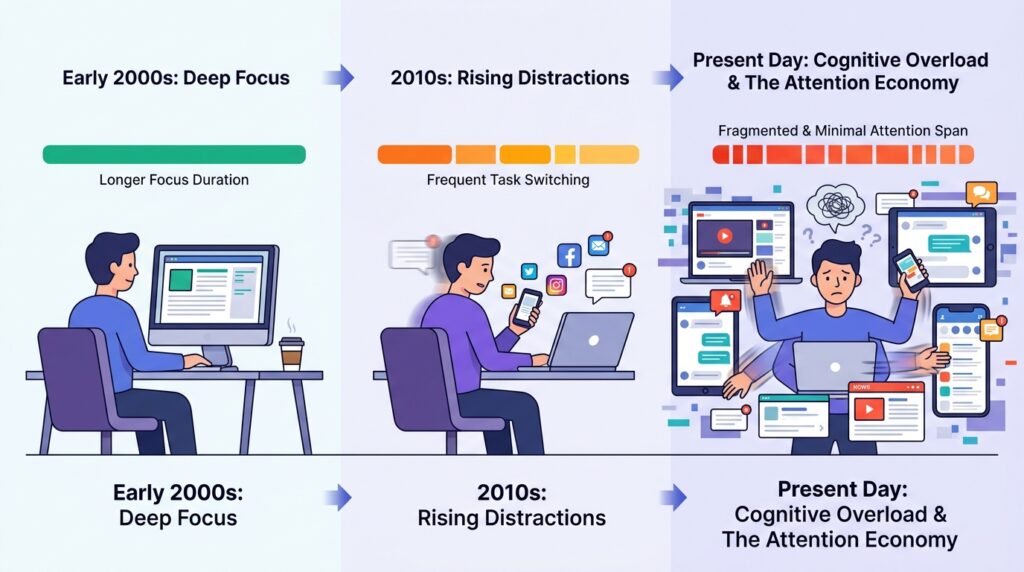
The “Always-On” Work Culture Trap
Modern work environments reward speed, not depth.
Quick replies = productive
Constant availability = professional
But neurologically, this pushes your brain into reactive mode, where:
- Deep thinking shuts down
- Alert systems stay activated
- Stress levels increase
You’re no longer creating—you’re responding.
Digital Presenteeism — Busy but Not Effective
You’re working all day, but producing very little that actually matters.
This is digital presenteeism.
Your brain is constantly:
- Switching contexts
- Rebuilding focus
- Filtering distractions
This drains energy rapidly, leading to mental fatigue—even if the tasks themselves are simple.
Why This Isn’t a Willpower Problem
Willpower is not infinite.
It’s a limited resource controlled by your brain’s executive system.
Every time you resist a distraction, you spend that resource.
Eventually, it runs out.
That’s why you start focused—and end the day scrolling.
Deep Work Neuroscience: How Focus Actually Works in the Brain
The Prefrontal Cortex — Your Focus Engine
The prefrontal cortex is responsible for:
- Planning
- Decision-making
- Sustained attention
During deep work, this region suppresses irrelevant stimuli and keeps you locked onto a goal.
But it’s fragile.
Even small interruptions weaken its control.
The Salience Network — The Real Challenge to Focus
Your brain has a built-in alert system that scans for important signals.
Notifications trigger this system instantly.
Even if the message is meaningless, your brain treats it as potentially important.
This creates a powerful urge to check.
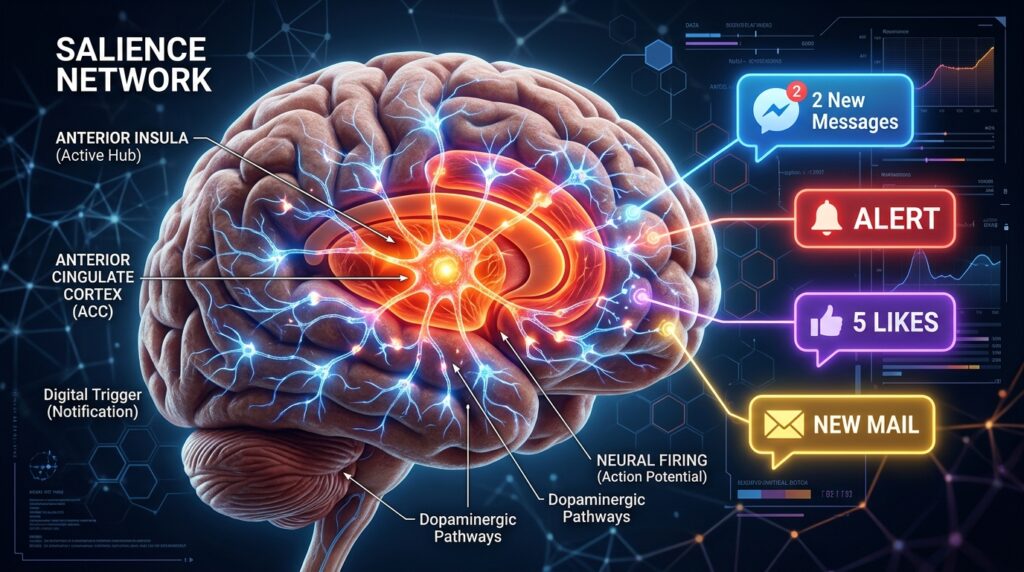
This is salience capturing attention—and it’s happening dozens (or hundreds) of times a day.
The Default Mode Network — Where Ideas Are Born
Deep work isn’t just about effort—it’s about insight.
The Default Mode Network activates when your brain connects ideas in the background.
But constant interruptions prevent this system from engaging.
You stay stuck in shallow thinking instead of creative synthesis.
Flow State — The Peak of Cognitive Performance
Flow is the state where everything clicks.
- Focus becomes effortless
- Time disappears
- Output increases dramatically
But flow requires uninterrupted time.
Notifications Interrupt flow before it even begins.

The Dopamine Distraction Cycle Explained
The Habit Loop Behind Every Notification
Every distraction follows a predictable pattern:
- Cue → Notification
- Craving → Curiosity
- Response → Checking
- Reward → Information
This loop reinforces itself over time.
Why Dopamine Isn’t About Pleasure
Dopamine isn’t the “pleasure chemical.”
It’s a prediction signal.
When your phone buzzes, your brain doesn’t know what’s coming.
That uncertainty creates a spike in dopamine.
You’re not strongly conditioned to the message.
You’re strongly conditioned to the possibility.
Variable Rewards — The Slot Machine Effect

Notifications are unpredictable.
Sometimes they matter. Most times, they don’t.
That unpredictability is what makes them addictive.
Your brain keeps checking because the next one might be important.
The Dopamine Crash That Follows
After you check a notification, your brain dips below baseline.
This creates:
- Restlessness
- Low motivation
- Difficulty focusing
You return to your work in a worse state than before.
Why Notifications Destroy Focus (At a Neural Level)
Attention Residue — The Hidden Cost
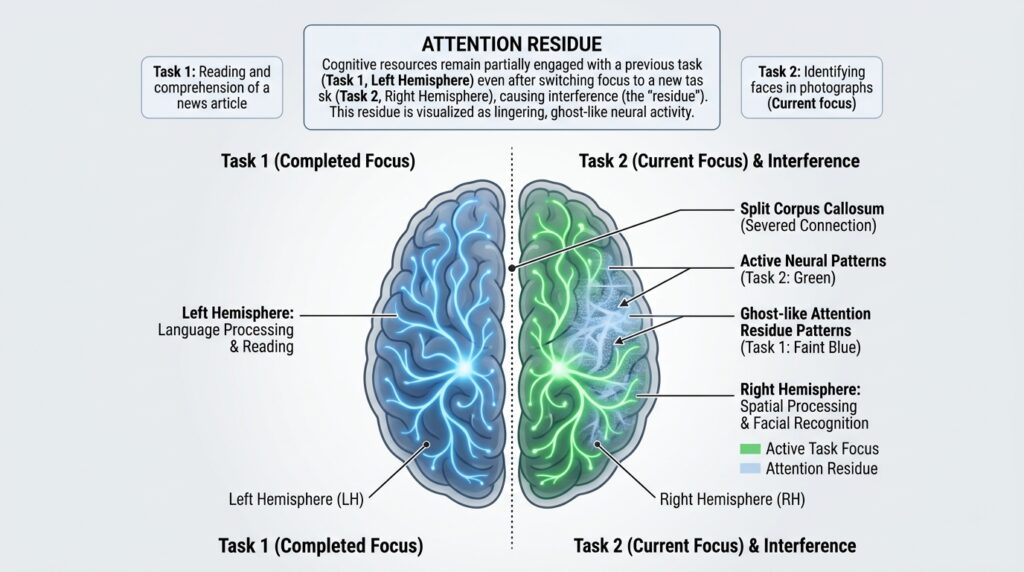
When you switch tasks, part of your brain stays stuck on the previous one.
This is called attention residue.
Even after returning to your work, your mind is partially elsewhere.
Cognitive Load — Your Brain Has Limited Capacity
Your working memory can only handle a small amount of information at once.
Deep work fills that capacity.
A notification forces your brain to clear that space.
Your progress resets.
The Metabolic Cost of Switching
Your brain uses energy to switch between tasks.
Each interruption consumes glucose and oxygen.
By afternoon, your brain is physically depleted.
Inhibition Fatigue — Even Ignoring Distractions Costs You
Here’s the surprising part:
Even if you don’t check the notification, your brain still reacts.
It must actively suppress the urge.
That suppression uses energy.
So even resisting distractions makes you tired.
Multitasking Is a Cognitive Illusion (And a Hidden Brain Cost)
The Switching Tax — Why Productivity Drops Instantly
Multitasking feels efficient.
You’re answering messages, checking emails, and working on a task—all at once.
But your brain isn’t doing multiple things simultaneously.
It’s switching.
And every switch comes with a cost.
Research in productivity science shows that frequent task switching can reduce efficiency by up to 40%. But the real cost isn’t just time—it’s cognitive degradation.
Each time you switch:
- Your brain must disengage from one task
- Reconfigure for another
- Rebuild context
This process isn’t instant. It creates lag.
And over a full day, that lag compounds into hours of lost productivity.
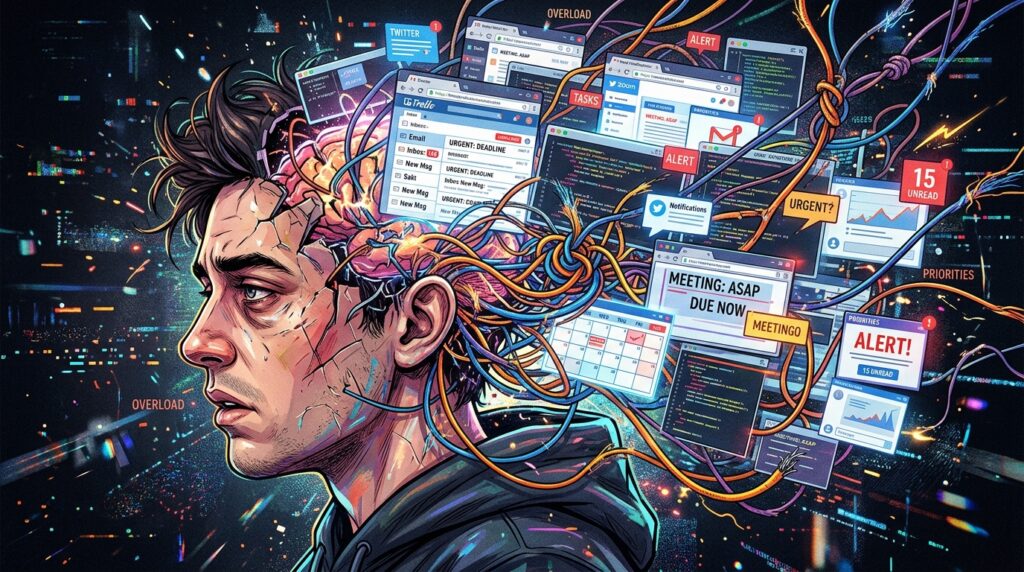
Neural Interference — Why Your Brain Gets “Noisy”
When you leave a task, your brain doesn’t fully shut it down.
Neural patterns from the previous task remain active.
Now, when you try to focus on something new, you’re dealing with:
- Overlapping signals
- Competing thoughts
- Reduced clarity
This is why multitasking makes you feel mentally scattered.
Your brain is literally running multiple “programs” at once.
Long-Term Effects — Training Your Brain to Be Distracted
Here’s where it gets serious.
Multitasking doesn’t just reduce performance—it reshapes your brain.
When you constantly switch tasks:
- You strengthen distraction pathways
- You weaken sustained attention circuits
This is known as negative neuroplasticity.
In simple terms:
You become better at being distracted.
Why Multitasking Feels Productive (But Isn’t)
Multitasking gives you quick wins:
- Replying to messages
- Clearing notifications
- Checking small tasks
Each of these releases small bursts of dopamine.
It feels productive.
But these actions rarely create meaningful output.
You’re busy—but not building anything valuable.
The Emotional Side of Distraction (The Hidden Driver)
Distraction as Emotional Relief
Distraction isn’t just about technology.
It’s about emotion.
When you hit a difficult task, your brain experiences discomfort:
- Uncertainty
- Effort
- Fear of failure
To escape that discomfort, you seek something easier.
Your phone becomes a relief mechanism.

This is the dopamine distraction cycle in action.
The Boredom Barrier — Where Most People Fail
The first 10–20 minutes of deep work are the hardest.
Why?
Because your brain is transitioning from high stimulation (notifications) to low stimulation (thinking).
This creates a feeling of boredom.
But here’s the key insight:
Boredom isn’t a problem—it’s a gateway.
If you push through it, your brain shifts into deeper focus states.
If you escape it, you reset the cycle.
The Zeigarnik Effect — Open Loops in Your Mind
Your brain hates unfinished tasks.
Every unread message, unanswered email, or pending task creates an “open loop.”
These loops:
- Consume mental energy
- Increase anxiety
- Reduce focus
Even if you’re not actively thinking about them, they’re running in the background.
Achievement Anxiety — The Illusion of Progress
You work all day.
You check off tasks.
You stay busy.
But at the end of the day, you feel like nothing meaningful was accomplished.
This creates a loop of anxiety:
- Feeling behind
- Doing more shallow work
- Avoiding deep tasks
This is one of the biggest hidden traps in modern work.
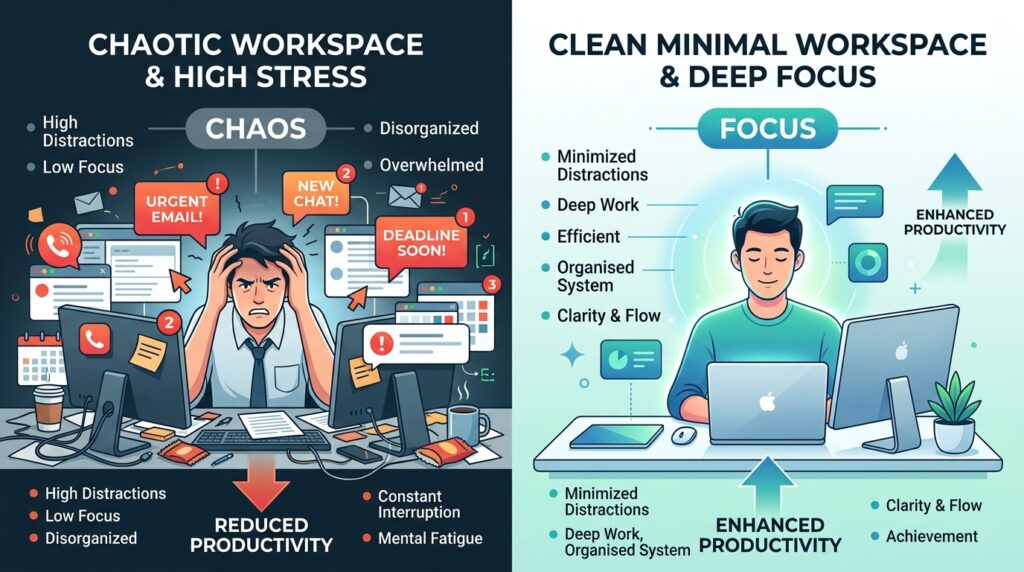
A Day in the Life: Deep Work vs Notification-Driven Work
Let’s make this real.
The Fragmented Day (Reactive Mode)
- Start work → check email
- Begin task → Slack notification
- Return → check phone
- Try again → new message
Result:
- Constant switching
- Low-quality output
- Mental exhaustion
By evening, you feel drained—but unfulfilled.
The Deep Work Day (Focused Mode)
- Start with a clear task
- No notifications
- Sustained focus block
- Controlled communication windows
Result:
- High-quality output
- Clear thinking
- Sense of accomplishment
You finish the day tired—but satisfied.
Energy & Output Comparison
| Factor | Notification-Heavy Day | Deep Work Day |
|---|---|---|
| Brain State | Reactive | Focused |
| Energy Use | Scattered | Efficient |
| Output Type | Shallow | High-value |
| End of Day | Burnout | Fulfillment |
Why Most Productivity Systems Fail (Even If You Try Hard)
The Willpower Fallacy
Most systems assume you can “just resist distractions.”
But resisting requires energy.
If your environment is full of triggers, you’re constantly fighting.
And eventually, you lose.
Ignoring Biological Rhythms
Not all hours are equal.
Your brain operates in cycles of high and low energy.
Rigid schedules ignore this.
Deep work requires aligning with your peak cognitive windows.
Productivity Theater vs Real Work
Answering emails feels productive.
Clearing notifications feels productive.
But these are low-value tasks.
They create the illusion of progress—without actual impact.
Over-Complex Systems Create Friction
If your system is too complicated:
- It increases cognitive load
- It becomes harder to follow
- You abandon it
Effective systems reduce friction—not add to it.
Focus Improvement Strategies Backed by Neuroscience
Environment Over Willpower
Your environment shapes your behavior.
If distractions are visible, your brain must constantly resist them.
Remove the cue—and you remove the struggle.
Focus Is About Elimination, Not Effort
Focus isn’t something you “do.”
It’s what remains when distractions are removed.
The goal is not to try harder—but to reduce interference.
You Only Have a Limited High-Quality Focus
Most people have about 3–4 hours of peak cognitive capacity per day.
Use it wisely.
Spend it on:
- Creation
- Problem-solving
- Deep thinking
Not on notifications.
The Deep Work Protocol (Your Cognitive Operating System)
The Morning Fortress
Start your day with 60–90 minutes of uninterrupted work.
No notifications. No email. No phone.
This is your most valuable time.
Protect it.
Notification Quarantine
Instead of constantly checking, batch notifications into specific windows.
Example:
- 11:00 AM
- 4:00 PM
This prevents constant interruption.
Batch & Burn Communication
Handle all messages in focused sessions.
Respond quickly, then exit.
Don’t linger in reactive mode.
The Shutdown Ritual
At the end of the day:
- Review tasks
- Plan tomorrow
- Close open loops
This reduces mental clutter and improves recovery.
Rewiring Your Brain for Focus (Neuroplasticity in Action)
Focus Is a Trainable Skill—Not a Personality Trait
One of the most empowering insights from deep work neuroscience is this:
Focus isn’t something you’re born with. It’s something you build.
Your brain changes based on how you use it. This process is called neuroplasticity.
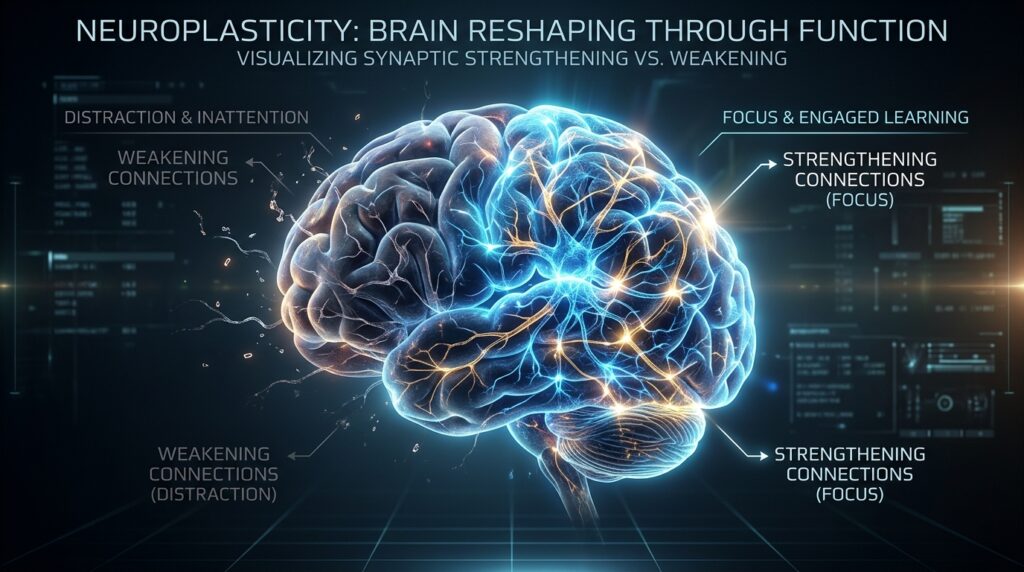
- Practice sustained attention → focus strengthens.
- Practice constant switching → distraction strengthens.
Every work session is training your brain.
Negative Plasticity — How Distraction Becomes Your Default
If you spend hours reacting to notifications, your brain adapts.
It becomes:
- Faster at switching
- Worse at staying still
- More sensitive to distractions
This is why many people feel like they’ve “lost” their ability to focus.
They haven’t lost it.
They’ve rewired it.
Attentional Training — Building the Focus Muscle
Think of focus like a muscle.
You don’t train it by doing more—you train it by resisting interruption.
Simple training methods:
- Work in short, uninterrupted blocks (30–60 minutes)
- Gradually increase duration
- Stay with the task even when it feels uncomfortable
That discomfort?
That’s the growth phase.
Baseline Reset — Reducing Stimulation for Better Focus
Modern life overstimulates your brain.
To restore focus, you need to lower that baseline.
This means:
- Less scrolling
- Fewer notifications
- More quiet time
When stimulation drops, deep work becomes easier.
Environment Design: Building a Focus-Proof Workspace
The Inverse Proximity Rule
The closer a distraction is, the harder it is to ignore.
Your brain constantly monitors what’s within reach.
So:
- Phone on desk → constant temptation
- Phone in another room → reduced cognitive load
Distance creates discipline.

Control Your Digital Environment
Notifications are not neutral.
They are designed to capture attention.
Reduce them aggressively:
- Turn off non-essential alerts
- Disable badges and sounds
- Use “Do Not Disturb” during work blocks
This isn’t extreme—it’s necessary.
Eliminate Visual Noise
Every open tab, app, or notification is a cognitive signal.
Your brain must process and ignore each one.
This creates mental clutter.
Simplify your workspace:
- Close unused tabs
- Use full-screen mode
- Keep your environment minimal
Clarity outside creates clarity inside.
Use Analog Tools for Cognitive Relief
Digital tools often increase stimulation.
Analog tools reduce it.
Try:
- A notebook for task planning
- Writing ideas by hand
- Offline thinking sessions
These reduce cognitive load and improve clarity.
The Future of Focus: Why Deep Work Is a Competitive Advantage
The Attention Economy vs Cognitive Sovereignty
Today, your attention is a commodity.
Apps compete for it. Platforms monetize it.
If you don’t control your focus, something else will.
Deep work is no longer just a productivity skill.

It’s a form of independence.
Deep Work as a Career Multiplier
In a world full of distractions, the ability to focus deeply is rare.
And rare skills are valuable.
Deep work allows you to:
- Learn faster
- Create better
- Solve harder problems
This directly impacts your career growth.
The Focus Wealth Gap
We’re entering a new kind of divide:
- People who can focus
- People who can’t
Those who master focus will produce high-value work.
Those who don’t will remain stuck in shallow tasks.
This is the new productivity gap.
Frequently Asked Questions (FAQs)
What is deep work neuroscience?
Deep work neuroscience studies how brain systems like the prefrontal cortex and dopamine networks support sustained attention and how distractions disrupt them.
Why are notifications so addictive?
Notifications trigger dopamine through uncertainty and variable rewards, making your brain crave checking them repeatedly.
How long does it take to refocus after a distraction?
On average, it can take up to 20–25 minutes to fully regain deep focus after an interruption.
Can you train your brain to focus again?
Yes. Through consistent deep work sessions and reducing distractions, your brain can rebuild focus pathways.
Is multitasking ever effective?
For simple tasks, yes. For complex thinking, no. It reduces efficiency and increases errors.
What are the best daily focus improvement strategies?
- Work in uninterrupted blocks
- Remove distractions from your environment
- Batch notifications
- Prioritize deep tasks early in the day
Conclusion: From Distracted Worker to Cognitive Architect
Here’s the truth most people never hear:
You are not bad at focusing.
You’ve been placed in an environment that trains distraction.
But once you understand the science, everything changes.
You stop blaming yourself—and start redesigning your system.
You move from:
- Reacting → Creating
- Scattered thinking → Deep clarity
- Constant noise → Controlled focus
This is the real transformation.
Not just productivity.
But cognitive control.
In a world full of noise, the ability to think deeply is becoming a superpower.
And now—you know how to build it.

