
The Hidden Mental Drain Most Professionals Never Notice

By 8:00 AM, most professionals have already made dozens of decisions.
Should you check your email first or start deep work? Coffee or tea? Respond now or later? Accept the meeting or decline it? Open Slack or stay focused? Reply formally or casually?
None of these choices feels important in isolation. But together, they quietly drain the brain’s cognitive reserves long before the truly meaningful decisions arrive.
This is the hidden psychology behind modern exhaustion — and it is known as decision fatigue, explained through neuroscience and real behavioral data.
It explains why highly intelligent people suddenly procrastinate over simple tasks, order unhealthy food late at night, snap at loved ones, doom-scroll social media for hours, or freeze when faced with important choices.
Your brain is not weak. Your brain is overloaded.
Modern professionals are not failing because they lack discipline. They are experiencing cognitive overload inside a world engineered to constantly compete for attention. The average knowledge worker now operates inside a nonstop stream of notifications, meetings, tabs, emails, algorithms, micro-decisions, and endless digital interruptions. The result is a mentally exhausted brain struggling to preserve energy — and once the brain’s executive systems become overloaded, decision quality collapses.
What Is Decision Fatigue? Explained in Simple Terms?
The Core Definition
Decision fatigue is the progressive decline in decision quality after prolonged mental effort.
In simple language: the more choices your brain makes throughout the day, the harder it becomes to make smart ones later.
This does not only apply to massive life decisions. Tiny micro-choices matter too — answering messages, choosing meals, selecting tasks, comparing products, filtering notifications, switching between tabs. Each choice consumes cognitive energy. Eventually, the brain begins searching for shortcuts. That is why mentally exhausted people often avoid decisions entirely, choose impulsively, default to comfort, procrastinate, or let others decide for them.
The Psychology of Choices
Behavioral psychology shows that the human brain treats decision-making as metabolically expensive work. Every choice forces the brain to evaluate options, predict consequences, suppress distractions, regulate emotions, and commit to uncertainty.
This process heavily relies on the brain’s executive systems — especially the prefrontal cortex. The problem? Modern life creates a volume of choices the human brain was never designed to handle.
Why Your Brain Has a Limited Decision Budget
Imagine your brain starts each morning with a finite mental budget. Every decision withdraws energy from that account. Small withdrawals feel harmless — checking notifications, choosing breakfast, responding to Slack, comparing pricing plans. But by late afternoon, the account becomes depleted.
At that point, the brain enters preservation mode. Instead of optimizing for long-term success, it starts optimizing for immediate relief. That is when fast food beats healthy eating, scrolling beats focus, avoidance beats action, and comfort beats discipline.
The Neuroscience of Brain Decision Making
The Prefrontal Cortex — Your Brain’s CEO

The prefrontal cortex (PFC) is the brain’s executive control center. It handles planning, impulse control, emotional regulation, prioritization, logic, and strategic thinking.
Think of the PFC as the CEO of your brain. When fully energized, this CEO operates calmly and intelligently — evaluating risks, filtering distractions, solving problems, and thinking long-term. But the PFC is biologically expensive. It consumes enormous amounts of energy during decision-making. And when overloaded, its performance rapidly declines.
How Mental Energy Is Actually Consumed
Although the brain represents only about 2% of body weight, it consumes roughly 20% of the body’s energy. Complex decision-making burns significant cognitive resources.
Historically, psychologists believed this process worked like a fuel tank. This idea became famous through the ego depletion theory, developed by psychologist Roy Baumeister. According to the theory, self-control, willpower, and decision-making all draw from the same limited mental resource.
However, later replication studies challenged parts of the ego depletion theory. Modern neuroscience now suggests the story is more nuanced. Your brain may not literally run out of fuel like a gas tank. Instead, decision fatigue appears to involve motivational shifts, attention exhaustion, emotional overload, and cognitive resource allocation. In other words, your brain starts protecting itself from further mental strain.
Attention Systems and Cognitive Filtering
The brain constantly filters incoming information. Without this filtering system, humans would collapse under sensory overload. But digital life overwhelms these attention systems. Every notification creates a forced micro-decision — ignore it, open it, respond now, save it for later. This process creates severe cognitive friction.
Why Context Switching Destroys Focus

Multitasking feels productive. Neuroscience says otherwise. The brain cannot truly focus on multiple cognitively demanding tasks simultaneously — instead, it rapidly switches attention between them, and each switch carries a mental cost.
Psychologist Dr. Sophie Leroy calls this phenomenon attention residue. When moving from Task A to Task B, part of your attention remains stuck on the previous task. That leftover cognitive residue weakens performance on the next activity. This is why checking Slack during deep work destroys concentration, notifications feel mentally exhausting, and back-to-back meetings leave people cognitively drained.
Ego Depletion: The Theory That Changed How We Understand Decision Fatigue
Roy Baumeister and the Original Fuel Tank Model
Roy Baumeister’s ego depletion theory became one of psychology’s most influential ideas. The model proposed that willpower, discipline, self-control, and decision-making all rely on a shared pool of finite mental energy. As this pool depletes, people become impulsive, emotionally reactive, cognitively lazy, and prone to poor decisions.
The Famous Cookie vs Radish Experiment
In one of Baumeister’s most cited studies, participants were asked to resist freshly baked cookies and eat radishes instead. Afterward, those participants gave up significantly faster on difficult puzzles compared to people who had eaten the cookies. The conclusion: mental effort appeared to reduce future persistence.
You can read more about this foundational research via the American Psychological Association’s overview of self-control research.
The Replication Crisis and Scientific Debate
In recent years, large-scale replication studies challenged some findings surrounding ego depletion. Researchers like Dr. Michael Inzlicht argued that decision fatigue may involve changing motivation, reward sensitivity, and shifting attention priorities — rather than literal resource depletion.
Meanwhile, Stanford psychologist Carol Dweck discovered something fascinating: people who believed willpower was unlimited showed significantly lower signs of ego depletion. This changed the conversation entirely.
Modern psychology now views decision fatigue as both biological and psychological. Your mindset matters. But so does cognitive overload.
Why Modern Life Creates Extreme Cognitive Overload

Social Media: The Algorithmic Choice Factory and Decision Fatigue Explained
Social media platforms are engineered to maximize engagement. Every swipe creates another decision — watch or skip, like or ignore, click or scroll. This endless stream of micro-choices silently drains mental energy. The human brain evolved for focused survival tasks, not infinite scrolling. Yet modern algorithms constantly force rapid cognitive evaluation, creating chronic mental exhaustion.
Notification Fatigue and Forced Context Switching

Notifications are not harmless interruptions. They are attention interruptions. Every ping spikes attention, interrupts focus, and forces an immediate decision. Should you respond now? Can it wait? Is it urgent? This constant state of vigilance keeps the nervous system overstimulated. Eventually, the brain loses the ability to sustain deep focus.
Research from the University of California, Irvine, found that it takes an average of 23 minutes to regain full focus after an interruption — making every notification far more expensive than it appears.
Information Overload and Digital Exhaustion
Modern professionals face a brutal paradox: unlimited information often creates worse decisions. The internet provides infinite opinions, endless strategies, nonstop advice, and overwhelming comparisons. The brain becomes trapped in excessive evaluation, creating overthinking, indecision, anxiety, and analysis paralysis. The result is not clarity — it is cognitive overload.
The Evolutionary Psychology Behind Decision Fatigue
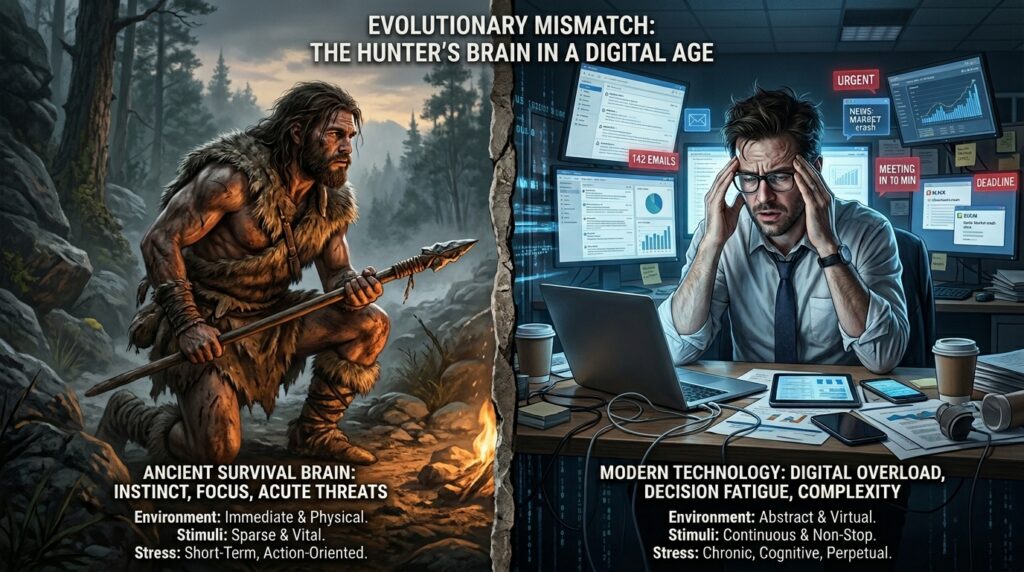
Your Brain Was Never Designed for Infinite Choices
For most of human history, daily choices were limited. Ancient humans focused on finding food, avoiding danger, maintaining social bonds, and conserving energy. Today, the average professional makes more decisions before lunch than our ancestors likely made in days. This creates an evolutionary mismatch.
Why the Brain Tries to Conserve Energy
From an evolutionary perspective, energy conservation was survival. The brain evolved to avoid unnecessary cognitive effort. Psychologists sometimes describe humans as “cognitive misers.” We instinctively seek shortcuts — habits, routines, defaults, and familiar patterns. This is not laziness. It is biology.
When overwhelmed, the brain automatically searches for low-effort solutions. That is why exhausted people default toward comfort foods, mindless entertainment, procrastination, and passive behaviors.
Real-Life Symptoms of Mental Exhaustion: Decision Fatigue Explained Through Daily Behavior
Decision fatigue rarely feels dramatic at first. Instead, it appears through subtle daily patterns.
Analysis Paralysis
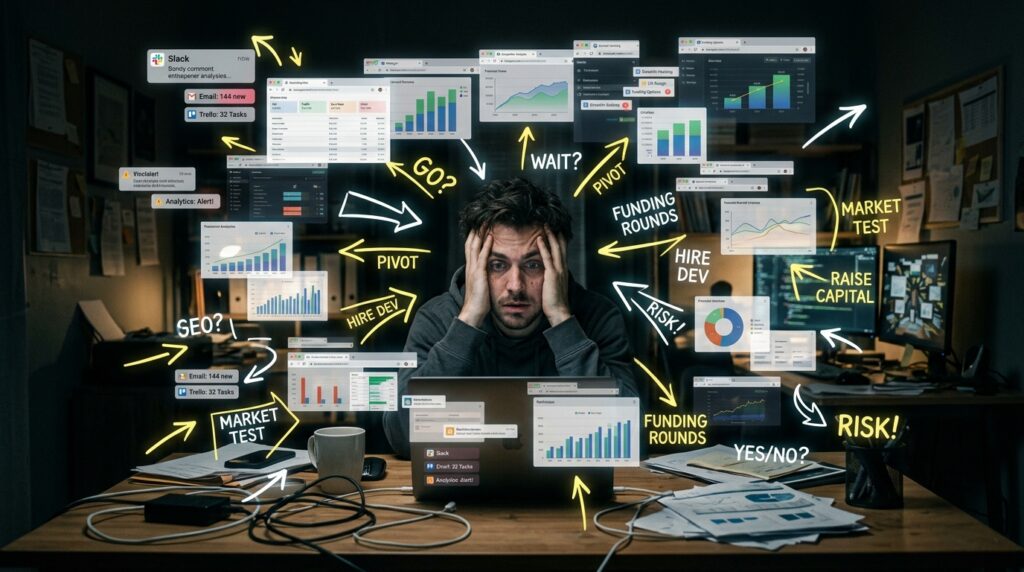
You stare at a simple email for 20 minutes without replying — not because the task is difficult, but because your brain cannot tolerate one more decision.
Irritability and Emotional Reactivity
Snap reactions to trivial questions. A colleague asks where to schedule a meeting, and you feel a flash of genuine frustration. This is not rudeness — it is the amygdala stepping in when the PFC goes offline.
“I Don’t Care, You Decide” Syndrome
Mentally exhausted people often surrender choices entirely. This explains why overwhelmed professionals suddenly say “whatever works,” “you pick,” or “I honestly don’t care.” It is not indifference — it is cognitive overload.
Revenge Bedtime Procrastination
One of the clearest modern symptoms of decision fatigue is staying awake far too late scrolling social media despite exhaustion. After an entire day of obligations and controlled behavior, the brain rebels — craving effortless dopamine and emotional escape.
Impulsive Spending and Poor Food Choices
Mental exhaustion weakens inhibitory control. That is why people impulsively buy online late at night, binge on unhealthy food, and abandon long-term goals after stressful days. The exhausted brain prioritizes immediate comfort over future rewards.
Inbox Avoidance and Productivity Loops
Opening an email, reading it, feeling a wave of dread, closing it without replying — then doing it again an hour later. This loop is not laziness. It is your cognitive budget refusing to authorize one more withdrawal.
Healthy Decision Making vs Cognitively Overloaded Thinking
The Two CEOs Metaphor
Imagine two CEOs running the same company.
The Healthy CEO is focused, strategic, emotionally regulated, and long-term oriented. They run meetings efficiently, ignore minor distractions, and make high-stakes choices with complete clarity.
The Exhausted CEO is overwhelmed, reactive, distracted, impulsive, and constantly firefighting. They stop planning for next quarter and start making impulsive choices just to survive the next ten minutes.
Both CEOs are equally intelligent. The difference is cognitive energy. Decision fatigue transforms the brain from strategic leadership into survival mode.
The Paradox of Choice: Why More Freedom Creates More Anxiety
Barry Schwartz and the Psychology of Choices
Modern culture teaches us that more choice equals more freedom. But cognitive psychology reveals something uncomfortable: too many choices often make humans less happy, more anxious, and mentally exhausted.
Psychologist Barry Schwartz explored this in The Paradox of Choice — a foundational text on how unlimited options create psychological friction rather than satisfaction. His research remains one of the most cited works in behavioral psychology.
Why Too Many Options Reduce Happiness
Imagine choosing between 3 productivity apps versus 300. At first, abundance feels empowering. But eventually, the brain becomes overwhelmed by comparison. You stop asking “which option works?” and start asking “what if another option is better?” This creates regret, over-analysis, perfectionism, and fear of making mistakes.
Maximizers vs Satisficers
Schwartz divided decision-makers into two groups. Maximizers obsess over finding the perfect choice — they compare endlessly, over-research, fear missing out, and struggle to commit. Satisficers identify core requirements and choose the first option that meets them, prioritizing momentum, simplicity, and mental preservation.
Modern professionals are trained to become maximizers. And maximizing destroys mental energy.
Leadership Burnout and Executive Decision Exhaustion
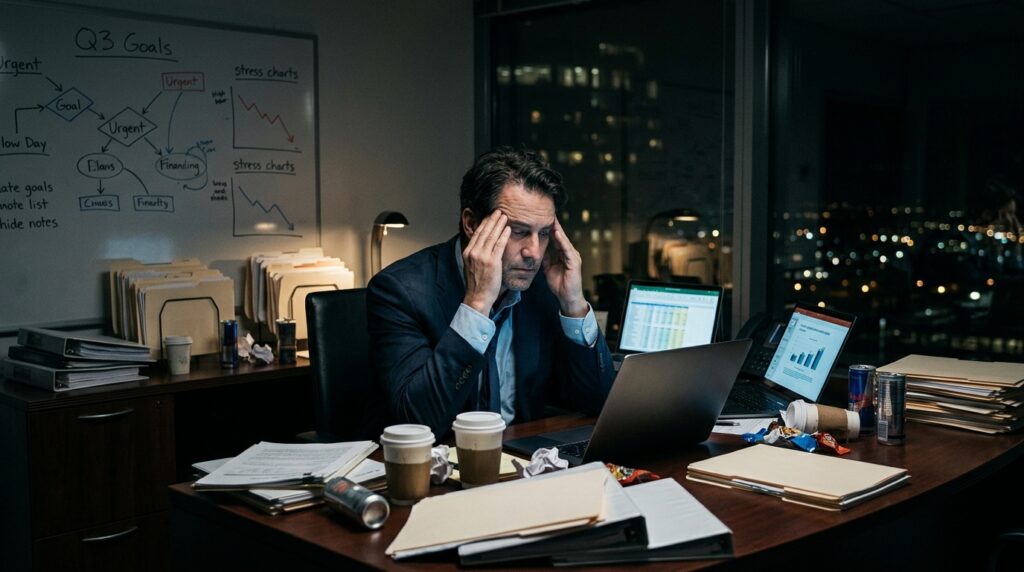
Why Leaders Experience Severe Cognitive Drain
Entrepreneurs and executives face a brutal cognitive environment. Every day requires strategic thinking, conflict resolution, risk assessment, communication filtering, and emotional regulation. But leadership creates something even more dangerous: decision compounding. Leaders are not only managing their own choices — they absorb everyone else’s problems too.
The Burnout Loop in Decision Fatigue Explained
Leadership burnout follows a predictable sequence: cognitive overload leads to mental fatigue, which triggers analysis paralysis, which forces reactive choices, which create organizational fires, which demand more emergency decisions — until full burnout shuts down motivation and emotional resilience entirely. This is why many high performers suddenly feel emotionally numb despite external success.
Why Exhausted Brains Make Worse Food, Spending, and Productivity Choices
The Neuroscience of Cravings
The exhausted brain constantly searches for energy-efficient rewards. That is why mentally drained people crave sugar, fast food, scrolling, dopamine, and passive entertainment. Healthy choices require executive control — but executive control weakens under cognitive overload.
Why You Buy Things You Don’t Need
Impulse purchases increase dramatically during mental fatigue because inhibitory control weakens. The prefrontal cortex normally acts like a psychological braking system — evaluating consequences, regulating impulses, and resisting emotional spending. Under decision fatigue, this system fails. Many retail environments are specifically designed to exploit this biology, placing impulsive items at checkout after an entire store of choices has already depleted the shopper’s reserves.
Why Mentally Exhausted People Procrastinate
Procrastination is often misunderstood as laziness. In reality, it is frequently cognitive self-protection. The overloaded brain avoids tasks that require uncertainty, emotional effort, or additional decisions. That is why exhausted professionals reorganize files, tweak slide designs, and endlessly plan instead of executing — low-risk tasks that create the illusion of productivity without requiring major cognitive effort.
The Daily Brain Energy Management System
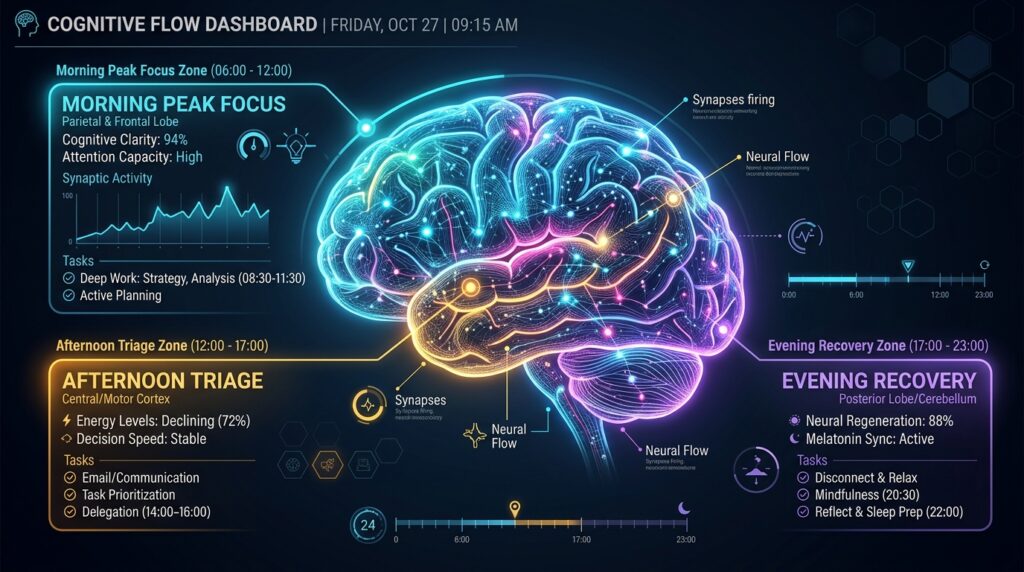
One of the biggest myths in productivity culture is the idea that time management matters most. It does not. Energy management matters more. The brain operates in fluctuating cognitive cycles throughout the day, and high performers unconsciously protect these cycles.
Peak Cognitive Window (Morning)
For most people, the first few hours after waking contain the highest executive function capacity. The prefrontal cortex, attention systems, and working memory operate most efficiently here. This window should be reserved for strategic decisions, deep work, creative output, and complex thinking — not email, not notifications, not meetings.
Morning Deep Work Protocol: Block the first 90 minutes of your day as a digital isolation zone. Devices on silent. Communication apps closed. One high-leverage task is open.
Triage Window (Afternoon)
By afternoon, cognitive energy naturally declines. This is the ideal period for administrative work, meetings, communication, and lower-intensity tasks. Trying to force deep strategic thinking during depleted states creates frustration and mental drag.
Afternoon Recovery Systems: Use the 80% rule in this window. If a decision meets your baseline criteria, commit and move on.
Preservation Window (Evening)
Evenings should focus on recovery and cognitive protection. Yet modern professionals often destroy this phase through endless scrolling, overstimulation, binge content, and digital overload. The brain never fully resets — and cumulative exhaustion compounds across days and weeks.
Evening Cognitive Protection: The night before is your most powerful productivity tool. Lay out tomorrow’s clothes, plan tomorrow’s meals, set your top three tasks, and close all open browser tabs.
Neuro-Hacking Decision Fatigue: Practical Solutions That Actually Work

Automate Low-Stakes Decisions
Every eliminated micro-decision preserves mental bandwidth. Apply this principle through meal prep, recurring routines, fixed morning systems, automated finances, and default schedules. The goal is not rigidity — it is cognitive preservation.
Build Choice Architecture
Choice architecture means designing environments that reduce unnecessary decision-making. Remove distracting apps, limit notifications, use scheduling tools, and create predefined workflows. The best decision-makers do not rely on motivation — they engineer environments that reduce friction.
The 80% Rule for Faster Decisions
For non-critical decisions, adopt the 80% rule. If an option meets roughly 80% of your criteria — choose it, commit, and move forward. Momentum is psychologically healthier than endless optimization.
Digital Buffer Zones
Create intentional communication windows instead of remaining permanently available. Check email three times daily. Batch notifications. Silence non-essential alerts. Protect uninterrupted focus periods.
The 5-Minute Attention Flush
After intense meetings or deep work sessions, avoid instantly switching tasks. Instead, sit quietly, walk briefly, breathe deeply, or stare outside for five minutes. This allows attention systems to reset and reduces cognitive residue.
Sleep and Cognitive Recovery
Sleep deprivation severely impairs judgment, impulse control, emotional regulation, and working memory. A sleep-deprived prefrontal cortex behaves similarly to an intoxicated brain. Protecting sleep is not laziness — it is cognitive maintenance.
Non-Sleep Deep Rest (NSDR)
NSDR techniques involve structured deep relaxation practices that calm the nervous system without actual sleep. These practices reduce cortisol, calm the amygdala, and improve mental recovery. Even 10–20 minutes can significantly improve cognitive clarity.
The 4-Step Cognitive Offloading Protocol
Step 1 — Eliminate Morning Micro-Decisions
Prepare clothes, meals, priorities, and schedules the night before. This preserves morning executive function for work that actually requires it.
Step 2 — Protect the CEO Window
Reserve your highest-energy hours for strategic thinking. Avoid email, Slack, notifications, and reactive communication during this period. Treat this window as non-negotiable.
Step 3 — Filter Downstream Decisions
Not every choice deserves your cognitive energy. Delegate aggressively. Automate repetitive tasks. Create defaults whenever possible.
Step 4 — Schedule Cognitive Recovery
Recovery should be intentional. Without recovery, cognitive overload compounds daily. Protect sleep, silence, reflection, movement, and mental stillness as seriously as you protect your calendar.
Famous Leaders Who Eliminated Decisions on Purpose
Steve Jobs and the Black Turtleneck
Steve Jobs famously wore the same outfit almost daily — a black Issey Miyake turtleneck, Levi’s jeans, and New Balance sneakers. He understood that trivial decisions quietly drain strategic thinking capacity.
Barack Obama’s Suit Strategy
Former President Barack Obama intentionally limited his wardrobe choices to gray and blue suits. He explained that he wanted to preserve mental energy for more important national decisions.
Mark Zuckerberg’s Decision Minimalism
Mark Zuckerberg adopted a similar philosophy. Reducing low-stakes decisions allowed him to direct attention toward higher-level priorities. These leaders were not trying to look robotic — they were protecting cognitive capital.
How to Know If Your Brain Is Running on Empty
A Quick Self-Assessment for Decision Fatigue Explained
Answer honestly. Do you regularly:
- Procrastinate over simple tasks that normally take minutes?
- Feel emotionally reactive late in the day over minor things?
- Scroll endlessly without satisfaction or a clear reason?
- Avoid opening certain emails or Slack channels for hours?
- Struggle to choose between minor options like what to eat or watch?
- Feel mentally exhausted despite not doing anything physically demanding?
If you answered yes to three or more, your cognitive budget is likely in deficit well before the workday ends.
The Difference Between Stress and Decision Fatigue
Stress is often caused by a specific threat or high-stakes situation. Decision fatigue is caused by volume — the sheer accumulation of choices, regardless of their stakes. You can experience severe decision fatigue on a perfectly calm, low-pressure day simply because the micro-choice count was high.
When Cognitive Overload Turns Into Burnout
Decision fatigue is acute and recoverable. Burnout is chronic and systemic. When the daily depletion cycle never fully resets — because of inadequate sleep, relentless cognitive load, and no protected recovery time — the damage accumulates. Burnout is what happens when decision fatigue becomes a permanent baseline.
If you’re noticing signs of longer-term exhaustion beyond daily fatigue, our guide on [executive burnout and cognitive depletion] explores how this progression develops and how to reverse it. (Replace bracket with your internal link)
Final Thoughts — Protecting Your Cognitive Capital in an Overstimulated World
Your Brain Is Not Weak — It’s Overloaded
The modern world rewards attention extraction. Every app, notification, platform, and advertisement competes for your cognitive resources. But your mental energy is finite.
With decision fatigue explained through neuroscience and behavioral psychology, everything changes. Burnout is not simply emotional. Procrastination is not always laziness. Poor choices are often symptoms of an overloaded brain — not a flawed character.
Why Intentional Constraints Create Freedom
The most successful professionals are not necessarily those with the strongest willpower. They are often the people who reduce unnecessary decisions, simplify environments, automate routines, and aggressively protect cognitive recovery.
True freedom is not the ability to choose everything, every day. It is the clarity to choose exactly what matters, when it matters most.
The Future Belongs to People Who Protect Their Attention
Your brain is not failing. It is adapting to overload. Once you understand how brain decision making actually works, you can stop fighting your biology — and start designing a life that works with it.
Your mind is the single most valuable asset your business, your career, and your family possess. Stop allowing algorithmic notification networks and trivial micro-choices to drain your cognitive currency before midday. Redesign your environment, respect your biological boundaries, and protect your prefrontal cortex.
The people who master this are not the ones who work harder. They are the ones who think more clearly.
Frequently Asked Questions About Decision Fatigue Explained
What is decision fatigue in psychology?
Decision fatigue refers to the progressive decline in decision quality after prolonged mental effort and repeated choices. As the day progresses and the volume of decisions accumulates, the brain’s executive systems — particularly the prefrontal cortex — become depleted, leading to impulsive choices, avoidance, or complete decision paralysis.
Is decision fatigue scientifically real?
Yes. Although the original ego depletion theory remains debated, modern neuroscience strongly supports the idea that cognitive overload weakens focus, emotional regulation, and executive functioning. The mechanism may differ from the original “fuel tank” model, but the real-world experience of declining decision quality is well-documented across multiple research traditions.
Why do people make worse decisions at night?
Mental energy declines throughout the day as the prefrontal cortex becomes fatigued from constant cognitive effort. By evening, inhibitory control weakens, cravings increase, and the motivation to make effortful choices drops — leading to impulsive spending, poor food choices, and revenge bedtime procrastination.
Can social media cause cognitive overload?
Yes. Social media platforms create nonstop micro-decisions and attention switching that overload executive attention systems. Every scroll, like, and content evaluation forces the prefrontal cortex to process input — making social media a significant driver of late-day cognitive depletion.
What is the fastest way to reduce decision fatigue?
Automating low-stakes choices, reducing notifications, protecting sleep, batching communication windows, and limiting multitasking are among the most effective immediate strategies. The 5-Minute Attention Flush and the 80% Rule for Satisficing can both be implemented today.
How does sleep affect brain decision-making?
Sleep restores executive functioning, emotional regulation, memory consolidation, and cognitive processing speed. A sleep-deprived prefrontal cortex shows measurably impaired judgment and impulse control. Consistent, quality sleep is the single most powerful cognitive recovery tool available.
What is the difference between burnout and decision fatigue?
Decision fatigue is short-term cognitive depletion from excessive choices — recoverable with rest and environmental redesign. Burnout is long-term emotional, mental, and physical exhaustion that develops when decision fatigue is chronic and never adequately addressed.
How do successful people reduce cognitive overload?
Many high performers simplify routines, automate repetitive decisions, limit distractions, protect morning focus windows, and aggressively delegate low-stakes choices. The goal is not to work less — it is to spend cognitive energy only on decisions that truly require it.

