
There’s a particular kind of loneliness that doesn’t look like loneliness at all. You’re sitting on the same couch. You cooked dinner together. You’ll fall asleep in the same bed tonight. And yet, somewhere in the last few months — or years — you stopped expecting anything back when you share something that matters to you.
This is what emotional neglect in relationships actually feels like from the inside: not a single betrayal, but the slow accumulation of moments where you reached out and nothing reached back.
Emotional neglect happens when a partner’s emotional needs — for warmth, attention, validation, and responsiveness — are consistently unmet, not through cruelty, but through absence. It’s rarely one event. It’s a pattern built from everything that didn’t happen: the question that was never asked, the news that got a distracted “cool,” the hand that wasn’t held.
If you’re reading this because something feels off but you can’t point to a fight, an affair, or a cruel word — you’re not imagining it, and you’re not being dramatic. You may simply be describing something real that most relationship advice doesn’t have language for.

Why Emotional Neglect in Relationships Is So Hard to Name
Human beings are wired to notice threats. A raised voice, an insult, a slammed door — these register instantly. But we’re much worse at detecting absence. A partner who doesn’t ask how your day went isn’t doing anything to you, which makes it tempting to conclude that nothing is actually wrong.
That’s the trap. A single quiet evening means very little. Five years of quiet evenings is a different story entirely. Emotional neglect tends to build the way sediment builds — one unremarkable layer at a time, until one day you notice the whole landscape has changed.
There’s also a particular kind of guilt that comes with this. Often, the partner who is emotionally distant is otherwise dependable — a good provider, a present parent, someone who would never dream of yelling or being unfaithful. That makes it easy to talk yourself out of your own experience: He’s a good person. She works so hard. Maybe I’m just asking for too much. But needing emotional connection from a partner isn’t asking for too much. It’s asking for the thing a relationship is supposed to provide.
Emotional Neglect Is Not the Same as Emotional Abuse
This distinction matters enormously, and a lot of relationship content online blurs it in ways that end up confusing or frightening people unnecessarily.
Emotional neglect is an act of omission. It’s the absence of warmth, attention, or emotional responsiveness. It’s often unintentional, and it can occur even in relationships where both people care deeply about each other.
Emotional abuse is an act of commission. It involves active behavior intended to control, demean, or destabilize a partner — things like consistent belittling, manipulation, or intimidation.
Why does this distinction matter so much? Because the two call for very different responses. Abuse is a safety issue, and it often requires boundaries, outside support, or an exit plan. Neglect, while genuinely painful, is frequently something a couple can work through together — if both people are willing to look honestly at the pattern.
Mislabeling one as the other tends to backfire. If you tell a withdrawn, overwhelmed partner that they’re being “abusive” when what’s actually happening is emotional shutdown, you’re likely to get defensiveness instead of reflection — because from their side, the accusation doesn’t match their internal experience. Naming what’s actually happening, with more precision, tends to open the conversation instead of closing it.
The Attachment Lens: Why Some People Withdraw
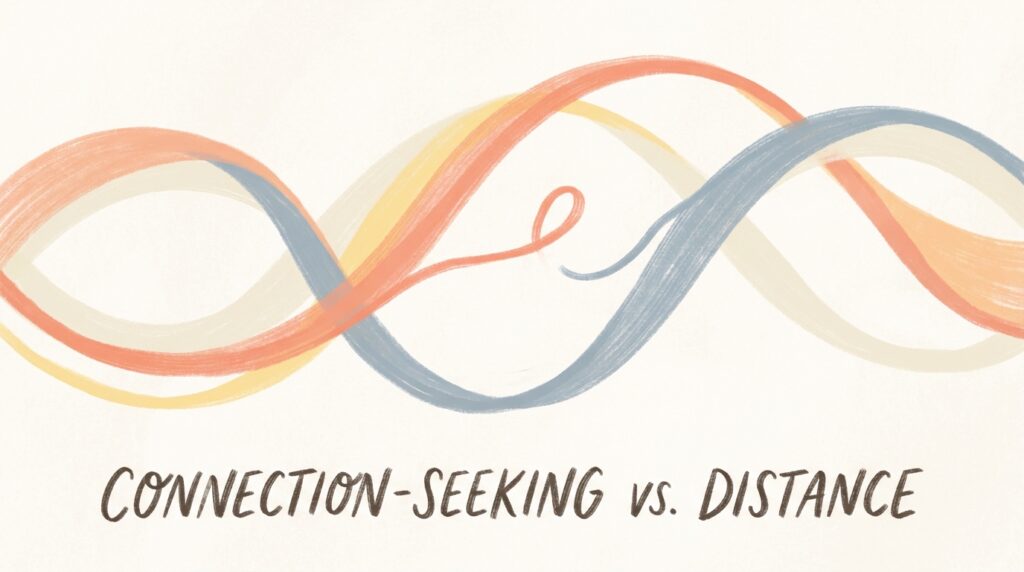
A lot of emotional distance in relationships starts to make more sense once you look at it through the lens of attachment theory — the idea, developed initially by psychologist John Bowlby and expanded by researchers like Mary Ainsworth, that our earliest relationships teach us what closeness is supposed to feel like, and how safe it is to depend on someone.
People who grew up in homes where emotional needs were met consistently tend to develop what’s called a secure attachment style — they’re generally comfortable with both closeness and independence. But people whose early emotional needs went unmet, or who learned that expressing feelings led to criticism or was simply ignored, often develop anxious or avoidant patterns instead.
In simple terms:
- Anxious attachment often shows up as a heightened need for reassurance and a fear of disconnection — sometimes leading to protest behaviors like pursuing, over-explaining, or picking fights just to get some reaction.
- Avoidant attachment often shows up as discomfort with emotional closeness itself. Vulnerability can register, at a nervous-system level, as something closer to a threat than a comfort — leading a person to withdraw, minimize, or intellectualize rather than engage.
None of this excuses neglect. But it reframes it. A withdrawn partner isn’t necessarily choosing indifference — they may genuinely never have learned a different way to respond to emotional intimacy. Understanding this doesn’t erase the impact of neglect. It just changes the story from “they don’t love me” to “they may not know how to show up here yet” — which is a very different, and often more workable, starting point.
The Two Sides of the Pattern
What It’s Like to Be the Partner Who Feels Neglected
If this is your experience, the toll is real, even without visible damage. Chronic emotional neglect tends to produce a specific kind of erosion: you start to feel invisible, then undesirable, then hyper-alert to every small sign of distance.
A common — and completely understandable — response is what researchers sometimes describe as a protest behavior: when quiet requests for connection go unanswered long enough, some people escalate. Nagging, criticizing, or picking fights can become, underneath the surface, a desperate attempt to get any emotional reaction rather than none. It rarely works the way it’s intended to. Escalation tends to trigger more withdrawal, not less — which deepens the very disconnection it’s trying to solve.
Why a Partner Withdraws — Context, Not a Free Pass
On the other side, withdrawal usually comes from one (or more) of a few sources:
- A nervous system response to intimacy. For some people, emotional closeness genuinely registers as threatening, triggering a freeze-or-retreat response rather than an approach response.
- Burnout and depletion. Chronic stress — from work, caregiving, financial pressure — consumes the mental bandwidth emotional attunement requires. When someone is running on empty, connection is often the first thing to go, not because it doesn’t matter, but because there’s nothing left to give it.
- Limited emotional vocabulary. Some people were never taught how to identify or name what they’re feeling, let alone communicate it. Silence, in this case, isn’t rejection — it’s often closer to not having the words.
Naming these isn’t about excusing the impact on the other partner. It’s about understanding the mechanism well enough to address it, instead of fighting a narrative (“they just don’t care”) that may not be accurate.
Where Modern Distance Actually Starts

Three patterns show up again and again as the entry points into emotional neglect.
Life transitions. A new baby, a job loss, a health crisis, a death in the family — these events demand an enormous reallocation of emotional energy. Couples often shift into pure logistics mode to survive the transition, which makes sense in the short term. The problem is when “survival mode” never gets renegotiated back into connection once the crisis passes, and the temporary distance quietly becomes the new normal.
Digital distraction. Researchers have started studying this directly. A 2025 study from the University of Connecticut and Columbia University, published in the Journal of Social and Personal Relationships, found that when people perceived their partner as frequently distracted by their phone during shared time — a behavior researchers call “phubbing” — they were more likely to feel deprived of affection, which in turn was linked to lower relationship satisfaction. The researchers noted this held even between partners with similar phone habits, and that the effect was strongest during periods of high stress. The mechanism isn’t really about the phone itself — it’s the repeated, small experience of choosing a screen over a person, which quietly teaches the other partner to stop reaching out.
Conflict avoidance. Some couples take pride in “never fighting.” But avoiding conflict and having a healthy relationship aren’t the same thing. When couples consistently sidestep disagreements to keep the peace, they often end up suppressing the very topics that matter most — which, over time, can create a kind of pseudo-harmony: a relationship that looks calm from the outside while both people quietly stop bringing each other their inner lives.
Moving From Erosion to Connection
There isn’t a single fix for emotional neglect, and any content that promises one should be treated with some skepticism. But there are structured, evidence-informed starting points that tend to help, especially when both partners are willing to engage.
If You’re the Partner Who Feels Neglected
- Notice the protest cycle, and consider stepping out of it. If you find yourself escalating to get a reaction, it may help to name that pattern to yourself first, before naming it to your partner.
- Separate temporary depletion from a long-term pattern. A partner who’s withdrawn during a genuinely brutal work quarter is in a different situation than a partner who has been distant for years with no signs of change. Both deserve compassion; only one requires patience without an endpoint.
- Bring concerns using specific, low-blame language rather than global accusations — more on this below.
For the Couple, Together
One structure that tends to work well for exactly this kind of distance is a short, low-stakes, time-capped check-in — sometimes called a “temperature check.” The format matters more than it might seem:
- Time-capped: 10–15 minutes, not an open-ended conversation. This reassures a withdrawal-prone partner that they won’t be pulled into something exhausting.
- Device-free: Phones out of the room, even briefly.
- One person speaks at a time, without the listener defending, interrupting, or jumping to fix things.
A simple, non-accusatory format for raising a concern:
“I feel [emotion] when [specific situation], and I need [specific, doable request].”
For example: “I feel lonely when we’re both on the couch and on our phones after dinner. I need us to spend ten minutes actually talking about our day.” This lands very differently than “You’re always on your phone, and you never care what I have to say,” which tends to trigger defensiveness rather than reflection.
For a partner who struggles to identify or articulate feelings, a simpler scaling question can lower the barrier further: “On a scale of one to ten, how much do you have left in the tank tonight?” This gives an avoidant or emotionally overwhelmed partner a way to participate without needing to produce a full emotional narrative on demand.
When to Seek Additional Support
Working through emotional neglect on your own, or as a couple, is genuinely possible — many couples do repair this kind of distance once both people can see the pattern clearly. That said, if the disconnection has been going on for a long time, if attempts to talk about it consistently go nowhere, or if it’s affecting your daily functioning, a licensed couples therapist can offer structure and support that’s difficult to replicate through articles or self-guided exercises alone.
This article is intended for educational purposes and should not be considered medical, psychological, or mental health advice. If concerns significantly affect daily functioning, consulting a qualified mental health professional may be helpful.

Frequently Asked Questions
How do you know if you’re experiencing emotional neglect? Common signs include feeling consistently lonely even when you’re physically with your partner, no longer sharing good or bad news because the response is usually flat or distracted, and a persistent sense of second-guessing whether your need for connection is reasonable.
What causes emotional neglect in relationships? It’s rarely driven by a lack of love. It often stems from a partner’s own upbringing (learning early on that emotions weren’t safe or useful to express), combined with modern accelerants like chronic stress, burnout, or habitual phone distraction that leave little emotional bandwidth for connection.
Is emotional neglect the same as emotional abuse? No. Emotional neglect is the absence of warmth or responsiveness; emotional abuse involves active attempts to control, demean, or intimidate a partner. The distinction matters because they call for different responses — repair and skill-building for neglect, and often safety and boundaries for abuse.
Can emotional neglect be repaired? Often, yes — but it typically requires both partners: awareness from the person who has been withdrawing, and a shift away from the protest cycle from the person who has felt neglected. Structured, low-stakes rituals for reconnecting tend to work better than expecting either partner to simply “communicate more.”

