
Have you ever walked into a room and suddenly become intensely aware of yourself?
Maybe you notice a stain on your shirt, stumble over a sentence, answer a question incorrectly, or say something that sounded awkward. Within seconds, it can feel as though everyone noticed.
And once the moment is over, your mind may keep returning to it:
Did they notice?
Did I look nervous?
Do they think I’m strange?
Are they still thinking about it?
This experience has a name: the Spotlight Effect.
The Spotlight Effect is the tendency to overestimate how much other people notice our appearance, behavior, mistakes, or actions. Classic research found that people often expected their behavior or appearance to stand out more to others than it actually did. Researchers have proposed that one reason is that we begin with our own vivid experience and do not fully adjust for what another person can actually see from their perspective.
That does not mean other people never notice you. They sometimes do.
The more useful insight is that your feeling of being highly visible is not necessarily an accurate measure of how much attention other people are actually giving you.
Understanding that difference can make everyday self-consciousness easier to interpret without dismissing your feelings or assuming that everyone is judging you.
What Is the Spotlight Effect?
The Spotlight Effect is a psychological phenomenon in which people tend to overestimate the extent to which their actions and appearance are noticed by others.
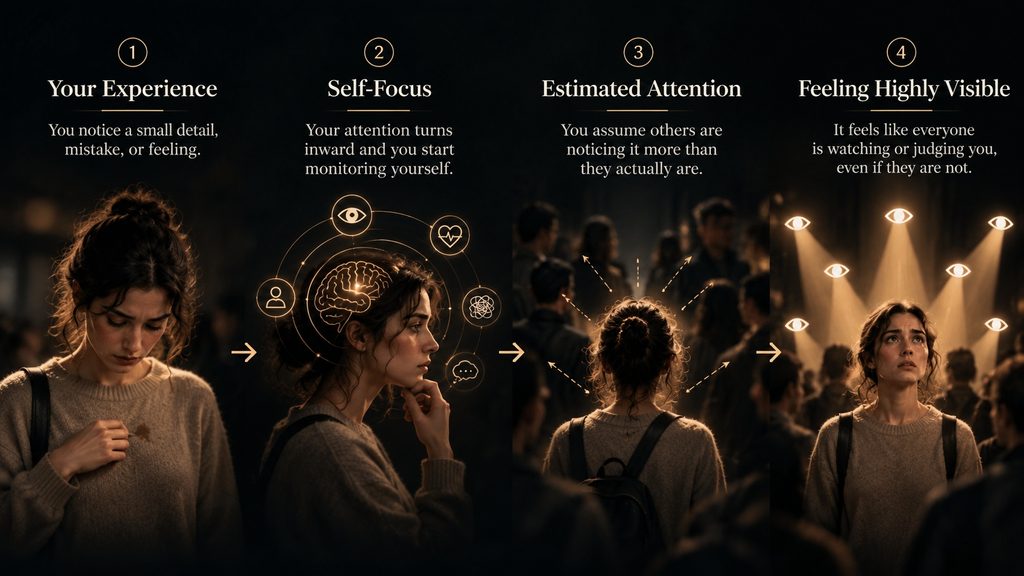
Imagine walking into university wearing a shirt with a small stain that you did not notice until you sat down.
Once you see it, your attention changes.
You know the stain is there. You can see it every time you look down. You may suddenly become conscious of how you are sitting, whether people are looking at you, and whether someone might be silently judging you.
But other people do not have access to your experience.
They may be focused on a lecture, checking their phone, thinking about an upcoming assignment, talking with a friend, or worrying about something in their own life.
Your experience is highly noticeable to you because you are the person experiencing it.
That distinction is at the heart of the Spotlight Effect.
What the Original Research Found
In classic experiments, researchers asked participants to wear shirts featuring either embarrassing or flattering images. Participants generally overestimated how many other people would notice and remember the image on their shirt.
In another study, participants in group discussions overestimated how prominent their own positive and negative comments were to the other people in the discussion.
The researchers described this as an egocentric bias: people tend to anchor their judgments around their own rich, immediate experience and then adjust insufficiently for another person’s perspective.
This helps explain why the feeling can be so convincing.
You know exactly what happened.
Other people usually do not.
Why the Spotlight Effect Happens
The Spotlight Effect is not simply about being self-centered.
It is closely connected to a basic feature of human perception: you experience your own thoughts, emotions, sensations, and actions directly, while everyone else’s experience is partly hidden from you.
Your Own Experience Feels Bigger Because You Are Inside It
Consider making a small mistake during a presentation.
You know the exact moment your voice changed.
You know that you forgot a word.
You remember what you were thinking.
You may even notice your heart beating faster.
From your perspective, the moment contains a lot of information.
But another person may have experienced it very differently.
They may have noticed a brief pause and then continued listening.
The amount of information available to you about your own experience can therefore make your behavior seem more obvious than it is from the outside.
Your Brain Starts With Your Own Perspective
Research on the Spotlight Effect suggests that people can use their own experience as an initial reference point when estimating what others notice.
The problem is that your perspective contains information other people do not have.
You know what embarrassed you.
You know why your face feels warm.
You know the sentence you wish you had said differently.
Because that information is so available to you, it can be easy to assume that other people have access to something similar.
They don’t.
They see only what is externally observable.
That gap between what you experience internally and what another person can actually observe is important.
Other People Have Their Own Attention
There is another simple reason your mistake may receive less attention than you imagine: other people have their own lives.
They are thinking about conversations they need to have, tasks they need to finish, problems at home, relationships, deadlines, money, health, plans for the evening, or something that happened earlier that day.
This does not prove that nobody noticed your behavior.
It means that noticing something and continuing to think about it are very different things.
Someone can notice that you stumbled over a sentence without deciding that the moment defines you.
The Spotlight Effect and Self-Focused Attention
Sometimes the strongest part of the experience is not what other people are doing.
It is what your own attention is doing.
When you become highly self-conscious, you may start monitoring yourself closely.
You notice:
- how your face looks
- how your voice sounds
- where your hands are
- whether you are making eye contact
- whether you are speaking too quickly
- whether people seem interested
- whether someone is looking in your direction
The more closely you monitor yourself, the more information you generate about yourself.
That can create a strange feedback loop.
You focus on yourself → you notice more sensations and imperfections → those details feel important → you become more self-conscious → you monitor yourself even more.
Experimental research has found that increasing self-focused evaluative attention can increase people’s perception that others are looking at them. This effect has been observed in people with both higher and lower levels of social anxiety, suggesting that self-focused attention can influence perceived observation more generally.
This does not mean that self-focus explains every experience of feeling watched.
It means that where you direct your attention can influence what social information feels most prominent.
The Spotlight Effect vs. the Illusion of Transparency
These two ideas are closely related but are not exactly the same.
The Spotlight Effect concerns overestimating how much other people notice your actions, appearance, or behavior.
The illusion of transparency concerns overestimating how easily other people can recognize your internal emotional state.
For example:
Spotlight Effect:
“Everyone noticed that I made that mistake.”
Illusion of transparency:
“Everyone can tell how nervous I am.”
You might feel your heart racing, your hands shaking, or your face becoming warm.
Because the sensations are obvious to you, it can seem obvious that other people can see them too.
Classic research found that people can overestimate other people’s ability to read their emotional states.
These biases can overlap during stressful social situations.
You may not only think people noticed what you did; you may also assume they can see exactly how embarrassed, nervous, or uncomfortable you feel.
But internal intensity and external visibility are not the same thing.
When the Spotlight Effect Feels Strongest
The Spotlight Effect can appear in ordinary situations, but certain circumstances may make self-consciousness more noticeable.
After Making a Mistake
A small mistake can suddenly become the most important event in your mind.
You may replay what happened and imagine that everyone else is replaying it too.
But your memory of the event is likely to contain much more detail than another person’s memory of the same moment.
During Public Speaking
Presentations can make people unusually aware of themselves.
You can hear every pause in your voice and notice every word that does not come out exactly as planned.
The audience, however, receives only the outward performance.
A short pause that feels enormous to the speaker may simply feel like a normal pause to someone listening.
When Meeting New People
First impressions can create intense self-monitoring.
You might wonder whether your handshake was awkward, whether you talked too much, whether you should have smiled more, or whether the other person liked you.
Some of these questions can be useful.
The problem begins when every small detail becomes evidence that you are being negatively evaluated.
At Work or University
You answer a question incorrectly.
You make a small error in a meeting.
You mispronounce a word.
You arrive late.
You send a message with a typo.
These moments can feel disproportionately important because they are highly available in your own memory.
On Social Media
Social media can create a different version of the same experience.
You post something and repeatedly check:
- Who viewed it?
- Who liked it?
- Why didn’t this person respond?
- Did that caption sound strange?
- Did I post too much?
- What will people think?
The technology makes social feedback more visible, but your interpretation can still be influenced by self-focused attention and assumptions about what other people are thinking.
Why Embarrassing Moments Can Feel Bigger Than They Look
The Spotlight Effect often becomes especially noticeable after embarrassment.
Your mind may replay an awkward conversation long after it happened.
That does not necessarily mean the memory is important to everyone else.
It may simply be emotionally important to you.
Your existing MOSU MIND content on replaying embarrassing memories already explores how rumination can keep attention focused on socially uncomfortable experiences. The useful distinction is between reflection that produces a lesson and repetitive thinking that simply keeps the same event emotionally active.
For example:
Constructive reflection:
“I spoke too quickly during the presentation. Next time I’ll slow down.”
The thought produces something useful.
Rumination:
“Why did I do that? What did everyone think? Why am I always like this? Did they think I was incompetent?”
The second pattern keeps asking questions without necessarily producing new information.
This is one reason an embarrassing moment can become much larger inside your mind than it appears from the outside.
The Spotlight Effect and Social Anxiety

The Spotlight Effect is relevant to social anxiety, but the two concepts should not be treated as identical.
Someone can occasionally feel watched, embarrassed, or self-conscious without having social anxiety.
Social anxiety involves a more persistent pattern of fear or anxiety around social or performance situations, particularly concerns about negative evaluation, and it can interfere substantially with daily functioning.
Research has found that people with higher social anxiety can show greater self-focused attention and more negative perceptions of how others are evaluating them.
Experimental research has also found that increasing self-focused attention can increase perceived observation, while other research has examined shifts from self-focused toward externally focused attention in relation to improvement during cognitive therapy for social anxiety.
But experiencing the Spotlight Effect by itself is not evidence that you have social anxiety.
That distinction matters.
Ordinary self-consciousness is part of human social life. The question is whether the experience is occasional and manageable or persistent enough to interfere with how you live.
What the Spotlight Effect Does Not Mean
Understanding the bias should not lead to another extreme.
The lesson is not:
“Nobody notices me.”
That would be inaccurate.
People do notice things.
Someone may notice your new haircut, your mistake during a presentation, an unusual comment, or the fact that you seem nervous.
The important point is that being noticed is not the same as being intensely judged, remembered, or defined by the moment.
It Does Not Mean Nobody Judges Anyone
People naturally form impressions of one another.
The Spotlight Effect does not eliminate social evaluation.
It simply suggests that we can overestimate the amount of attention directed toward our own behavior.
It Does Not Mean Your Feelings Are Imaginary
If you feel embarrassed, the feeling is real.
The question is whether the conclusion attached to the feeling is accurate.
There is a difference between:
“I feel extremely noticeable right now.”
and:
“Therefore everyone is closely watching and judging me.”
The first describes an internal experience.
The second makes a claim about other people’s minds.
It Does Not Mean You Should Ignore Social Feedback
Sometimes people really are giving you useful feedback.
If several people tell you that you interrupted them during a conversation, it may be worth considering.
The goal is not to dismiss every social signal as a cognitive bias.
The goal is to avoid automatically treating your own self-consciousness as proof of what everyone else thinks.
How to Stop Feeling Like Everyone Is Watching You
You do not need to convince yourself that nobody is looking at you.
A more realistic goal is to become less dependent on your immediate feeling as evidence.
1. Separate Feeling From Evidence
Try noticing the difference between:
“I feel like everyone noticed.”
and:
“What evidence tells me everyone noticed?”
This does not require arguing with yourself.
It simply creates a little distance between your emotional experience and your interpretation.
2. Shift Some Attention Outward
If you are monitoring your voice, face, posture, hands, and every sentence, experiment with placing more attention on the actual conversation.
Listen carefully to what the other person is saying.
Notice the environment.
Think about the subject being discussed.
Focus on what you want to communicate rather than constantly evaluating how you are performing.
Research on social anxiety has specifically examined the role of shifting attention away from excessive self-focus and toward external information.
3. Ask What You Would Remember About Someone Else
Suppose another student gives an awkward answer during class.
Would you think about it for six hours?
Would you remember the exact wording three days later?
Maybe you would.
But often, the moment would simply pass.
This is not proof that everyone will forget your mistakes. It is a perspective-taking exercise that helps challenge the assumption that your experience is automatically shared by everyone around you.
4. Stop Treating Every Detail as Evidence
A person looks in your direction.
That does not automatically mean they are judging you.
Someone is quiet.
That does not automatically mean they disliked what you said.
Someone does not respond immediately.
That does not automatically mean you made a bad impression.
A useful habit is to distinguish observation from interpretation.
Observation: “They looked at me.”
Interpretation: “They think I look strange.”
Only the first statement is directly observable.
5. Let Small Imperfections Exist
Trying to eliminate every awkward moment can actually make you more aware of them.
You may become so focused on avoiding mistakes that ordinary social interaction starts feeling like a performance test.
Instead, allow yourself to be imperfect.
You can mispronounce a word.
You can pause.
You can forget someone’s name.
You can say something that does not come out perfectly.
Being socially comfortable does not require performing flawlessly.
6. Learn From Mistakes Without Replaying Them Forever
Ask yourself:
“Is there something useful I can learn from this?”
If the answer is yes, identify the lesson.
If the answer is no and you are simply replaying the event, continuing to analyze it may not provide new information.
The goal is not to erase the memory.
It is to stop treating every return of the memory as a problem that must be solved.
A Simple Reality Check for the Spotlight Effect
When you suddenly feel as though everyone is watching you, try this short sequence:
| Your mind says | A more balanced question |
|---|---|
| “Everyone noticed.” | “How much evidence do I actually have?” |
| “They are still thinking about it.” | “What makes me certain they are?” |
| “Everyone can tell I’m nervous.” | “What is actually visible from the outside?” |
| “I ruined the whole interaction.” | “Was the entire interaction really defined by one moment?” |
| “They must think badly of me.” | “Am I assuming what another person is thinking?” |
| “I need to fix how I look immediately.” | “Is there actually a problem that needs fixing?” |
This is not a diagnostic test or a way to prove that your fears are always wrong.
It is simply a way to slow down the jump from feeling to conclusion.
When Feeling Watched Deserves More Attention
Occasional self-consciousness is very different from persistent fear that makes everyday life difficult.
It may be worth speaking with a qualified mental-health professional if concerns about being watched or judged repeatedly lead you to:
- avoid classes, work, social events, or conversations
- avoid meeting new people
- experience substantial distress before or during ordinary interactions
- spend large amounts of time monitoring yourself
- repeatedly seek reassurance about how you appeared
- change important decisions mainly because of fear of judgment
- struggle to function normally because of these concerns
These experiences do not automatically tell you what diagnosis, if any, is involved. A qualified professional can evaluate the broader pattern and context.
FAQs
What is the Spotlight Effect in psychology?
The Spotlight Effect is the tendency to overestimate how much other people notice our appearance, actions, mistakes, or behavior. Research suggests that people can anchor on their own vivid experience and insufficiently adjust for another person’s perspective.
Why do I feel like everyone is watching me?
Self-focused attention can make your own behavior, appearance, emotions, and bodily sensations unusually prominent in your awareness. Research suggests that increasing self-focused attention can also increase people’s perception that others are observing them.
Is the Spotlight Effect the same as social anxiety?
No. The Spotlight Effect is a cognitive bias involving perceived social attention. Social anxiety is a broader pattern of fear and anxiety around social evaluation that can become persistent and impairing. The two can be related, but experiencing the Spotlight Effect does not by itself indicate social anxiety.
Why do embarrassing mistakes feel like everyone remembers them?
Your own memory contains details that other people may never have noticed. Emotional significance can also make an event feel especially vivid to you. This can make it easy to assume that the experience was equally memorable to everyone else.
What is the difference between the Spotlight Effect and the illusion of transparency?
The Spotlight Effect involves overestimating how much others notice your behavior or appearance. The illusion of transparency involves overestimating how easily others can detect your internal emotional state.
How can I stop worrying about what everyone thinks of me?
A useful starting point is to distinguish what you feel from what you know. Shift some attention toward the conversation or environment, question assumptions about other people’s thoughts, and allow small imperfections without repeatedly analyzing them.
Do people really notice us less than we think?
Research on the Spotlight Effect suggests that people often overestimate how noticeable their own actions and appearance are to others. That does not mean other people never notice you; it means your personal experience is not necessarily a reliable measure of how much attention everyone else is giving you.
Final Thought
The next time you walk into a room and suddenly feel as though every eye is on you, pause before accepting that feeling as a fact.
You may be experiencing something much more ordinary.
Your attention has turned inward.
You know exactly what you are worried about.
You can feel every heartbeat, every awkward pause, and every small mistake.
That makes the moment feel enormous from the inside.
But your perspective is not the same as everyone else’s.
The Spotlight Effect reminds us that being highly aware of yourself is not the same as being highly visible to everyone around you.
You do not have to become invisible.
You simply have to remember that other people are living inside their own perspectives too.

