
Disclaimer:
This article is for educational and informational purposes only. It discusses psychological concepts and workplace behavior patterns but is not intended as mental health, medical, or professional advice.
How “being too nice at work” quietly drains your authority, income, and executive presence—and how to fix it without becoming a jerk.
The 5-Minute “Yes” That Costs You Years: Introducing the Niceness Tax
It happens fast.
A colleague pings you:
“Hey, quick favor?”
You already know it’s not quick.
You already know your plate is full.
You already know this will push your real work into the evening.
But instead of pausing, you say it anyway:
“Yeah, sure.”
And just like that—you feel relief.
The tension disappears.
The awkwardness is avoided.
The “vibe” is saved.
Your brain relaxes.
But here’s the truth most professionals never realize:
That 5-minute “yes” just cost you far more than time.
It cost you:
- Focus on high-impact work
- Visibility in your actual role
- Energy you needed for strategic thinking
- And most dangerously… your professional positioning
This is what we call:
The Niceness Tax
Every time you choose short-term social comfort over long-term professional clarity, you pay a hidden cost.
Not immediately.
Not obviously.
But consistently.
The Math No One Talks About
Let’s make it real.
- 1 “small favor” = ~45 minutes
- 5 times per week = ~4 hours
- Per month = ~16 hours
- Per year = ~200 hours
That’s five full workweeks.
Five weeks not spent on:
- High-visibility projects
- Strategic contributions
- Skill development
- Promotion-driving work
Now multiply that across 5–10 years.
That’s not kindness.
That’s Professional Opportunity Cost.
Why Smart, Capable People Fall Into This Pattern
This isn’t about intelligence.
It’s not about ambition.
And it’s definitely not about work ethic.
Some of the most capable professionals fall hardest into this pattern.
Let’s meet three of them.
The Silent Architect (Tech/Product)
They see the flaw in the system.
They know the idea won’t scale.
They could prevent the failure.
But in the meeting, they stay quiet.
Why?
Because challenging someone feels… uncomfortable.
So they nod.
They smile.
They let it go.
Two weeks later, the system breaks.
And now they’re fixing a problem they could’ve prevented.
The Reliable Mediator (Corporate/HR/Ops)
They’re the one everyone trusts.
The one who:
- Fixes slide decks
- Smooths team conflicts
- Picks up “just one more thing”
They are indispensable.
But not in the way that leads to promotion.
Because while others are building strategy…
They’re managing emotions.
The Soft Negotiator (Finance/Sales/Leadership)
They deliver results.
They hit targets.
They outperform expectations.
But when it’s time to negotiate?
They hesitate.
They soften.
They accept.
Because asking for more feels… Excessively Forceful.
So they settle.
And over time, that “nice” decision compounds into:
- Lower salary
- Slower advancement
- Reduced authority
The Common Workplace Assumption
All three of these professionals believe the same thing:
“Being easy to work with will get me ahead.”
It sounds right.
It feels right.
It’s been reinforced your entire life.
But in reality?
Being too nice at work doesn’t build respect.
It dilutes it.
The Shift You Need to Make
This article isn’t about becoming cold.
It’s not about being Excessively Forceful.
And it’s definitely not about turning into “that difficult person.”
It’s about understanding one critical truth:
There is a difference between being kind… and being Habitually Approval-Seeking.
And if you don’t learn that difference:
You won’t just feel stuck.
You’ll Reduce Professional Visibility in rooms where decisions are made.
What’s Actually Happening Behind the Scenes
Here’s where it gets uncomfortable.
Your “niceness” isn’t just a personality trait.
It’s not even a conscious choice most of the time.
It’s something far more powerful:
It’s a trained behavioral loop.
A loop your brain has been reinforcing for years.
And until you understand that loop…
You will keep paying the Niceness Tax—
in time, money, and missed opportunity.
You’re Not Nice—You’re Conditioned: The Habit Pattern Affecting Growth
Let’s break the illusion.
You don’t say “yes” because you’re a nice person.
You say “yes” because your brain has learned that it’s the fastest way to feel safe.
This is called:
Operant Conditioning
And it’s the real reason you feel stuck.
The Reinforcement Cycle (The Real Aha Moment)
Here’s the loop:
- A request creates tension
- Your brain perceives potential conflict
- Anxiety spikes
- You say “yes”
- The anxiety disappears
That last step is everything.
Because your brain registers it as:
“Good. Do that again.”
This is called negative reinforcement.
Not punishment—reinforcement.
You’re not rewarded with something new.
You’re rewarded with the removal of discomfort.
And your brain LOVES that.
Why This Loop Is So Dangerous
Because it doesn’t feel like a problem.
It feels like:
- Being helpful
- Being cooperative
- Being a team player
But underneath?
You’re training your brain to believe:
“Avoiding discomfort is more important than protecting your future.”
And the more you repeat it…
The stronger that loop becomes.
The Cortisol Escape Mechanism
That uncomfortable feeling before you say “yes”?
That’s not just in your head.
It’s biological.
When you face potential conflict:
- Your brain triggers a stress response
- Cortisol levels rise
- Your body prepares for “threat”
Even if the “threat” is just:
- A Slack message
- A meeting disagreement
- A simple boundary
When you say “yes”?
That cortisol drops.
Instantly.
Relief.
And your brain locks in the lesson:
“Compliance = safety.”
The Dopamine Approval Pattern
Now layer this on top.
When you help someone:
- They smile
- They thank you
- They appreciate you
Your brain releases dopamine.
A reward chemical.
So now you’re not just avoiding discomfort…
You’re chasing approval.
The Full Loop
You’re stuck between two forces:
- Avoiding anxiety (cortisol relief)
- Chasing approval (dopamine reward)
Which creates a powerful cycle:
Say yes → Feel relief → Get validation → Repeat
Over time, this becomes automatic.
You don’t decide to be nice.
You react.
The Brutal Truth
This is where most people have their real “Aha” moment:
You’re not being nice.
You’re being trained.
Trained to:
- Prioritize comfort over clarity
- Avoid tension at all costs
- Trade long-term growth for short-term relief
And in a corporate environment?
That training becomes a liability.
Why Awareness Isn’t Enough
At this point, you might be thinking:
“Okay… I get it. I’ll just start saying no.”
But if it were that simple…
You would’ve already done it.
Because the moment you try?
That same loop fires again:
- Anxiety spikes
- Your body resists
- Your brain pushes you back to “yes”
That’s why most advice fails.
It treats this like a mindset issue.
When in reality?
It’s a biological and psychological conditioning problem.
What We Do Next
Now that you understand the loop…
We go deeper.
Because this behavior didn’t start at work.
It started long before that.
And unless you understand where it came from—
You’ll keep fighting the symptom
instead of fixing the source.
Why Your Brain Treats Disagreement Like Danger (And How to Override It)
If the last section made you realize you’re conditioned, this one explains something even more important:
Why that conditioning feels so powerful.
Because when you hesitate to speak up…
When your heart races before saying “no”…
When a simple disagreement feels weirdly intense…
That’s not weakness.
That’s your brain doing exactly what it was designed to do.
The Ancient Problem in a Modern Office
Your brain wasn’t built for Slack messages.
It wasn’t built for performance reviews.
It definitely wasn’t built for passive-Excessively Forcefulemails.
It was built for one thing:
Survival in small social groups.
For most of human history, one truth mattered:
If you were rejected by the group, you didn’t just feel bad… you died.
No tribe meant:
- No protection
- No food
- No shelter
So your brain evolved a simple rule:
“Stay accepted at all costs.”
The Amygdala Hijack: Why a Simple “No” Feels Like a Threat

4
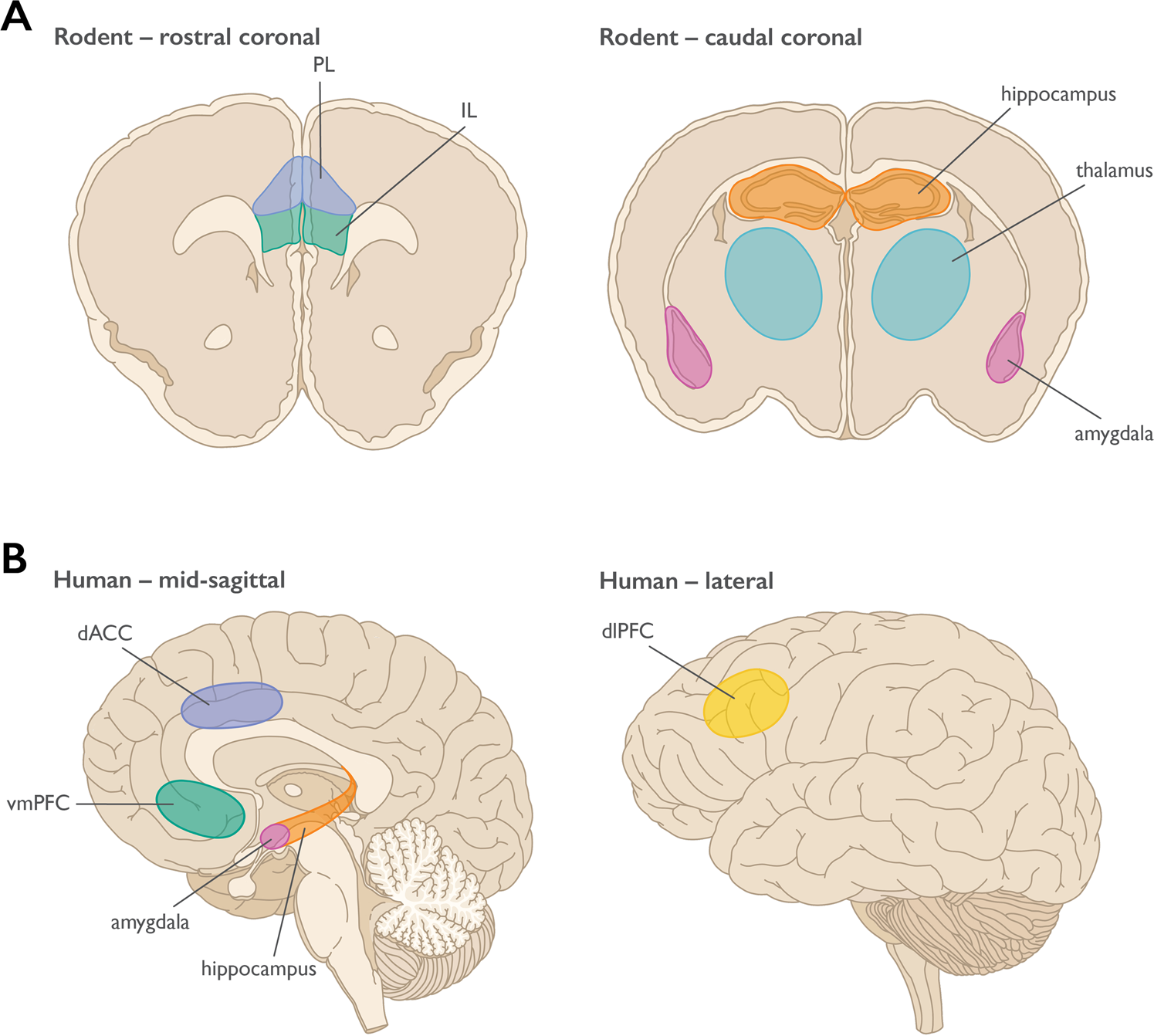
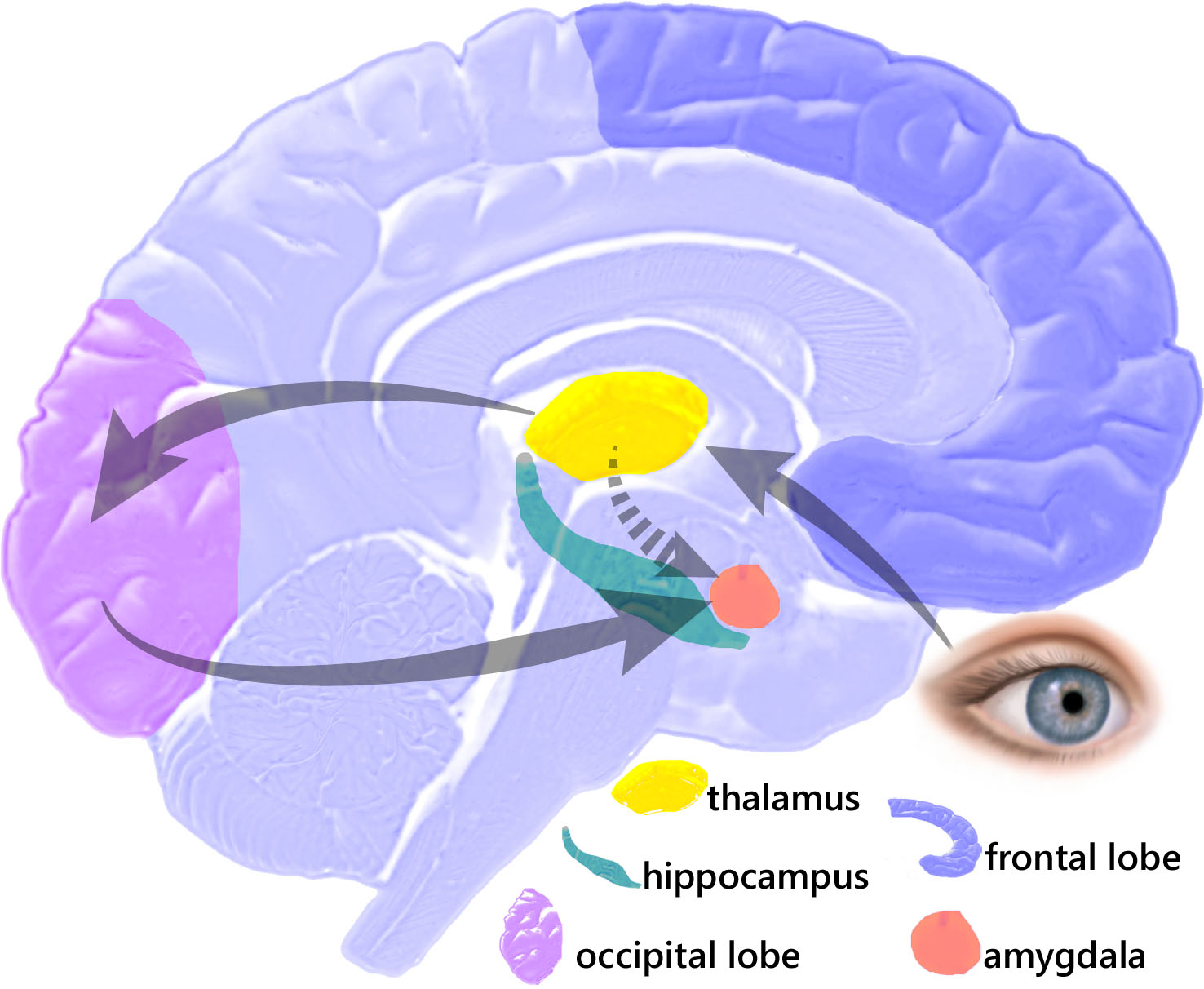
Deep inside your brain sits a structure called the amygdala.
Its job?
Detect threats. Instantly.
The problem?
It doesn’t distinguish between:
- A predator in the wild
- A tense conversation with your boss
To your amygdala, both feel like:
“Something is wrong. Act now.”
What Happens in Real Time
You’re in a meeting.
You disagree with a senior colleague.
In that moment:
- Your heart rate increases
- Your breathing changes
- Your body tightens
- Your mind starts scanning for danger
And before your logical brain can step in…
Your amygdala fires:
“Stay safe. Don’t disrupt. Just agree.”
The Prefrontal Cortex: Your Logical Brain (That Arrives Late)
Now, you do have a system designed to override this.
It’s called the prefrontal cortex (PFC).
This is your:
- Decision-maker
- Strategist
- Long-term thinker
It knows:
- Speaking up adds value
- Setting boundaries builds respect
- Saying no protects your priorities
But here’s the problem:
The PFC is slower than the amygdala.
So by the time logic shows up…
You’ve already said:
“Yeah, that works.”
The Internal Tug-of-War
This creates the exact feeling most professionals struggle to explain:
“I knew I should’ve spoken up… but I just didn’t.”
Because internally, two systems were fighting:
- Amygdala: “Avoid risk. Stay liked.”
- PFC: “Speak up. This matters.”
And in high-pressure social moments?
The amygdala usually wins.
The Fawn Response: Safety Through Niceness
Most people know:
- Fight
- Flight
- Freeze
But there’s a fourth response that explains being too nice at work perfectly:
The Fawn Response
Instead of confronting or escaping a threat…
You neutralize it through appeasement.
You:
- Agree quickly
- Offer help immediately
- Avoid disagreement
- Try to “keep things smooth”
Not because you want to…
But because your brain has learned:
“Pleasant = safe.”
Why It Feels Automatic
This is why people-pleasing feels like a reflex, not a decision.
Because it is one.
Your brain isn’t asking:
“Is this good for my career?”
It’s asking:
“Will this keep me accepted?”
And it answers instantly.
Hyper-Vigilance: Why You’re Always “Reading the Room”
If you’re someone who:
- Notices subtle tone shifts
- Picks up micro-expressions
- Feels tension before others say anything
That’s not random.
That’s your brain scanning for social threats.
Constantly.
This is called hyper-vigilance.
And it’s a core part of the fawn response.
The Hidden Cost
You become:
- Emotionally aware
- Socially intelligent
- Easy to work with
But also:
- Drained
- Over-responsible
- Unable to switch off
Because you’re not just doing your job…
You’re managing everyone else’s emotional state too.
Mirror Neurons: Why You Feel Other People’s Discomfort
There’s another layer most people never realize:
Your brain is literally wired to feel what others feel.
Through something called mirror neurons.
The “Internal Echo”
When someone around you is:
- Frustrated
- Disappointed
- Stressed
Your brain mirrors that state.
You don’t just see it.
You feel it.
Why This Leads to Over-Helping
Now combine that with the fawn response.
Someone is overwhelmed → You feel their stress →
You want to remove that feeling →
You say “yes” to help them.
Not always because it’s logical…
But because it stops your discomfort too.
The Modern Mismatch
Here’s the core problem:
Your brain is running ancient survival software…
In a modern corporate environment.
Then vs Now
Then:
- Disagreement = risk of exile
- Compliance = survival
Now:
- Disagreement = contribution
- Boundaries = professionalism
But your brain hasn’t updated.
So it still reacts to:
- Feedback
- Conflict
- Assertion
As if your social survival is on the line.
The Realization That Changes Everything
This is the shift most people never make:
You’re not afraid of conflict.
Your brain is misinterpreting it.
That “pit in your stomach”?
It’s not a sign you’re doing something wrong.
It’s a sign your amygdala is overreacting.
So How Do You Override It?
Not by “being confident.”
Not by “forcing yourself.”
And definitely not by pretending you don’t feel it.
You override it by doing something much simpler:
You create space between stimulus and response.
Even 3 seconds is enough.
That pause allows:
- The amygdala to settle
- The prefrontal cortex to activate
- A different response to emerge
Instead of:
“Yeah, sure.”
You say:
“Let me check my priorities and get back to you.”
That’s it.
That’s the bridge.
The First Real Skill You Need
Before scripts…
Before boundaries…
Before assertiveness…
You need this:
The ability to pause.
Because without it—
You’re not choosing your behavior.
You’re reacting.
What Comes Next
Now you understand:
- The conditioning loop
- The biological triggers
- The emotional pull
But there’s still one deeper layer.
Because this pattern didn’t just start at work.
It started much earlier.
And it shaped how you relate to:
- Approval
- Rejection
- Your own worth
The Hidden Trade-Off: You’re Choosing Likeability Over Autonomy
By now, you understand the loop.
You understand the biology.
But here’s where it gets uncomfortable:
This pattern didn’t start at work.
Work just exposed it.
The Origin Story: Why “Being Good” Became Your Strategy
Long before deadlines, meetings, and Slack messages…
You learned a simple rule:
“If I’m agreeable, I’m safe.”
For many professionals, this wasn’t taught directly.
It was reinforced subtly:
- Praise for being “easy”
- Approval for being “helpful”
- Avoidance of conflict at home or school
Over time, your brain connected two things:
Approval = Safety
And even more dangerously:
Disapproval = Risk
Attachment Patterns: The Approval-Seeking Loop
This is where psychology gives us a deeper lens.
If you developed what’s known as an anxious attachment pattern, you likely learned:
- To monitor others’ reactions closely
- To adjust your behavior to maintain connection
- To prioritize harmony over honesty
Not because you lacked confidence—
But because connection felt conditional.
The Internal Script You Carry
Even today, this shows up as:
- “What if they think I’m difficult?”
- “I don’t want to make this awkward.”
- “It’s not a big deal, I’ll just do it.”
These thoughts feel rational.
But they’re actually protective patterns.
Patterns designed to keep relationships stable—even at your expense.
Why This Becomes a Career Problem
In personal life, this strategy can maintain relationships.
In the workplace?
It quietly erodes your professional identity.
Because corporate environments don’t reward:
- Silent agreement
- Invisible effort
- Unspoken boundaries
They reward:
- Clarity
- Ownership
- Decision-making
And those require something your pattern avoids:
Discomfort.
The Real Cost: You’re Starving Your Own Agency
This is where Self-Determination Theory becomes critical.
It says human motivation depends on three needs:
- Relatedness → feeling connected
- Autonomy → having control over your choices
- Competence → feeling capable and effective
What People-Pleasing Does
When you’re “too nice at work,” you over-invest in one:
- Relatedness (being liked)
And under-invest in two:
- Autonomy (your boundaries, your choices)
- Competence (your visibility, your authority)
The Trade-Off You Don’t See
Every time you say “yes” to maintain harmony…
You’re saying “no” to:
- Your priorities
- Your time
- Your strategic growth
And over time, this creates a silent identity shift:
From “high-potential professional” → to “reliable support system”
Why This Feels So Frustrating
Because on the surface, you’re doing everything right:
- You’re helpful
- You’re responsive
- You’re dependable
But internally, it feels like:
- You’re stuck
- You’re overlooked
- You’re under-recognized
That disconnect creates a specific kind of frustration:
“Why am I doing so much… and getting so little back?”
The Answer (That Most People Avoid)
Because the system you’re using is optimized for:
Being liked—not being respected.
And those are not the same thing.
Likeability vs Respect: The Professional Divide
Here’s the distinction that changes everything:
- You can like someone and not trust them with responsibility
- But you cannot respect someone without trusting their judgment
Why Likeability Is Unstable
Likeability depends on:
- Mood
- Personality fit
- Social dynamics
It fluctuates.
It’s subjective.
And most importantly—
You don’t control it.
Why Respect Compounds
Respect is built on:
- Consistency
- Boundaries
- Clear thinking
- Decision-making under pressure
It grows over time.
And it leads to:
- Promotions
- Authority
- Influence
The Agreement Pattern
There’s another hidden cost to “being too nice”:
You become predictable.
If you:
- Agree with everyone
- Accept every request
- Avoid every disagreement
Then your input loses value.
Because people start to assume:
“They’ll say yes anyway.”
Why This Kills Your Influence
In high-performance environments, value comes from:
- Insight
- Judgment
- Selectivity
If you never push back…
You’re not seen as collaborative.
You’re seen as non-critical.
The Harsh Reality (But Necessary)
This is the moment most readers feel the “sting”:
Being too nice isn’t neutral.
It’s a signal.
A signal that says:
- “I won’t challenge you”
- “I won’t disrupt the flow”
- “I will adapt, even if it costs me”
And in leadership contexts?
That signal translates to:
Low authority.
The Identity Shift You Need
To move forward, you need to redefine something fundamental:
Not who you are—
But how you operate.
From This:
“I need to be liked to succeed.”
To This:
“I need to be respected to lead.”
Kindness vs Niceness (The Critical Distinction)
This is where most people get stuck.
They think:
“If I stop being nice, I’ll become harsh.”
That’s not the goal.
Niceness (Fear-Based)
- Avoids conflict
- Seeks approval
- Protects comfort
- Hides truth
Kindness (Values-Based)
- Tells the truth
- Sets boundaries
- Protects outcomes
- Respects both sides
The Reframe That Changes Everything
Niceness is about managing your anxiety.
Kindness is about serving the outcome.
One keeps things comfortable.
The other makes things better.
Why This Shift Feels So Hard
Because you’re not just changing behavior.
You’re changing identity.
If you’ve always been:
- “The helpful one”
- “The easy one”
- “The reliable one”
Then setting boundaries feels like:
Losing who you are.
But Here’s the Truth
You’re not losing your identity.
You’re upgrading it.
From:
“The person who keeps everyone comfortable”
To:
“The person who moves things forward”
What Comes Next
Now you see the full picture:
- Your behavior is conditioned
- Your brain is wired for social safety
- Your identity reinforced approval over autonomy
And most importantly:
You’ve been optimizing for the wrong metric.
Now we fix it.
Not with random tips.
Not with generic advice.
But with a system designed for high-performance professionals.
The Competence vs Warmth Pattern (Why Nice People Get Overlooked)


4
You’ve been told your entire career:
“Be collaborative.”
“Be approachable.”
“Be a team player.”
And you followed that advice.
You became:
- Easy to work with
- Supportive
- Positive
- Reliable
So why does it still feel like you’re being overlooked?
The Two Judgments Everyone Makes About You
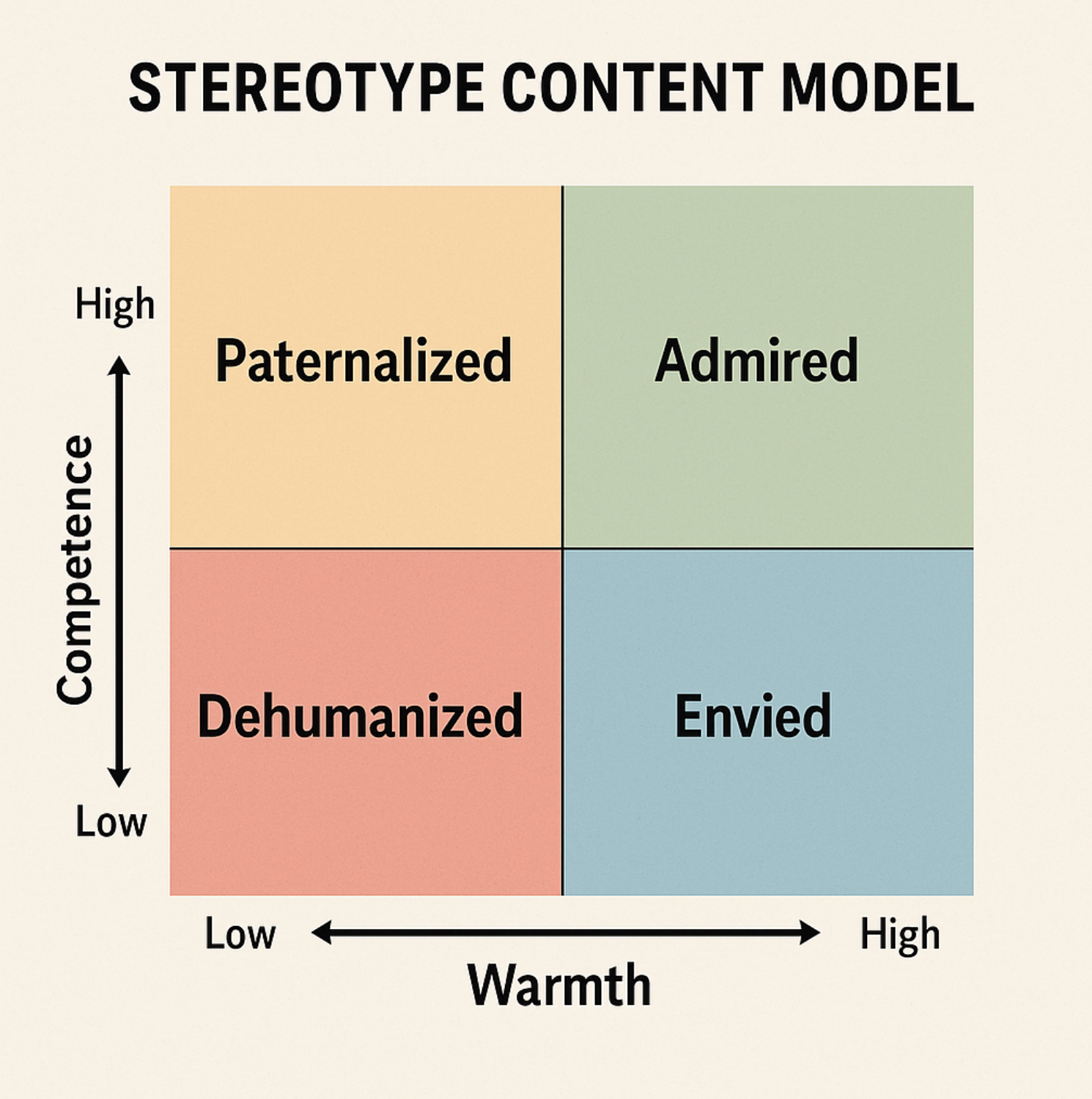
Every time someone interacts with you at work, their brain makes two rapid judgments:
- Warmth → “Do I like/trust this person?”
- Competence → “Can this person lead/deliver?”
This happens automatically. Instantly.
Before your ideas are fully heard.
Before your results are fully evaluated.
The Pattern: When Warmth Gets Too High
Here’s where most “nice” professionals fall in:
High Warmth / Lower Perceived Competence
Not because they lack competence.
But because of how they signal.
The “Nice but Not Serious” Perception
When you:
- Avoid disagreement
- Over-accommodate
- Speak softly or hesitantly
- Over-apologize
You unintentionally communicate:
- “I won’t challenge you”
- “I’m flexible to your needs”
- “I’m not a threat”
Which sounds positive…
But gets interpreted as:
“Not leadership material.”
The Compensation Effect (The Hidden Bias)
There’s a psychological effect most people never realize:
When someone appears very warm, people subconsciously discount their competence.
It’s not logical.
But it’s consistent.
Why This Happens
Your brain simplifies people into categories:
- Warm + Competent → Leader
- Competent + Cold → Respected but distant
- Warm + Low competence → Liked but not trusted with responsibility
If you over-index on warmth…
You get placed in the third category.
The “Pity Quadrant”
This is where many high-performing professionals get stuck:
- People like you
- People trust you with small things
- People rely on you for support
But they don’t:
- Put you in high-stakes decisions
- Give you strategic ownership
- Consider you for leadership roles
Because subconsciously:
You feel safe—but not authoritative.
The Visibility Paradox
Here’s the irony:
The more you try to maintain harmony…
The less visible your actual value becomes.
What Happens Over Time
You:
- Do more work
- Say yes more often
- Help more people
But:
- Others present ideas
- Others take ownership
- Others get recognized
And you become:
The background force behind visible success.
Why Competence Alone Isn’t Enough
Some people try to fix this by “working harder.”
That doesn’t solve it.
Because perception isn’t built on effort.
It’s built on signals.
What Actually Signals Competence
Not just results—but behavior:
- Clear opinions
- Boundary setting
- Decision-making
- Willingness to disagree
- Ownership of outcomes
Without these signals…
Your competence stays hidden.
The Leadership Sweet Spot
The goal isn’t to become less warm.
It’s to combine warmth with authority.
High Warmth + High Competence
This is where true influence lives.
You are:
- Respected
- Trusted
- Approachable
- Decisive
People feel comfortable with you—
But they also take you seriously.
Why Nice People Avoid This Zone
Because moving into this quadrant requires:
- Saying no
- Disagreeing publicly
- Setting boundaries
- Holding standards
And all of those trigger:
The exact discomfort your brain is trying to avoid.
The Misinterpretation That Holds You Back
Most people believe:
“If I assert myself, I’ll lose my likability.”
But in reality:
Strategic assertiveness increases respect—and doesn’t destroy likability when done correctly.
The Real Shift
You don’t need to become Excessively Forceful.
You need to become clear.
From This:
“I don’t want to upset anyone.”
To This:
“I want the best outcome—even if it creates short-term tension.”
The Hidden Cost You’re Paying
Let’s bring it back to the Niceness Tax.
When you stay in the “too warm” zone:
You pay with:
- Missed promotions
- Lower compensation
- Reduced authority
- Slower career trajectory
Not because you’re not capable—
But because you’re not signaling it.
The Moment of Realization
This is where most professionals pause and think:
“So I’ve been optimizing for being liked…
when I should’ve been optimizing for being trusted.”
Exactly.
The Strategic Upgrade
You don’t abandon warmth.
You layer authority on top of it.
That’s the difference between:
- Being pleasant
- And being powerful
What Comes Next
Now you understand:
- Why being too nice lowers perceived competence
- How warmth without authority limits your growth
- Where the leadership “sweet spot” actually is
But here’s the next question:
What does “too nice” actually look like in real workplaces?
Because it doesn’t always look obvious.
In fact, it often hides in behaviors that seem completely normal.
The Three Faces of “Too Nice” at Work
Being “too nice at work” doesn’t always look like weakness.
In fact, it often looks like:
- Reliability
- Helpfulness
- Professionalism
That’s what makes it dangerous.
Because you don’t realize it’s costing you—
until you’re already stuck.
Instead of one generic pattern, most professionals fall into one of three archetypes.
Identify yours.
Because each one has:
- A different trigger
- A different blind spot
- A different career cost
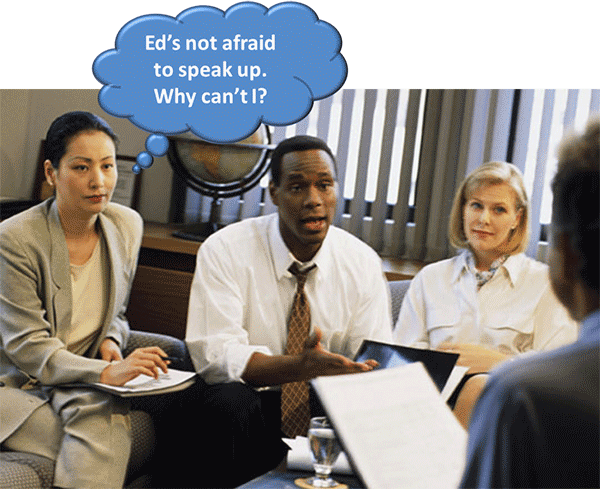
The Silent Architect (Tech / Product / Analytical Roles)


4
The Profile
- Highly competent
- Deep thinker
- Strong technical or analytical skills
- Low visibility
They don’t lack ideas.
They lack expression under pressure.
What It Looks Like
- Staying quiet in meetings despite having better ideas
- Letting others take credit unintentionally
- Avoiding “challenging” senior voices
- Over-preparing but under-speaking
The Internal Dialogue
- “Maybe I’m overthinking it…”
- “I don’t want to sound wrong…”
- “Let’s just go with the flow…”
The Real Driver
This archetype is often powered by:
- Amygdala sensitivity to social risk
- Mirror neuron overload (feeling others’ discomfort)
They don’t just think about conflict.
They feel it.
So they avoid it.
The Career Cost
- Invisible contributions
- Missed leadership opportunities
- Others becoming the “face” of their work
The Brutal Truth
If you don’t voice your thinking, your competence doesn’t exist in the room.
The Reliable Mediator (Corporate / HR / Operations)


4
The Profile
- Highly dependable
- Emotionally intelligent
- The “go-to” person for everything
They are the glue of the team.
But glue doesn’t get promoted.
What It Looks Like
- Taking on extra tasks “just to help”
- Fixing other people’s mistakes
- Managing team dynamics and emotions
- Saying yes before checking capacity
The Internal Dialogue
- “It’s easier if I just do it myself…”
- “I don’t want things to fall apart…”
- “They’re already stressed, I’ll handle it…”
The Real Driver
This archetype is driven by:
- Fawn response (safety through service)
- Hyper-vigilance to team tension
They equate:
Being needed = being safe
The Career Cost
- Stuck in low-visibility “support” roles
- Overloaded with non-promotable work
- Burnout without recognition
The Brutal Truth
You’re being rewarded with more work—not more growth.
The Soft Negotiator (Finance / Sales / Leadership Tracks)



4
The Profile
- High performer
- Results-driven
- Trusted—but under-assertive
They deliver value.
But they don’t claim it.
What It Looks Like
- Accepting initial offers without pushback
- Avoiding salary or promotion conversations
- Softening opinions in high-stakes discussions
- Prioritizing being liked over being respected
The Internal Dialogue
- “I don’t want to seem difficult…”
- “This is probably fair…”
- “I should just be grateful…”
The Real Driver
This archetype is heavily influenced by:
- Cortisol spikes during conflict
- Fear of damaging relationships
So they trade:
Short-term comfort → Long-term loss
The Career Cost
- Lower compensation over time
- Slower advancement
- Reduced authority in decision-making
The Brutal Truth
If you don’t advocate for your value, the system will undervalue you by default.
The Common Thread Across All Three
Different roles.
Different behaviors.
Same core pattern:
Avoid discomfort → Maintain harmony → Pay the price later
Why These Patterns Are So Hard to Spot
Because none of them look like failure.
They look like:
- Being a team player
- Being supportive
- Being professional
Which makes them socially rewarded…
But strategically costly.
The Identity Lock
Most people don’t change because these roles become identities:
- “I’m just more collaborative”
- “I’m naturally helpful”
- “I don’t like conflict”
But underneath those labels is something else:
Conditioned avoidance of tension.
The Key Realization
You don’t need to change your personality.
You need to upgrade your behavior.
From This:
“I’m just a nice person.”
To This:
“I’m a high-agency professional who chooses when to be agreeable.”
What Comes Next
Now you’ve identified the pattern.
But here’s where it hits hardest:
What is this actually costing your career?
Because the impact isn’t just emotional.
It’s structural.
It affects:
- Promotions
- Visibility
- Income
- Leadership trajectory
The Career Cost: How Being Too Nice Quietly Stalls You
By now, you’ve probably recognized yourself in at least one archetype.
But recognition isn’t enough.
Because the real danger of being too nice at work isn’t how it feels…
It’s how it positions you.
Quietly. Consistently. Systematically.
The Low-Value Work Pattern
This is where it starts.
You become known as:
- Reliable
- Helpful
- Easy to work with
So naturally, more work comes your way.
But not the kind that gets you promoted.
What You Actually Get
You’re assigned:
- Meeting notes
- Slide formatting
- Coordination tasks
- “Quick fixes” for others
These are called:
Non-promotable tasks
They keep things running.
But they don’t move your career forward.
Why You Get Picked
Because people know:
You won’t say no.
And over time, that becomes your role.
Not officially.
But functionally.
The Hidden Shift
You stop being seen as:
- A strategic contributor
And start being seen as:
- Operational support
Even if your capability is far higher.
The Visibility Paradox
Here’s the contradiction:
The more you help…
The less visible your actual value becomes.
Why This Happens
You spend your time:
- Supporting others’ work
- Fixing problems quietly
- Avoiding attention
So when leadership looks around for:
- Strategic thinkers
- Decision-makers
- Future leaders
They don’t see you.
Not because you’re not capable—
But because your work isn’t visible in the right way.
The Leadership Ceiling
This is where careers stall.
Not because of performance.
But because of perception.
How You Get Labeled
Managers think:
- “They’re great to have on the team…”
- “Very dependable…”
- “Easy to work with…”
But also:
- “Not quite ready for leadership”
- “Might struggle with tough conversations”
- “Too accommodating”
The Internal Logic (That No One Says Out Loud)
“If they can’t say no to peers…
how will they handle pressure as a leader?”
That’s the ceiling.
And most people never realize they’ve hit it.
The Negotiation Gap (The Most Expensive Cost)
This is where the Niceness Tax becomes real money.
What Happens in Practice
You:
- Accept initial offers
- Avoid negotiating salary
- Don’t push for promotions
- Downplay your achievements
Because it feels:
- Awkward
- Greedy
- Confrontational
The Long-Term Impact
Small decisions compound:
- Slightly lower salary → Every year
- Slightly delayed promotion → Every cycle
Over time, this creates:
Massive financial gaps.
The Hard Truth
Your career doesn’t reward quiet contribution.
It rewards visible value and negotiated outcomes.
The Feedback Desert
This is the cost no one talks about.
And it’s one of the most dangerous.
What Happens When You’re “Too Nice”
People:
- Avoid giving you tough feedback
- Assume you’re “fine”
- Don’t challenge you
Because you appear:
- Low-conflict
- Easygoing
- Stable
Why This Hurts You
You miss:
- Growth signals
- Blind spot awareness
- High-level coaching
So while others improve…
You plateau.
The Paradox
Your niceness makes people comfortable.
But it also makes them:
Less honest with you.
The “Reliable Worker” Pattern
This is where many careers quietly stall for years.
You Become Irreplaceable… in the Wrong Way
You’re so good at:
- Executing
- Supporting
- Delivering
That leadership thinks:
“We can’t move them—we need them here.”
Sounds Like Praise. It’s Not.
Because while you stay:
- Others get promoted
- Others get visibility
- Others move forward
And you remain:
Essential—but stuck.
The Compounding Effect (The Niceness Tax in Action)
Let’s connect everything.
Every time you:
- Say yes when you should pause
- Stay quiet when you should speak
- Accept when you should negotiate
You’re not making isolated decisions.
You’re reinforcing a pattern.
Over Time, That Pattern Becomes:
- Your reputation
- Your role
- Your ceiling
And That’s the Real Danger
Because it doesn’t feel like failure.
It feels like:
“I’m just doing my job.”
The Moment Most People Wake Up
It usually happens years later.
When they realize:
- They’ve worked harder than peers
- They’ve been more reliable
- They’ve contributed consistently
But somehow—
They’re still behind.
The Brutal Conclusion
Being too nice at work doesn’t slow you down immediately.
It slows you down silently.
Until one day…
You realize you’ve been running hard—
In the wrong direction.
The Good News (And the Turning Point)
Everything you’ve read so far might feel heavy.
It should.
Because you’re seeing a pattern most people never question.
But here’s the shift:
You don’t need to:
- Work harder
- Become Excessively Forceful
- Change your personality
You need something else.
You Need a System
Not random tips.
Not generic advice.
A clear framework that tells you:
- When to be warm
- When to be firm
- How to balance both without losing yourself
And that’s exactly what we build next.
The High-Agency Harmony™ Framework (The Turning Point)


4
Up to this point, we’ve dismantled the problem.
- You’re not “too nice”—you’re conditioned
- Your brain is wired to avoid social risk
- Your behavior is costing you visibility, authority, and growth
Now comes the shift.
Because the solution is not:
- Becoming Excessively Forceful
- “Toughening up”
- Or suppressing your empathy
That approach fails.
The Real Goal: High-Agency Harmony™
You don’t need to choose between:
- Being liked
- Being respected
You need to integrate both.
The New Target Identity
A high-agency professional who is both warm and authoritative.
Someone who:
- Understands people
- Communicates clearly
- Protects their time and priorities
Without guilt.
Without over-explaining.
Without losing relationships.
The 3 Pillars of High-Agency Harmony™
This framework is your bridge:
From → People-Pleasing
To → Professional Authority
Pillar 1: Strategic Empathy (Stop Absorbing, Start Understanding)
The Old Pattern
You feel what others feel.
- They’re stressed → You take on their work
- They’re overwhelmed → You say yes
- They’re uncomfortable → You fix it
That’s not empathy.
That’s emotional absorption.
The Upgrade
Strategic Empathy means:
Understanding someone’s needs—without taking responsibility for solving them.
The Shift in Practice
Instead of:
“I’ll just handle it so they’re not stressed.”
You think:
“What outcome are they trying to achieve—and is it my responsibility?”
Why This Changes Everything
You stop reacting emotionally…
And start responding strategically.
Pillar 2: Radical Clarity (Replace Softness with Precision)
The Old Pattern
You soften everything:
- “I just think maybe…”
- “Sorry, quick question…”
- “If that’s okay…”
This feels polite.
But it signals uncertainty.
The Upgrade
Radical Clarity means:
Saying exactly what needs to be said—without unnecessary softening.
The Shift in Practice
Instead of:
“Sorry, I’m kind of busy right now…”
You say:
“My current priority is [X], so I can’t take this on today.”
Why This Works
Clarity builds:
- Trust
- Authority
- Predictability
People don’t respect what they can’t understand.
And soft language creates ambiguity.
Pillar 3: Protective Boundaries (Treat Your Time Like Capital)
The Old Pattern
You treat requests like favors.
Something you should accommodate.
The Upgrade
Protective Boundaries means:
Treating your time and energy as limited professional resources.
The Shift in Practice
Instead of:
“I’ll squeeze it in.”
You think:
“What is this replacing—and is it worth it?”
Why This Is Critical
Every “yes” has a cost.
Not emotionally.
Strategically.
The Integration Point (Where Most People Fail)
Most professionals try to fix this by focusing on just one pillar.
That doesn’t work.
If You Only Use Empathy
You stay:
- Kind
- Overextended
- Under-recognized
If You Only Use Clarity
You become:
- Direct
- But perceived as harsh
If You Only Use Boundaries
You risk:
- Isolation
- Friction
- Misalignment
The Power Is in the Combination
High-Agency Harmony™ works because it blends all three:
- Empathy → You understand the situation
- Clarity → You communicate your position
- Boundaries → You protect your priorities
Example in Real Life
Request:
“Hey, can you take this on today?”
Old Response (People-Pleasing)
“Yeah, sure, I’ll figure it out.”
High-Agency Response
“I understand this is urgent. I’m currently focused on [Project X] to meet our deadline.
If this takes priority, which should I shift?”
What Just Happened?
- You acknowledged (Empathy)
- You stated reality (Clarity)
- You protected your workload (Boundary)
No aggression.
No guilt.
No over-explaining.
The Internal Reframe
This is the identity shift:
You are not rejecting people.
You are prioritizing outcomes.
Why This Framework Works (Psychologically)
This isn’t just communication.
It’s brain regulation.
What Changes Internally
- The pause activates your prefrontal cortex
- Clarity reduces ambiguity (lower anxiety)
- Boundaries prevent overload (lower stress)
Over time:
You retrain your brain out of the “auto-yes” loop.
The New Standard You Operate By
Not:
“How do I avoid discomfort?”
But:
“What creates the best outcome—for me and the team?”
The First Mistake to Avoid
Don’t try to apply this everywhere immediately.
That’s where most people fail.
Instead:
Start small.
Low-stakes situations.
Build the muscle.
What Comes Next
Now you have the framework.
But a framework alone doesn’t change behavior.
You need something more:
Execution under pressure.
Because in the moment—
when your brain is triggered—
You won’t think.
You’ll default.
individual experiences vary. If workplace stress, anxiety, or people-pleasing behaviors significantly affect daily functioning, consider consulting a qualified mental health professional.

