
Being too nice at work might feel like a strength—but it’s one of the biggest hidden reasons professionals get overlooked.
How being too nice at work quietly kills your authority, visibility, and growth—and what to do instead.
The 5-Minute “Yes” That Costs You Years
Someone asks:
“Hey, quick favor?”
You hesitate… then say:
“Yeah, sure.”
Instant relief.
No tension. No awkwardness. No friction.
But what you don’t see is this:
That one “yes” just cost you more than time.
It costs:
- Focus
- ImVisibility
- Strategic work
- And most importantly—respect
The Niceness Tax (Most People Never Notice This)

Every unnecessary “yes” is a trade:
- Short-term comfort
→ for long-term career cost
Let’s quantify it:
- 1 extra task = ~45 minutes
- 5 times/week = ~4 hours
- Per year = 200+ hours lost
That’s 5 full workweeks.
Not spent on:
- High-impact work
- Promotions
- Leadership visibility
This is the Niceness Tax.
And most professionals pay it silently.
You’re Not “Nice”—You’re Conditioned
This is the real shift.
Your behavior isn’t personality.
It’s conditioning.
The Loop That Keeps You Stuck
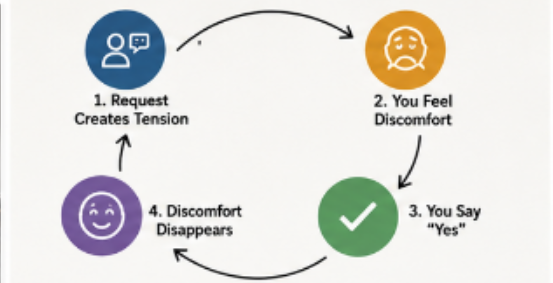
Every time this happens:
- Request creates tension
- You feel discomfort
- You say “yes.”
- Discomfort disappears
Your brain learns:
“Saying yes = relief.”
This is negative reinforcement.
This concept is rooted in behavioral psychology and has been widely studied in human decision-making patterns.
You’re not rewarded with praise.
You’re rewarded with less anxiety.
And that’s addictive.
Why Saying “No” Feels So Hard

Because it’s not just mental.
It’s biological.
When conflict appears:
- Your brain triggers stress
- Cortisol rises
- Your body prepares for a threat
Even if it’s just a message.
When you say “yes”?
Relief.
And your brain locks it in:
Compliance = safety
The Hidden Addiction: Approval

Now layer this on top:
- You help → people appreciate you
- You get validation → dopamine release
So now you’re:
- Avoiding discomfort
- Chasing approval
That’s a powerful loop:
Say yes → feel better → get liked → repeat
This constant need for approval is also closely linked to imposter syndrome in high achievers.
The Real Problem
You’re optimizing for comfort instead of growth.
In some cases, this behavior can even be exploited by others, as explained in our breakdown of workplace influence dynamics
And in the workplace?
That becomes a liability.
Your Brain Is Misfiring (And It’s Not Your Fault)
Your brain still operates on ancient rules:
“If I disrupt the group, I might get rejected.”
And historically?
That meant danger.
The Amygdala Problem (Simplified)

Your brain treats:
- Disagreement
- Feedback
- Saying no
Like threats.
So it pushes you to:
- Agree
- Avoid
- Appease
In more extreme cases, this fear response can be manipulated through tactics like communication distortion patterns
The Fawn Response (The Missing Piece)
Most people know fight or flight.
But there’s a fourth:
Fawn = Stay safe by being agreeable
This is “being too nice at work.”
- You smooth things over
- You avoid tension
- You prioritize others
Not consciously.
Automatically.
This is especially common in high-conflict workplaces where agreeable employees are quietly overburdened.
The Career Trade-Off You’re Making
Here’s the uncomfortable truth:
You’re choosing likeability over autonomy.
What That Looks Like
You:
- Say yes to everything
- Avoid pushing back
- Downplay your ideas
Which leads to:
- Low authority
- Low visibility
- Low leverage
Why Being Too Nice at Work Lowers Your Perceived Competence
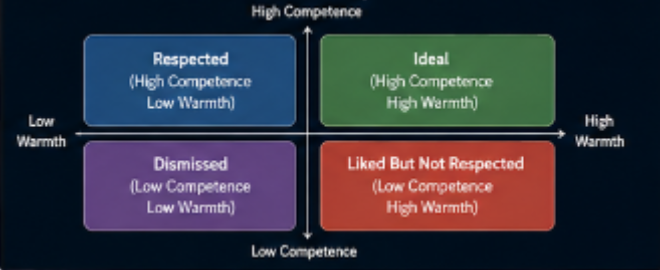
Everyone judges you on two things:
- Warmth → “Do I like you?”
- Competence → “Can I trust you to lead?”
Where “Nice” People Get Stuck
You become:
High Warmth / Low Perceived Competence
Not because you lack skill—
But because you signal:
- Agreement
- Flexibility
- Non-resistance
Which gets interpreted as:
“Not leadership material.”
The Harsh Reality
You can be liked…
And still not be respected.
But you cannot be respected…
Without boundaries.
3 Types of People Who Are Too Nice at Work

Most professionals fall into one of these:
1. The Silent Architect
- Smart but quiet
- Avoids speaking up
- Let others take credit
Cost: Invisible competence
2. The Reliable Mediator
- Helps everyone
- Takes extra work
- Fixes everything
Cost: Stuck in low-value work
3. The Soft Negotiator
- Delivers results
- Avoids conflict
- Doesn’t advocate
Cost: Lower pay, slower growth
The Career Cost of Being Too Nice at Work

Being too nice leads to:
1. Low-Value Work Trap
You get assigned everything no one wants.
2. Visibility Problem
You support work—but don’t own it.
3. Leadership Ceiling
You’re seen as reliable—not decisive.
4. Negotiation Gap
You accept instead of asking.
Over time, this pattern leads to burnout, making small daily recovery habits essential.
The Result
You work more… and advance less.
The Shift: Kind ≠ Nice
This is critical.
Niceness (Fear-Based)
- Avoids conflict
- Seeks approval
- Protects comfort
Kindness (Strength-Based)
- Tells the truth
- Sets boundaries
- Protects outcomes
Niceness is about you.
Kindness is about results.
The Solution: High-Agency Harmony™
You don’t need to become harsh.
You need balance.
The 3 Pillars
1. Strategic Empathy
Understand people—don’t absorb their problems.
2. Radical Clarity
Say what you mean—without softening.
3. Protective Boundaries
Treat your time like a resource.
Example Shift
Instead of:
“Yeah, I’ll handle it.”
Say:
“I’m focused on [X]. If this is a priority, what should shift?”
What This Does
- Shows awareness
- Signals competence
- Protects your time
Without damaging relationships.
The Assertiveness System (Simple but Powerful)
The PAR Method
Pause → Assess → Respond
Step 1: Pause
“Let me check my priorities.”
Step 2: Assess
Is this aligned with your goals?
Step 3: Respond
Set a clear boundary.
The Most Useful Scripts
Saying No (Without Conflict)
“I can’t take this on without delaying [X]. Which should I prioritize?”
Stopping Over-Apologizing
Instead of:
“Sorry for the delay.”
Say:
“Thanks for your patience.”
Holding Your Ground
“I’m not finished—give me 10 seconds.”
Handling Late Requests
“I’ll review this first thing tomorrow.”
Why Most People Fail (Even After Learning This)
Because of three things:
If left unchecked, this behavior can negatively impact your mental health over time.
1. The Guilt Hangover
You feel bad after saying no.
That’s not wrong.
That’s withdrawal from a habit.
2. The Pushback Phase
People test your new boundaries.
That’s expected.
3. Identity Shift
You’re no longer “the nice one.”
That feels uncomfortable.
The Reframe That Fixes Everything
You’re not being difficult.
You’re being clear.
The 90-Day Transformation Plan
Days 1–30: Break the Reflex
- Pause before every “yes.”
- Remove “sorry” and “just.”
- Practice small numbers
Days 31–60: Build Boundaries
- Decline low-value tasks
- Speak early in meetings
- Protect focus time
Days 61–90: Establish Authority
- Clarify priorities with your manager
- Push back strategically
- Start owning decisions
What Changes After 90 Days
- You’re taken more seriously
- You get better opportunities
- You stop feeling overwhelmed
- You regain control
Final Truth: Respect Beats Likeability
Likeability is unstable.
Respect compounds.
If everyone likes you,
your “yes” has no value.
Your First Step (Do This Today)
Think of one thing you’ve been avoiding.
One “yes” you regret.
Now replace it with:
“Let me check my priorities and get back to you.”
That’s it.
That’s the shift.
Interestingly, the same people-pleasing patterns often affect personal relationships as well.
Final Thought
Being too nice at work isn’t a strength.
It’s a strategy that stopped working.
The moment you replace it—
You don’t lose relationships.
You gain respect, clarity, and control.

