
How to Enter Flow State: A Science-Based Guide for Deep Focus
There’s a moment—rare, almost elusive—when everything just locks in.
Learning how to enter flow state consistently can completely change how you work, think, and perform.
You’re working, but it doesn’t feel like work.
Your thoughts aren’t scattered—they’re aligned.
Time stops behaving normally. Hours disappear.
And the output? It’s better than anything you could’ve forced.
That’s not luck. That’s not talent.
That’s flow state.

And once you understand how to enter flow state, it stops being accidental—and starts becoming a performance tool.
For founders and creatives, this isn’t just a productivity hack. It’s the difference between:
- Grinding for 10 hours vs producing breakthrough work in 90 minutes
- Reacting all day vs creating something that actually moves the needle
- Feeling busy vs becoming highly effective
But here’s the truth most people never hear:
Flow doesn’t feel good at the start. It feels like resistance.
That friction? That’s the transition point.
The “Effortless Effort” Paradox
Flow is often described as effortless—but that’s misleading.
Because the entry into flow is anything but.
In fact, the first 10–20 minutes of deep work feel:
- Mentally heavy
- Slightly uncomfortable
- Distracting
- Even frustrating
This is what most people misinterpret.

They assume:
“If it feels hard, I’m not in flow.”
So they check their phone. Switch tasks. Refresh email.
And unknowingly, they quit right before the threshold.
What’s actually happening is biological.
Your brain is transitioning from:
- Scattered attention → Directed focus
- Conscious control → Automatic execution
This transition phase—what we’ll later call the Struggle Phase—is the price of admission.
Push through it, and something shifts.
From Chaos to Clarity in Seconds
Once the flow “clicks,” the experience transforms instantly:
- Decisions feel automatic
- Ideas connect faster than you can explain
- Self-doubt disappears
- You stop thinking about the work—and become the work
This is what psychologists call an action-awareness merger.
And it’s not just subjective.
It’s neurological.
Your brain literally changes how it operates.
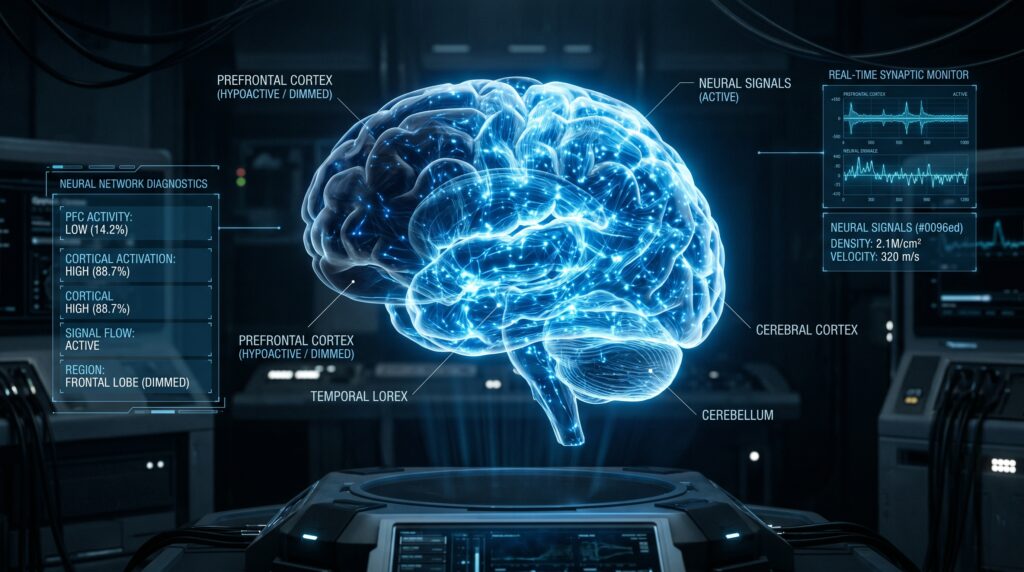
To understand how to enter flow state consistently, you need to understand what’s happening under the hood.
What Is Flow State (Really)? The Science Behind Deep Focus
Mihaly Csikszentmihalyi and the Flow Channel
The concept of flow wasn’t invented by productivity gurus.
It was discovered by psychologist Mihaly Csikszentmihalyi, who spent decades studying what makes life feel meaningful and engaging.
His core insight?
For deeper research on flow science, you can explore the work done by the Flow Research Collective
People are happiest not when they’re relaxed—but when they’re fully immersed in a challenge.
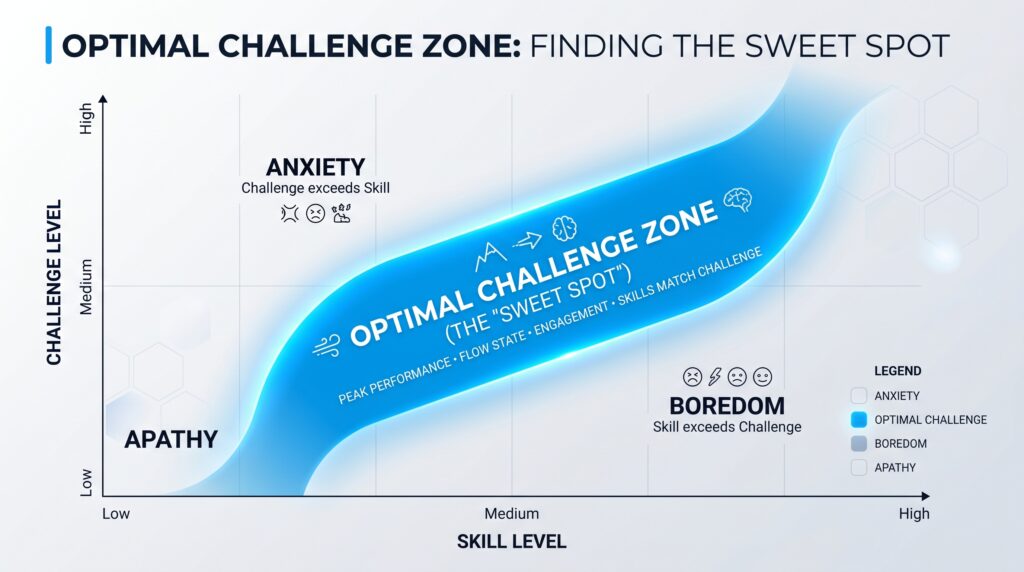
He mapped this into what’s now known as the Flow Channel:
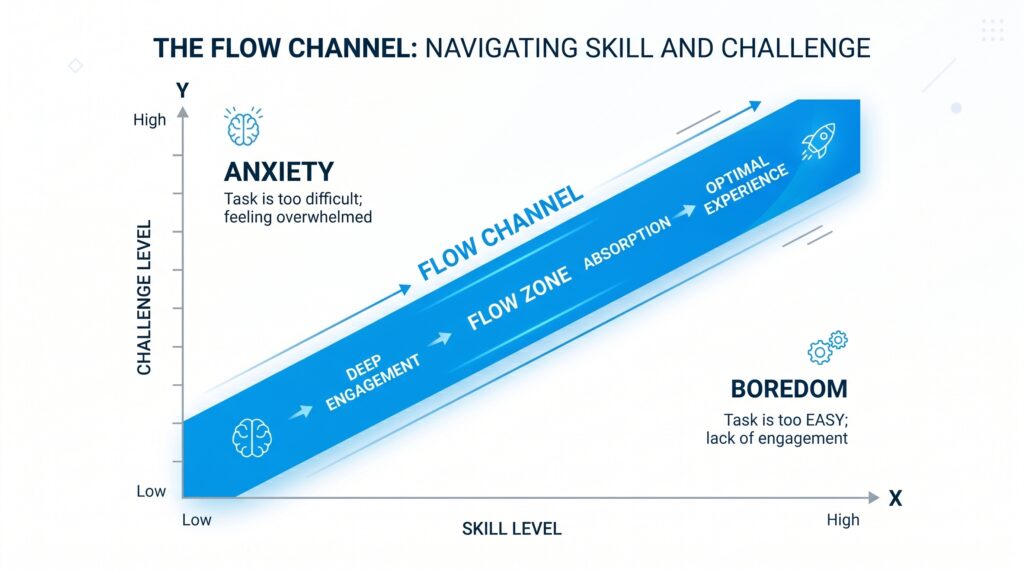
| State | Cause | Result |
|---|---|---|
| Boredom | Low challenge | Disengagement |
| Anxiety | High challenge | Stress & overthinking |
| Flow | Challenge ≈ Skill | Peak performance |
The key insight here:
👉 Flow lives on a razor’s edge.
Not too easy. Not too hard.
Just slightly beyond your current ability.
We’ll come back to this when we break down the 4% Rule—one of the most powerful triggers for entering flow on demand.
Transient Hypofrontality: Turning Off the Inner Critic
Here’s where things get interesting.
When you enter flow, your brain doesn’t become more active.
It becomes selectively quieter.
This phenomenon is called Transient Hypofrontality.
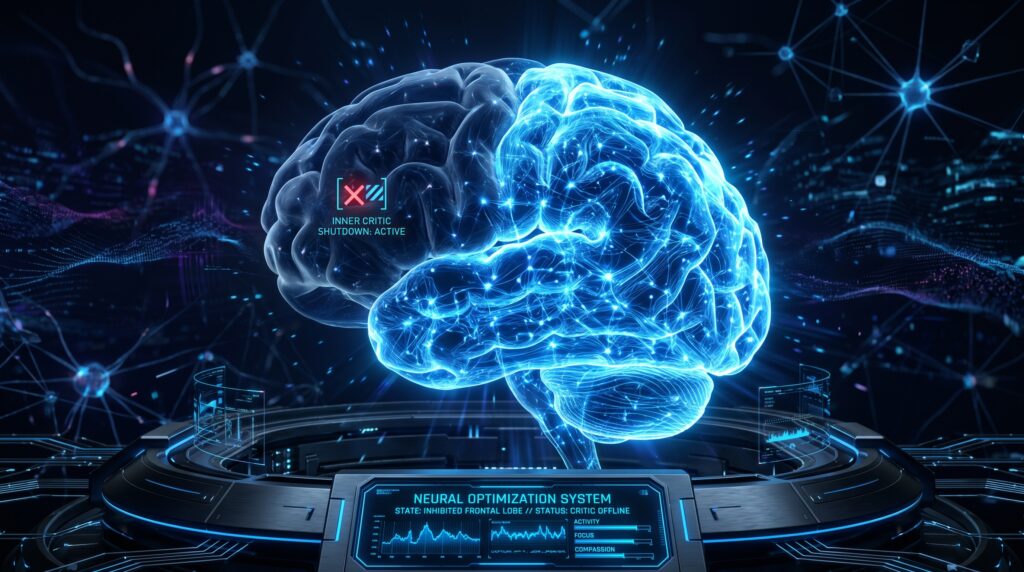
In simple terms:
The part of your brain responsible for self-doubt, overthinking, and identity temporarily temporarily reduces activity.
Specifically, the prefrontal cortex—your “inner CEO”—reduces activity.
And when that happens:
- The inner critic goes silent
- Fear of judgment disappears
- Time tracking weakens
- Decision-making speeds up
It’s like removing a bottleneck.
Normally, your brain filters everything through:
- “Is this good enough?”
- “What will people think?”
- “Am I doing this right?”
In flow, those filters disappear.
And suddenly, execution becomes fluid.
This is why creatives produce their best work in flow—not because they’re trying harder, but because they’ve stopped interfering.
Default Mode Network: Reducing Mental Distraction
Another major shift happens in something called the Default Mode Network (DMN).
This is the part of your brain responsible for:
- Mind-wandering
- Rumination
- Self-referential thinking
- Replay of past/future scenarios
In everyday life, the DMN is constantly active.
It’s the voice that says:
- “Check your phone real quick.”
- “What if this fails?”
- “Did you reply to that message?”
But in flow?
The DMN goes quiet.

And when it does:
- Distractions lose their grip
- Mental noise disappears
- Focus locks onto the present task
This is why flow feels like mental silence.
Not empty—but directed.
The Neurochemical Cocktail of Flow
Flow isn’t just a mental state.
It’s a full-body neurochemical event.
When you enter flow, your brain releases a powerful mix of chemicals:
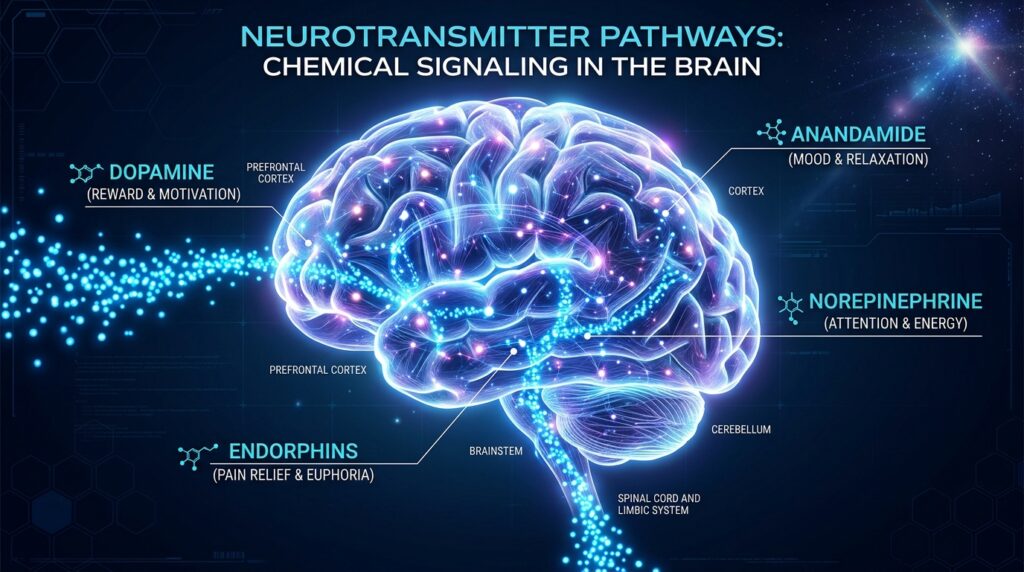
🔹 Dopamine
- Drives motivation and reward
- Enhances pattern recognition
- Distorts time perception
🔹 Norepinephrine
- Sharpens attention
- Increases alertness
- Boosts energy
🔹 Endorphins
- Reduce pain
- Increase endurance
- Create a sense of ease
🔹 Anandamide
- Enhances creativity
- Promotes lateral thinking
- Creates a subtle sense of euphoria
Together, this creates what can only be described as:
A state of calm intensity.
You’re focused—but not stressed.
Engaged—but not overwhelmed.
Operating at full capacity—without friction.
⚡ Key Takeaway
Flow isn’t magic.
It’s a predictable biological state.
Which means:
👉 If you understand the triggers, you can reproduce them.
And that’s exactly what we’re about to do next.
Up Next:
We break down:
- Why your brain was designed for flow
- The evolutionary advantage behind deep focus
- And how to use that to your advantage in modern work
The Evolutionary Edge: Why Your Brain Is Built for Flow
Flow isn’t a modern productivity hack.

It’s ancient.
Long before Slack notifications and startup dashboards, your brain evolved under very different conditions—ones where deep focus wasn’t optional, it was survival.
Understanding this changes everything.
Because once you see flow as a biological default, not a rare state, the goal shifts from forcing focus to removing interference.
The Hunter’s Brain: Flow as Survival Mode
Imagine tracking prey across miles of terrain.
No distractions.
No second chances.
Every sound, movement, and pattern matters.
This is where flow came from.

Early humans who could:
- Sustain attention for long periods
- Recognize subtle environmental patterns
- Push through physical discomfort
…were far more likely to survive.
Flow enhanced all three.
What happened in the brain?
- Endorphins reduced pain → enabling endurance
- Dopamine enhanced pattern recognition → spotting tracks
- Transient hypofrontality reduced hesitation → faster decisions
In other words:
Flow wasn’t about feeling good. It was about performing under pressure.
That same mechanism now activates when:
- A founder is solving a complex strategic problem
- A developer is debugging deep in code
- A writer is fully immersed in creation
The environment changed.
The biology didn’t.
Group Flow and Collective Intelligence
However, not all team dynamics are healthy. In some environments, psychological manipulation can disrupt focus and performance—explored deeply in Dark Empathy in the Workplace: How Emotional Intelligence Becomes a performance tool
Flow isn’t just individual—it’s social.

In tribal settings, survival often depended on coordinated group action:
- Hunting in sync
- Navigating terrain together
- Responding to threats collectively
This created group flow, where:
- Communication became non-verbal
- Actions were synchronized
- Decisions happened instantly
Today, you see this in:
- High-performing startup teams
- Elite sports squads
- Creative collaborations
When everyone is aligned:
The team starts behaving like a single organism.
For founders, this has a powerful implication:
👉 Your environment doesn’t just affect your flow—it shapes your team’s ability to access it.
Why You Can’t Focus: The Hidden Barriers Blocking Flow
If flow is natural… why does it feel so hard to access?
Once you understand how to enter flow state, distractions lose their power over your attention.
Because modern life is almost perfectly designed to disrupt it.

Let’s break down the real blockers—not surface-level distractions, but the deeper psychological and biological constraints.
The Ambiguity Trap (Lack of Clear Goals)
Your brain is a goal-seeking system.
If it doesn’t know what “done” looks like, it defaults to easier rewards.
This is why vague tasks kill focus:
- “Work on the business.”
- “Make progress on the project.”
- “Figure things out.”
There’s no finish line.

And without a finish line:
- Dopamine doesn’t activate properly
- Motivation drops
- Attention drifts
Fix:
Turn every task into a micro-win:
- Write 300 words of the introduction.”
- “Fix the login bug.”
- “Design 1 landing page section.”
Clarity isn’t optional.
It’s a trigger.
The Challenge-Skill Imbalance
Flow lives in a narrow zone.
Too easy → boredom
Too hard → anxiety
Most founders oscillate between both.
Scenario 1: Overwhelm
- Huge, undefined tasks
- High stakes
- Fear of failure
Result: Overthinking, paralysis, no flow.
Scenario 2: Under-stimulation
- Repetitive admin work
- Low cognitive demand
Result: Distraction, procrastination.
The Solution: The 4% Rule
You need a task that’s just slightly beyond your current ability.
Not 50% harder.
Not 20%.
About 4%.
Enough to demand focus.
Not enough to trigger fear.
Attention Fragmentation & Dopamine Hijacking
Many people stay stuck in reactive work patterns because they feel the need to respond instantly. This behavior is often rooted in deeper patterns explained in The Likeability Trap: Why Being Too Nice Stalls Your Career
Every notification is a reset button.

When you check:
- Slack
- Social media
You’re not just pausing work.
You’re breaking the neurological buildup required for flow.
Research shows:
It can take up to 20+ minutes to regain deep focus after a single interruption.
Now multiply that by:
- 10 notifications
- 5 “quick checks.”
- Constant tab switching
You’re never entering flow.
You’re restarting.
The deeper issue?
Your brain is being trained by variable reward loops.
Just like a slot machine:
- You don’t know what reward you’ll get
- So you keep checking
And compared to that…
Deep work feels slow.
This is why dopamine discipline is foundational to flow.
Perfectionism and the Hyperactive Prefrontal Cortex
Perfectionism feels like high standards.
But neurologically?
It’s interference.
When you constantly evaluate your work:
- “Is this good enough?”
- “Should I rewrite this?”
You keep the prefrontal cortex active.
And that blocks:
- Transient hypofrontality
- Automatic execution
- Creative flow
The paradox:
The more you try to be perfect, the less likely you are to produce great work.
Because great work comes from uninterrupted output, not constant correction.
The Flow Equation: Understanding the 4% Rule
If there’s one concept that unlocks flow consistently, it’s this.
Flow isn’t random.
It’s mathematical.
The Goldilocks Zone of Performance
You’ve experienced this before:
- Too easy → you get bored
- Too hard → you shut down
- Just right → you lock in
That “just right” zone is where flow lives.
And it’s defined by one key variable:
👉 Challenge relative to skill
Why Slight Discomfort Is Required
Flow doesn’t happen in comfort.
It happens at the edge.
That slight tension you feel when a task is:
- Just a bit intimidating
- Slightly uncertain
- Mentally demanding
That’s not a problem.
That’s the signal.
Biologically:
- It increases norepinephrine (focus)
- Triggers dopamine (engagement)
- Forces full attention
Without that edge, your brain doesn’t “upgrade” into flow mode.
⚡ Practical Reframe
Instead of asking:
“How do I make this easier?”
Ask:
“How do I make this slightly more challenging?”
Examples:
- Add a time constraint
- Increase output expectations
- Remove safety nets
That small shift can be the difference between distraction and deep focus.
The 20-Minute Threshold: The Phase Everyone Gets Wrong
This is the most important section of the entire article.
Because this is where almost everyone fails.
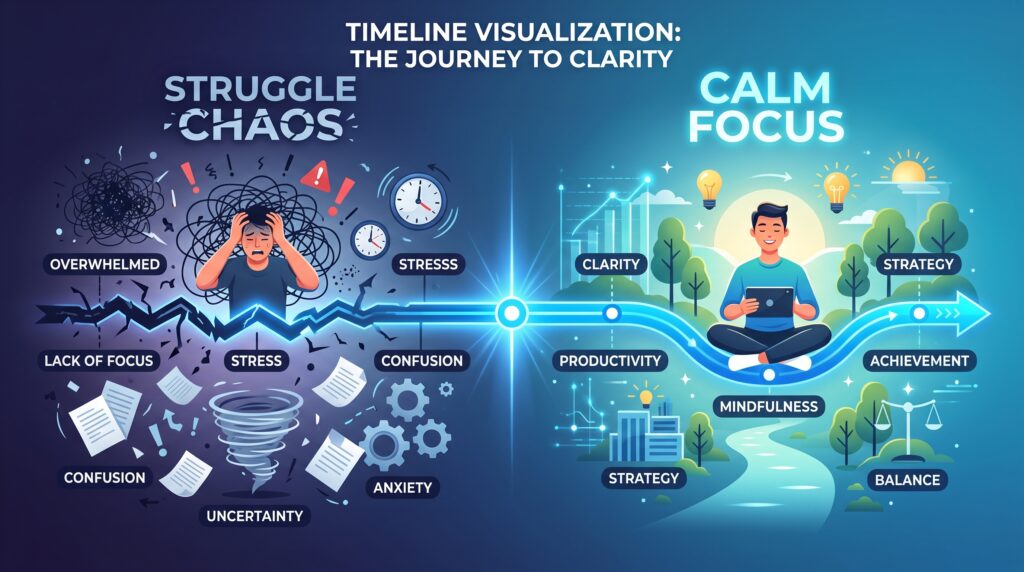
The Struggle Phase (0–20 Minutes)
The beginning of deep work feels wrong.
Let’s be honest.
You sit down, and:
- Your mind wanders
- You feel resistance
- You want to quit
This is not failure.
This is the loading screen.
Your brain is:
- Searching for patterns
- Activating relevant neural circuits
- Filtering distractions
But during this phase:
- The Default Mode Network is still active
- The Prefrontal Cortex is still loud
- Dopamine hasn’t fully kicked in
So it feels like effort.
The Release Point: When Flow “Catches” You
If you push past ~20 minutes…
Something shifts.
- Thoughts become fluid
- Focus stabilizes
- Effort drops
This is where:
- Transient hypofrontality begins
- Neurochemicals activate
- Flow emerges
You don’t force this moment.
You earn it by staying.
Why Most People Quit Too Early
Here’s the brutal truth:
Most people never experience flow—not because they can’t, but because they leave too soon.
They interpret the struggle phase as:
- Lack of motivation
- Lack of clarity
- Lack of ability
So they escape.
Phone. Email. Task switch.
And reset the clock.
⚡ The Rule That Changes Everything
👉 The 20-Minute No-Exit Rule
You are not allowed to:
- Switch tasks
- Check your phone
- Open new tabs
For at least 20 minutes.
No exceptions.
Because:
Flow is on the other side of discomfort.
How to Enter Flow State: The 20-Minute Launch Protocol
This system is designed specifically to teach you how to enter flow state on demand
This is where everything comes together.
You now understand:
- The neuroscience
- The behavioral blockers
- The critical 20-minute threshold
Now it’s time to operationalize it.
This is your repeatable system for how to enter flow state on demand—not occasionally, not randomly, but reliably.
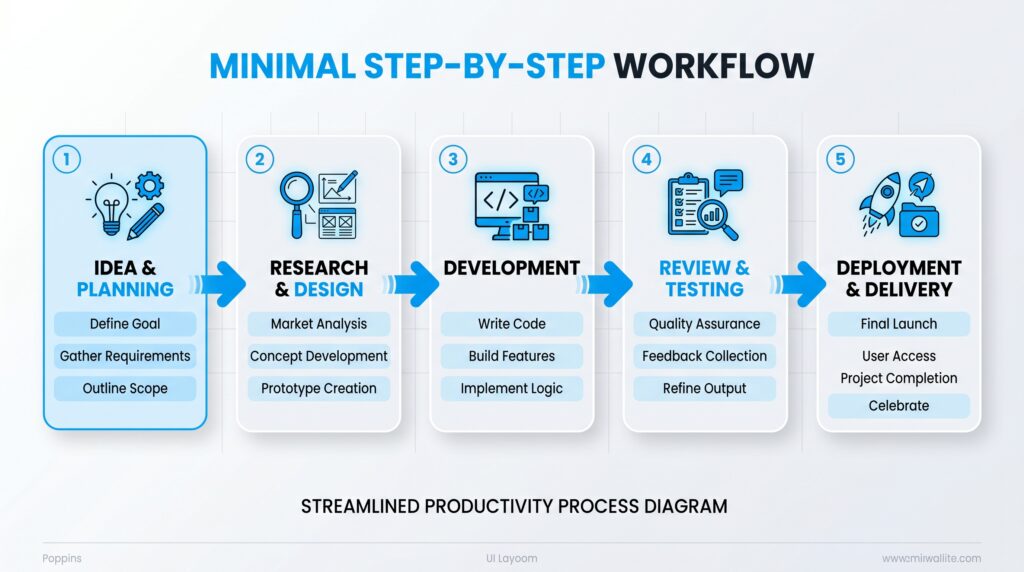
Think of this as a launch sequence.
You’re not hoping for focus.
You’re engineering it.
Phase 1: External De-Clutter (Environment Setup)
Before your brain can focus, it needs silence from the outside world.
Because attention isn’t just about what you do.
It’s about what you remove.
Digital Sunset & Sensory Anchors
Start with a hard reset:
- Close all unnecessary tabs
- Turn off notifications (Slack, email, phone)
- Put your phone in another room
- Clear your physical workspace
This isn’t optional.
Every distraction is a potential reset of your flow cycle.
One interruption = 20+ minutes lost.
Now add a sensory anchor:
- Lo-fi beats
- Instrumental music
- Binaural beats (alpha/theta range)
This acts as a signal to your brain:
“We’re entering deep work mode.”
Over time, this becomes conditioned.
The moment the music starts, your brain shifts.
Phase 2: Internal Alignment (Mental Setup)
Now that the environment is clean, we move inward.
Because clarity—not motivation—is what drives flow.
Micro-Wins & the 4% Challenge
Write down one single objective:
“I will complete ______.”
Not vague.
Not broad.
Specific and measurable.
Examples:
- “Draft 500 words of the article intro.”
- “Fix the payment bug.”
- “Design the hero section.”
This activates goal-directed dopamine.
Next, apply the 4% Rule:
Ask:
- Is this too easy? → Increase difficulty
- Too overwhelming? → Reduce scope
You want that slight tension.
That “this might be hard… but doable” feeling.
That’s the flow trigger.
Phase 3: The No-Exit Rule (Struggle Commitment)
This is the phase that separates amateurs from professionals.
Lowering the Bar to Enter Flow Permit Yourself
Permit yourself to be bad.
Yes—intentionally.
- Write messy
- Think slowly
- Produce imperfect output
Why?
Because perfectionism keeps the prefrontal cortex active.
And that blocks flow.
Instead, adopt this rule:
“For the first 20 minutes, quality does not matter. Only presence does.”
The 20-Minute Lock-In
Set a timer for 20 minutes.
And commit to:
- Staying in your seat
- Working on the task
- Not switching context
No matter what.
Even if:
- It feels slow
- You get distracted
- You want to quit
This is the transition point.
Push through—and your brain will take over.
⚡ What Happens Next
Somewhere between minute 15–25:
- Focus stabilizes
- Effort drops
- Thoughts accelerate
You don’t notice the shift immediately.
But suddenly:
- You’re in it
- Time disappears
- Output increases
That’s flow.
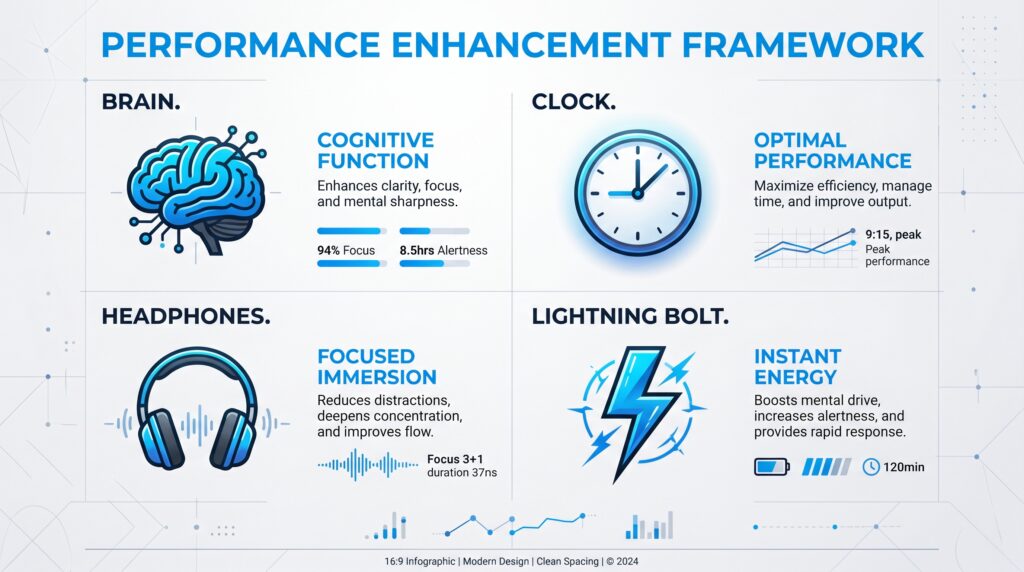
Build Your Flow Stack: Tools That Amplify Deep Focus
Flow isn’t just mental.
It’s physiological.
Which means you can prime your biology to make flow easier to access.
Think of this as building your personal flow stack.
Biological Primers (Neurochemistry Boosters)
These prepare your brain before the session starts.
🔹 Caffeine Timing
- Delay caffeine 60–90 minutes after waking
- Prevents early crashes
- Stabilizes energy for deep work
🔹 Cold Exposure / Movement
- 30–60 seconds cold water OR
- 5–10 minutes of intense movement
This spikes:
- Norepinephrine → focus
- Dopamine → motivation
Result: Faster entry into flow.
Cognitive Containers (Structure for Flow)
Structure creates boundaries.
And boundaries create depth.
🔹 The 90-Minute Deep Work Block
Your brain operates in ultradian cycles.
Ideal structure:
- 20 min struggle
- 60+ min flow
- 10–20 min recovery
🔹 Flowmodoro Technique
Instead of fixed timers:
- Work until the flow breaks
- Then take a break
Don’t interrupt momentum.
Extend it.
Sensory Shields (Focus Amplifiers)
These protect your attention once the flow begins.
🔹 Music & Sound
- Repetitive, lyric-free
- Consistent rhythm (no sudden changes)
🔹 Environment Design
- Same workspace for deep work
- Minimal visual clutter
- Consistent lighting
The goal:
Reduce variability → increase predictability → enable flow
The Flow Saboteurs: Psychological Forces Killing Your Focus
Even with the perfect setup, internal resistance can still block you.
These are the three biggest enemies of flow.

Fear of Starting (Activation Energy Problem)
The brain hates large, undefined effort.
So it delays.
Not because you’re lazy.
Because it perceives a threat.
⚡ Fix: The 5-Minute Rule
Tell yourself:
“I’ll just do this for 5 minutes.”
This lowers resistance.
And once you start?
Momentum takes over.
Perfectionism (The Inner Critic Loop)
Perfectionism = constant evaluation.
And evaluation = no flow.
⚡ Fix: The “Vomit Draft” Method
- Write fast
- Don’t edit
- Don’t judge
Separate creation from correction.
Flow happens in creation—not editing.
Dopamine Addiction (The Slot Machine Brain)
Your brain is wired for quick rewards.
Social media exploits that.
Deep work doesn’t.
⚡ Fix: Dopamine Reset
Before deep work:
- No scrolling
- No notifications
- No quick hits
Let your brain feel bored.
Because:
Flow requires a lower baseline of stimulation.
Identity Shift: Becoming a Deep Work Operator
Many professionals struggle with boundaries, especially in workplaces where constant availability is rewarded. If that sounds familiar, read this: Being Too Nice at Work: 7 Brutal Ways It Silently Stalls Your Career
Tactics get you started.

Identity keeps you consistent.
From Reactive Worker to Flow Architect
Most people operate reactively:
- Responding to messages
- Handling interruptions
- Switching constantly
Flow requires the opposite.
You must become:
Someone who protects focus like an asset.
Identity-Based Focus vs Outcome-Based Pressure
Instead of:
- “I need to finish this today.”
Shift to:
- “I am someone who enters deep work daily.”
This removes pressure.
And builds consistency.
Every session becomes a vote for your identity.
Real-World Flow: How Top Performers Use It
Flow isn’t theory.

It’s the common denominator of elite performance.
Founders: Strategic Deep Thinking
Top founders block time for:
- Thinking
- Problem-solving
- Vision work
Because shallow work doesn’t build companies.
Deep thinking does.
Creatives: Bypassing the Inner Critic
Writers, designers, musicians:
They don’t wait for inspiration.
They create conditions for flow.
And let the work emerge.
Athletes: Performing Under Pressure
In high-stakes environments:
- There’s no time to think
- Only to act
Flow becomes survival.
And the same mechanism applies to your work.
Flow vs Grind: Why More Hours Don’t Equal More Output
The biggest lie in productivity?
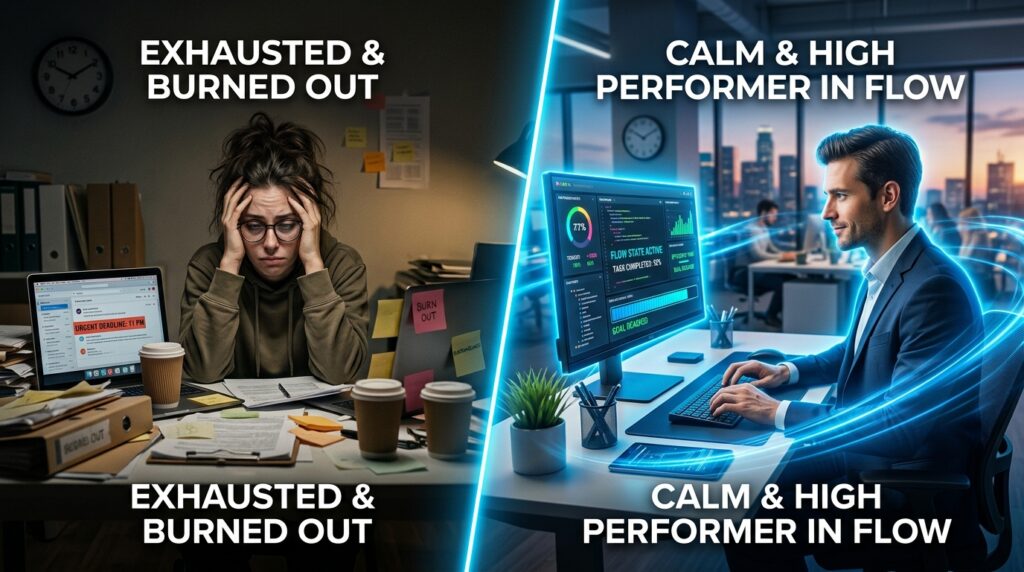
More time = more results.
Ultradian Rhythms & Energy Limits
Your brain isn’t built for endless output.
Peak focus lasts:
- 90–120 minutes
After that:
- Performance drops
- Errors increase
- Motivation fades
Deep Work vs Shallow Work
One hour of flow can produce:
- Breakthrough ideas
- High-quality output
- Real progress
Five hours of shallow work produce:
- Noise
- Busywork
- Burnout
Recovery Protocol: Why Flow Requires Recharge
If your mental energy is constantly drained, sustaining flow becomes impossible. Here are practical ways to rebuild it: How to Improve Mental Health Without Spending Money
Flow is powerful—but expensive.

You can’t stay in it forever.
The Flow Cycle
- Struggle
- Release
- Flow
- Recovery
Skip recovery—and performance collapses.
Recharge Essentials
- Sleep (non-negotiable)
- Nutrition (stable energy)
- Breaks (mental reset)
Recovery isn’t optional.
It’s part of the system.
FAQs About How to Enter Flow State
How long does it take to enter flow state on Demand?
Typically 15–20 minutes. This is the “Struggle Phase,” where your brain transitions into deep focus.
Can you force flow state?
Not directly—but you can create the conditions that make it highly likely.
What kills flow state fastest?
Interruptions. Even a quick distraction can reset your focus cycle.
Is flow state addictive?
It can be highly rewarding, but it’s not harmful when balanced with recovery.
Can beginners achieve flow quickly?
Yes—if they follow structured protocols like the one outlined above.
How often should you aim for flow?
1–3 deep work sessions per day are optimal for most people.
Understanding how to enter flow state gives you a long-term advantage in focus, productivity, and performance.
Conclusion: From Distracted to Dangerous (In the Best Way)
Mastering how to enter flow state is one of the most valuable skills in the modern world.
Flow isn’t a mystery.
It’s a system.
And now—you have it.
You know:
- Why it works
- What blocks it
- How to trigger it
The final shift is simple:
Stop waiting for focus—and start creating it.
Because in a world full of distractions…
The ability to enter flow state on demand isn’t just an advantage.
It’s a superpower.
🚀 Start your first 20-minute flow session right now.
Close this tab, remove distractions, and apply the protocol.