
By 4:30 in the afternoon, something changes. The same person who confidently made a dozen sharp calls before lunch is now staring at a spreadsheet, rereading the same line, unable to decide whether a Slack message needs a reply now or can wait. A minor scheduling conflict that would have taken thirty seconds to resolve in the morning suddenly feels unreasonably hard. Tempers shorten. Emails get shorter and blunter than intended.
This is decision fatigue at work, and it’s one of the most common — and most misunderstood — experiences in modern professional life.
Decision fatigue is the decline in the quality of your choices after a period of sustained decision-making. It’s not about running out of energy in some general sense. It’s specifically about your capacity to weigh options, evaluate trade-offs, and choose well, degrading the more choices you’ve already made that day. And for most professionals, work is essentially a decision-generating machine: what to answer first, what to prioritize, what to say in a meeting, how to phrase a difficult message, whether an idea is worth pursuing.
The good news is that once you understand what’s actually happening — and what isn’t — decision fatigue becomes something you can work with, rather than something that just happens to you.
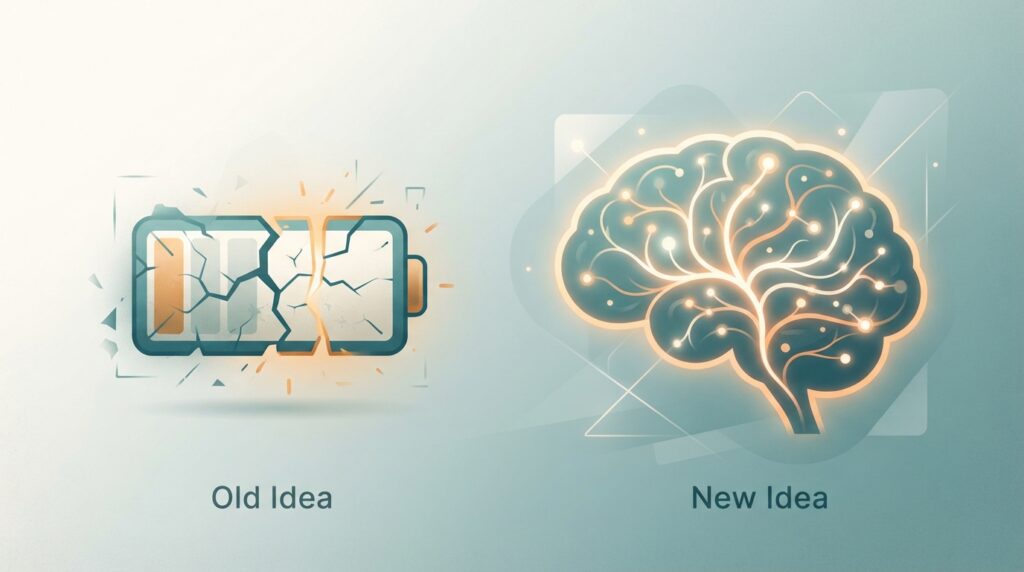
The Real Cause of Decision Fatigue at Work — And Why the ‘Battery’ Myth Doesn’t Hold Up.
For a long time, the explanation for this afternoon crash was simple and tidy: willpower works like a muscle, or a battery. Every decision you make drains it a little. Eventually it runs low, and self-control fails.
This idea, known as ego depletion theory, came out of psychology research from the late 1990s, led by social psychologist Roy Baumeister. It proposed that self-control draws on a limited internal resource — one that could even be tied to blood glucose levels in the brain. The appeal of this explanation is obvious: it’s intuitive, it gives you something to blame, and it comes with an easy fix (rest, eat something, recharge).
Here’s the complication. Over the past decade, as psychology went through a broader reckoning with how reliably its classic findings actually replicate, ego depletion was one of the theories that came under the heaviest scrutiny. A large, preregistered multi-lab replication effort — involving dozens of independent research teams running the same experiments — failed to reliably reproduce the core ego depletion effect. That doesn’t mean fatigue isn’t real. It means the specific mechanism — a literal, physical reservoir of willpower running dry — isn’t well supported by the evidence as it currently stands.
So if it’s not a depleting battery, what is it?
Researchers including Michael Inzlicht have proposed what’s often called a process model of self-control. The idea is that after a stretch of effortful, “have-to” tasks, your brain doesn’t run out of fuel — it shifts its priorities. Attention starts drifting toward things that offer quicker, easier reward. Motivation for hard, effortful work drops, while motivation for low-friction, satisfying activities (checking your phone, tidying your desktop, scrolling the news) rises. It’s less a mechanical failure and more a change in what your brain decides is worth the effort.
That distinction matters practically. If fatigue were a fuel problem, the fix would be rest and food. If it’s a motivational and attentional shift, the more useful fix involves changing the type of task, the environment, or the perceived cost of continuing — not just powering through or grabbing a snack.
It’s also worth being honest that this is an area of active research, not a fully settled question. What’s changed is confidence in the specific “battery” mechanism — not the basic observation that decision-making quality declines with sustained cognitive effort. That part holds up well across multiple lines of evidence, including research on attention and working memory limits.
So What’s Really Happening in Your Brain
A few concepts from cognitive science help explain the pattern more precisely.
Working memory has hard limits. Cognitive load theory, developed by educational psychologist John Sweller, describes how your working memory can only hold a small amount of active information at once. Every unresolved decision, every half-finished task, every piece of context you’re holding onto adds to that load. When the load exceeds capacity, performance doesn’t decline gently — it tends to fall off sharply. This is part of why a cluttered task list feels disproportionately exhausting compared to how much “work” it actually represents. For a deeper look at how this bottleneck functions, see Cognitive Overload Explained.
Every choice carries an opportunity cost, and your brain tracks it. Some researchers frame fatigue through an economic lens: each time you choose to keep working on something effortful, your brain is implicitly weighing that against everything else you could be doing instead — resting, socializing, doing something more immediately rewarding. As the day goes on and the “cost” of continued effort rises relative to its perceived payoff, harder tasks start to feel disproportionately unappealing. This is closely related to why an exhausted brain gravitates toward quick, low-effort rewards — something explored further in Why Your Brain Loves Instant Gratification.
Switching between tasks leaves residue behind. Jumping from one context to another — a client call straight into a budget review, straight into a Slack thread — doesn’t give your brain time to fully disengage from what it was just doing. Some attention stays behind, a phenomenon researchers call attention residue. String enough of these together, as back-to-back meetings often do, and the cumulative effect is a kind of mental fog well before the workday winds down. This ties closely into broader patterns of shortened focus, covered in Why Your Attention Span Feels Shorter.
None of these mechanisms require you to have done anything wrong. They’re describing how cognition generally works under sustained demand — which is exactly why decision fatigue is close to universal in demanding jobs, not a sign of personal weakness.
Where Decision Fatigue Hits Hardest at Work
Not all workplace decisions cost the same. Three categories tend to do the most damage, often without being recognized as decisions at all.

Micro-decisions — email and chat triage. Each message in your inbox or Slack asks something of you: reply now, ignore, flag for later, decide on tone, decide who to loop in. Individually, none of this feels significant. Multiplied across dozens or hundreds of messages a day, it adds up to a steady drip of small decisions that fragment attention long before any “real” work gets touched.
Prioritization — deciding what to do next. When a task list is long and everything feels urgent, the decision about where to start becomes its own drain. This is where cognitive load theory shows up clearly: an unordered list of competing demands occupies working memory just by existing, even before you’ve acted on any of it.
People decisions — feedback, conflict, and difficult conversations. These carry an emotional weight the other two don’t. Delivering hard feedback or navigating a disagreement requires active emotional regulation on top of the decision itself, which draws on much of the same mental capacity used for focused thinking. It’s part of why difficult conversations often get pushed to “later” — and why later so often turns into never.
The Environmental Triggers Making It Worse
Decision fatigue rarely happens in a vacuum. Certain conditions make it worse, and most professionals are working inside several of them at once.
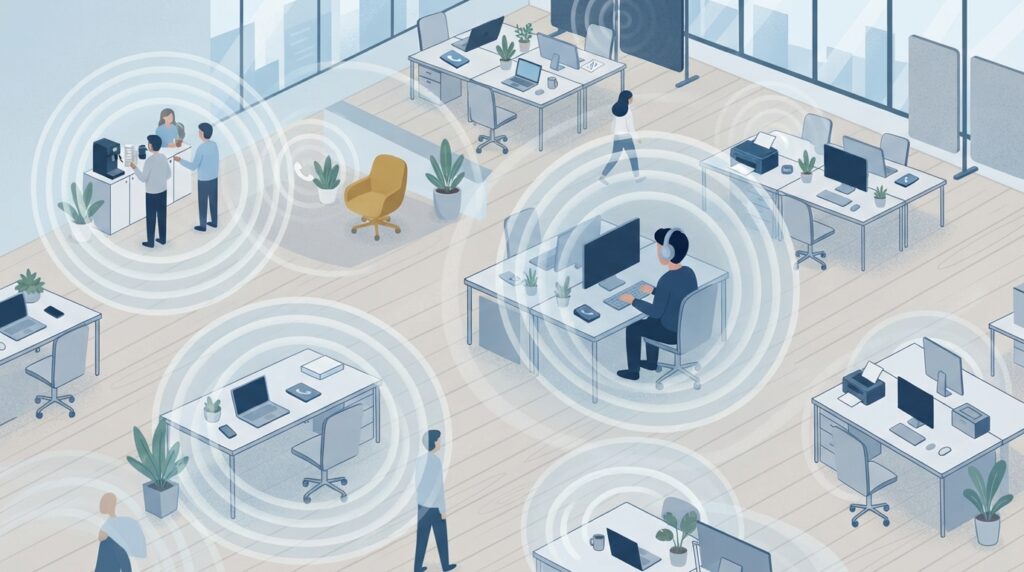
Notifications. Every ping asks your brain, even briefly, to evaluate whether it matters. Even choosing to ignore a notification takes a small amount of attention. Over a full day, that adds up to meaningful cognitive drag — sometimes described as a kind of persistent “attentional itch” that’s hard to fully tune out.
Meeting-heavy calendars. Back-to-back meetings leave no room to mentally close out one conversation before opening the next. The result is compounding attention residue, and by early afternoon, a backlog of half-processed context that makes fresh decisions feel heavier than they should.
Open floor plans. Environments with constant ambient noise and movement ask the brain to continuously filter out background activity just to stay focused. That filtering isn’t free — it’s ongoing cognitive work happening underneath whatever task you’re actually trying to do.
Remote work’s collapsed boundaries. When your workspace and your rest space are the same three feet of couch, the mental effort of staying on task competes directly and constantly with more immediately appealing alternatives. Without a physical transition into or out of “work mode,” that tug-of-war runs all day.
None of these triggers are fixed. Recognizing them is often the first real step toward reducing their pull.
The End-of-Day Pattern: Declining Choices, Shorter Patience
Put these pieces together and a familiar arc emerges. Choices made in the morning tend to be sharper and more considered. By afternoon, the same brain starts favoring the path of least resistance — the safe option, the status quo, the thing that requires the least additional thought. Hard decisions get deferred, often in favor of low-effort busywork that feels productive without requiring much from an already-taxed mind.
Emotional regulation runs through the same overworked circuitry as decision-making. So it’s not a coincidence that the same stretch of the day that produces worse decisions also tends to produce shorter tempers, a curt reply, less patience with a colleague’s question. This isn’t a character flaw showing up at 5 p.m. — it’s the predictable result of a taxed system, and understanding it that way tends to be far more useful than judging it. For more on how sustained overload shapes daily experience, see Always Busy? How Constant Busyness Affects Mental Health.
Common Myths Worth Retiring
“Just power through it.” Pushing harder on an already-fatigued system doesn’t produce more output — it tends to produce the same output more slowly, with more errors. If fatigue is a motivational and attentional shift rather than a depleted resource, forcing continued focus mostly just fights against how the brain is currently allocating its attention.
The daily-uniform idea. The image of a CEO wearing the same outfit every day to “save” decisions for bigger things is a nice story, but it overstates how much cognitive cost a low-stakes, automatic choice like picking clothes actually carries. The real drains on a professional’s day are rarely wardrobe-related — they’re chaotic inboxes, back-to-back meetings, and unclear priorities. Chasing the wrong fix can feel productive while leaving the actual sources of fatigue untouched.
What Actually Helps

On a personal level:
- Match tasks to your energy, not just your calendar. Protect your sharpest hours — often earlier in the day — for the decisions that genuinely need careful thought. Push lower-stakes, routine choices to later.
- Batch similar decisions together. Checking messages continuously throughout the day multiplies the cost of context-switching. Set a few dedicated windows instead of leaving communication channels open by default.
- Build a short shutdown routine. Spending even ten to fifteen minutes at day’s end reviewing what’s unfinished and naming tomorrow’s priorities clears working memory rather than carrying that load, unresolved, into the evening.
- Use if-then planning for recurring hard decisions. Deciding in advance — “if it’s 10 a.m., I close my inbox and start the report” — removes the in-the-moment decision entirely, which is often where fatigue does the most damage.
- Take breaks that actually disengage. Scrolling a phone during a break keeps working memory active. Stepping away from screens, even briefly, gives your attentional system more of a genuine reset.
On an organizational level:
- Rethink default meeting lengths. Even a small built-in buffer between meetings — trimming a 30-minute block to 25, or an hour to 50 — gives people a chance to mentally close one conversation before opening the next.
- Clarify who actually decides. Ambiguity about ownership turns simple choices into slow, anxious ones. Clear frameworks for who is responsible, who is consulted, and who makes the final call reduce unnecessary deliberation.
- Normalize asynchronous communication. Not every message needs an instant reply. Explicit expectations around response time — rather than an unspoken assumption of constant availability — reduce the low-grade vigilance that notifications create.
- Be deliberate about high-stakes conversations. Difficult feedback or conflict resolution deserves a time slot when people have capacity for it, not the last item squeezed in after a long day of triage.
FAQ
What is decision fatigue? Decision fatigue is the tendency for the quality of a person’s decisions to decline after a period of sustained decision-making, as attention and motivation shift away from effortful, considered choices toward easier, lower-effort ones.
Is decision fatigue the same as burnout? No. Decision fatigue is a shorter-term dip in decision-making capacity that can build across a single day and typically resets with rest. Burnout is a more prolonged state of exhaustion, cynicism, and reduced effectiveness that develops over weeks or months of sustained stress. Chronic, unaddressed decision fatigue can be one contributing factor among many in the development of burnout.
Does eating something help with decision fatigue? The evidence for this is weaker than commonly assumed. Earlier theories tied fatigue directly to blood glucose levels, but that mechanism hasn’t held up well under closer scrutiny. A meal or snack may help simply by giving you a genuine break from decision-making, rather than through any special replenishing effect on willpower itself.
What’s the single most useful change to make first? For most people, reducing the number of small decisions made throughout the day — through batching communication and using if-then planning for recurring choices — tends to produce a noticeable difference faster than any single organizational change.
This article is intended for educational purposes and should not be considered medical, psychological, or mental health advice. If work-related exhaustion or stress is significantly affecting your daily functioning, consulting a qualified healthcare or mental health professional may be helpful.

