
If you’ve ever felt a flicker of panic when your partner goes quiet, or caught yourself needing to hear “we’re okay” more than once a day, you’ve probably also felt the next wave: am I too dependent on this person?
That question has become almost reflexive. Somewhere in the last decade, popular psychology quietly rewrote the rules of intimacy. Needing someone got recast as a red flag. Wanting reassurance became evidence of anxious attachment. And independence — the ability to function as though you needed no one — got treated as the finish line of emotional maturity.
Here’s the problem: that framing isn’t quite right, and it leaves a lot of people feeling ashamed of something completely ordinary.

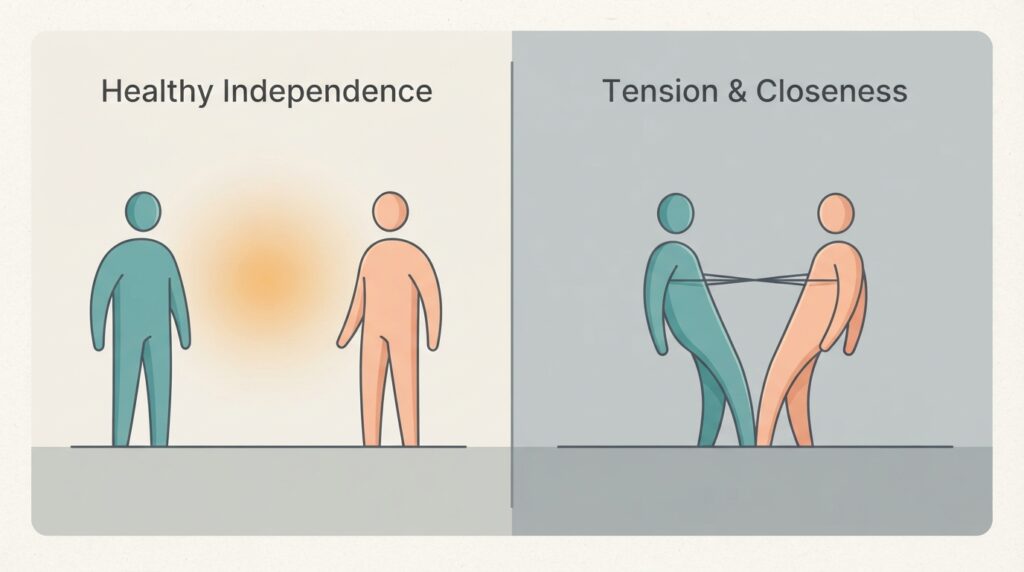
Emotional safety and emotional dependence can look similar from the outside — both involve leaning on a partner — but they run on different fuel. Emotional safety is connection chosen from a place of security; it can flex, disagree, and tolerate distance without falling apart. Emotional dependence is connection driven by fear of what happens if the bond wavers; it has a harder time with distance, disagreement, or not being reassured on demand.
The rest of this article is about learning to tell those two apart in your own relationship — not by score or checklist, but by noticing what’s actually driving the need to connect.
In this article:
- What Emotional Safety Actually Means
- What Emotional Dependence Actually Means
- The Real Dividing Line
- What This Looks Like Day to Day
- Why “Just Be More Independent” Is Bad Advice
- If You’re Working on This — Together
- FAQ
What Emotional Safety Actually Means
Emotional safety, in the way relationship researchers generally use the term, is the sense that you can be honest, upset, needy, or wrong in front of your partner without the relationship itself coming under threat. It’s not the absence of conflict. It’s confidence that conflict won’t dissolve the bond.
This idea has deep roots in attachment theory — the body of research, originating with John Bowlby and later extended by Mary Ainsworth and others, on how humans form and rely on close bonds throughout life. One of its more counterintuitive findings is what researchers sometimes call secure base behavior: people who feel securely attached to a partner tend to explore the world more freely, not less, because they trust there’s a stable place to return to. The psychologists Amir Levine and Rachel Heller popularized this as the “dependency paradox” in their book Attached — the idea that reliable emotional support tends to produce more independence, not less.

Some clinicians also describe emotional safety through the lens of co-regulation: the way a calm, attuned partner can help settle your nervous system, the same way a parent’s steady presence calms a distressed child. This idea draws partly on polyvagal theory, a framework developed by Stephen Porges that’s widely used in couples and trauma therapy — though it’s worth noting the underlying physiology is still debated among researchers, and it’s best treated as a useful lens rather than settled fact. What’s less contested is the plain behavioral pattern: people in emotionally safe relationships generally recover from an argument, a bad mood, or a few hours of silence without those things spiraling into a threat to the relationship itself.
What Emotional Dependence Actually Means
Emotional dependence describes a pattern where a person’s sense of stability — their mood, self-worth, even their ability to function day to day — becomes so tied to a partner’s presence or approval that ordinary relational friction feels dangerous. It’s not about how much someone relies on a partner. It’s about what happens when that reliance isn’t immediately met.
Codependency Isn’t a Diagnosis — Here’s What the Term Actually Describes
“Codependency” gets used constantly in this conversation, usually as a catch-all insult for anyone who needs their partner. It’s worth being precise here: codependency is not a diagnosis in the DSM-5. It originated in addiction-recovery literature to describe a specific, more severe dynamic — one partner organizing their identity around managing, enabling, or controlling another’s destructive behavior, often losing their own needs and boundaries in the process.
That’s a meaningfully different thing from wanting a hug after a hard day, feeling hurt when you’re ignored, or wanting to talk through a disagreement before bed. Those are just needs. Calling them codependent doesn’t make them clinically accurate — it just makes people feel bad for being human. If you want to go deeper on where healthy reliance ends and dysfunction begins, our guide to setting boundaries in relationships covers that line in more detail.

Emotional Safety vs. Emotional Dependence: The Real Dividing Line
If it isn’t about how much someone relies on their partner, what actually separates safety from dependence? Three things tend to travel together.
| Emotional Safety | Emotional Dependence | |
|---|---|---|
| What drives the need for connection | Choice — reaching out because it feels good, not because distance feels dangerous | Fear — reaching out to relieve distress or avoid a feared loss |
| Sense of self | Identity stays intact; “I” exists distinctly from “us” | Identity blurs into the relationship; mood and self-worth track the partner’s |
| Response to distance or disagreement | Tolerable, sometimes even welcome | Threatening, hard to sit with |
None of these show up in isolation. A person who reaches for their partner mainly to relieve anxiety (motivation) usually also struggles to hold a separate sense of self-worth (identity) and finds even brief distance unsettling (tolerance of separateness). The three tend to reinforce each other — which is also why shifting one, over time, tends to loosen the others.
It’s worth saying plainly: almost everyone touches the “dependence” side of this sometimes. A bad week, an insecure moment, a fight that goes badly — these can temporarily pull anyone toward fear-driven reaching. The distinction that matters is which pattern is the default, not whether the fear-driven one ever shows up at all.
What This Looks Like Day to Day
Theory is one thing; a Tuesday night is another. Here’s how the same situations tend to play out differently depending on which pattern is running the show.
When a partner is unusually quiet or in a bad mood. In a secure dynamic, the other partner might notice, check in once, and then go about their evening — trusting that the mood is about the day, not about them. In a dependence-driven dynamic, the quiet often gets read as a threat: something to investigate, fix, or head off with a flurry of texts, because sitting with the uncertainty feels unbearable.
During disagreement. Emotional safety allows for “I disagree with how you handled that” without either partner fearing it’s a step toward the relationship ending. Relationship researcher John Gottman’s work on conflict patterns has found that certain communication habits — like contempt and stonewalling — are far more predictive of relationship trouble than disagreement itself. Dependence tends to produce one of two extremes: either conflict gets avoided altogether — real opinions go unspoken to keep the peace — or it escalates fast, with a felt need to resolve everything immediately because unresolved tension is genuinely hard to tolerate.
Reassurance-seeking. Wanting reassurance isn’t itself a warning sign — everyone needs it sometimes. The difference is in the shape of it. Safety-driven reassurance tends to be specific and finite: “I felt insecure about that comment, can we talk about it?” — and once it’s addressed, the anxiety actually settles. Dependence-driven reassurance tends to repeat: asking “are we okay?” multiple times, needing to hear it again shortly after already hearing it, because the relief doesn’t hold.
Time apart. In safety, separateness — a solo trip, a night with friends, a quiet weekend alone — tends to be experienced as room to breathe rather than a threat. In dependence, any contact gap can trigger real distress, disproportionate to what’s actually happening.

New Relationships Are Different — and That’s Not a Red Flag
One place this gets genuinely confusing: the first several months of a new relationship can look a lot like dependence even when nothing is wrong. Constant texting, intrusive thoughts about a new partner, difficulty concentrating on anything else — this is largely what researchers studying limerence, an intense early-romance state, describe as a normal (if intense) part of pair-bonding, tied to shifts in dopamine and related reward-system activity.
The distinguishing feature isn’t intensity — it’s trajectory. Early-relationship intensity, for most people, gradually settles as the relationship stabilizes and normal life resumes its shape. Dependence-driven patterns tend not to settle on their own; if anything, they tend to persist or deepen over time. If you’re a few months into something new and slightly obsessed, that’s probably just what new love does to a brain. If you’re years in and the intensity hasn’t changed, that’s worth a closer look.
Why “Just Be More Independent” Is Bad Advice
A lot of relationship content, in trying to correct for unhealthy dependence, overcorrects into a different problem: treating any emotional reliance as weakness, and holding up self-sufficiency as the goal.
This isn’t well supported by what’s known about human attachment. Humans are a highly social species, and NIH-funded research on relationships has consistently linked strong social bonds to better mental and physical wellbeing — the drive to seek comfort from a trusted person isn’t a bug to be engineered out; it’s baseline wiring. The “dependency paradox” that Levine and Heller describe cuts the other way — people with a stable, dependable source of emotional support tend to take more risks and operate with more independence in the rest of their lives, not less, because they’re not spending energy managing relational uncertainty.
What often gets labeled as admirable independence — never needing anyone, handling everything solo, discomfort with closeness — is sometimes closer to an avoidant pattern than a healthy one: a way of keeping intimacy at arm’s length so it can’t disappoint. The goal isn’t independence or reliance. It’s reliance that doesn’t cost you your sense of self — sometimes called healthy interdependence.
If You’re Working on This — Together

Most people aren’t purely one pattern or the other, and most couples end up with one partner leaning slightly more toward fear-driven reaching and the other leaning slightly more toward needing space. Both roles have work to do.
If you notice yourself leaning toward dependence:
- When the urge to seek immediate reassurance hits, try building in even a short pause before acting on it — long enough to ask whether the fear matches what’s actually happening.
- Keep something in your life — a hobby, a friendship, a solo routine — that’s genuinely yours, not shared. It’s a small, steady reminder that your identity doesn’t collapse without the relationship.
- When your partner pulls back, try writing down the story your mind is telling you (“they’re losing interest”) next to what you actually know to be true. The gap between the two is often the real source of the panic.
If you’re the one who tends to need space:
- When you step back, say so out loud instead of just disappearing. “I need an hour to myself, then I’d love to catch up” lands very differently than silence.
- Offer reassurance before it’s asked for occasionally. A short, unprompted “thinking of you” can do more for a partner’s sense of security than a longer conversation after the anxiety has already built.
- During conflict, try naming the feeling before addressing the issue: “I can see this is stirring up something for you, and we’re okay” — then get into the substance of the disagreement.
A couple of small scripts, if the words don’t come easily in the moment:
Instead of “Why are you being so distant, did I do something?” — try “I’m noticing some distance, and it’s making me a little anxious. Are we okay, or do you just need some space?”
Instead of “I need you to leave me alone” — try “I love you, and I need an hour to recharge — I’ll be more present once I’ve had it.”
Neither script is about performing calm. They’re just a way of saying the true thing without the fear or the withdrawal doing the talking instead. If you’re curious where your own patterns come from, our guide to attachment styles is a good next stop.

The Bottom Line
Needing your partner isn’t a diagnosis. Wanting closeness, reassurance, or comfort from someone you love is not a character flaw — it’s what humans are built for. The question worth asking isn’t do I need them too much, but what’s underneath the need in this moment — choice, or fear. That shift in attention, more than any checklist, is usually where the real change starts.
This article is intended for educational purposes and should not be considered medical, psychological, or mental health advice. If relationship patterns are significantly affecting your daily functioning or well-being, consulting a qualified therapist or counselor may be helpful.
FAQ
Is it normal to depend on my partner emotionally? Yes. Relying on a partner for comfort, reassurance, and emotional support is a normal, healthy part of close relationships — not a sign of weakness or dysfunction on its own.
What’s the difference between codependency and emotional dependence? Codependency, as the term originated, describes a specific and more severe pattern — usually organizing your identity around managing or enabling a partner’s destructive behavior. It’s not a clinical diagnosis. Everyday emotional dependence is a broader, more common pattern where a person’s stability relies heavily on their partner’s presence or approval.
How do I know if I’m emotionally dependent or just in love? Early-relationship intensity tends to settle over time as the relationship stabilizes. Emotional dependence tends to persist or deepen rather than settle. Trajectory, more than intensity, is usually the better indicator.

