
You can have a genuinely good time with people and still come home feeling completely mentally drained after socializing.
Maybe you laughed, talked for hours, and enjoyed the evening. Nothing went wrong. Yet once you close the door behind you, you want silence. No messages. No conversation. Just a little time alone.
That experience can feel confusing.
If you enjoy people, why do you sometimes feel exhausted by them?
The answer is more nuanced than simply saying that you have a “small social battery.” Social interaction can involve attention, emotional regulation, self-monitoring, decision-making, and constant interpretation of other people’s signals. How demanding that becomes depends on the situation, your personality, your current stress level, and even how stimulating the environment is.
For many people, social exhaustion is not a sign that they dislike others. It may simply mean that an interaction required more mental and emotional effort than they noticed at the time.
What Does Feeling Drained After Socializing Actually Mean?

Feeling drained after socializing generally refers to a temporary sense of mental, emotional, or physical fatigue following social interaction.
It isn’t a formal medical diagnosis. People use terms such as social exhaustion, social fatigue, or “social battery” to describe the experience.
The important distinction is that socializing can be enjoyable and tiring at the same time.
| What you experience | What it may mean |
|---|---|
| You enjoyed the gathering but want silence afterward | You may need recovery from prolonged stimulation |
| You feel mentally tired rather than physically exhausted | The interaction may have required sustained attention |
| You want to be alone for a while | Solitude may help you transition out of a socially demanding environment |
| You feel tired after large groups but fine with close friends | The type of interaction may matter more than socializing itself |
| You feel anxious before and during nearly every social situation | Anxiety may be contributing and deserves a different consideration |
So if you occasionally leave a gathering thinking, “That was fun, but I’m done for today,” there may be nothing unusual about the experience.
Why Do You Feel Mentally Drained After Socializing?
Social interaction looks simple from the outside. You’re just talking.
But your mind is doing considerably more than producing words.
During a conversation, you’re listening, interpreting meaning, deciding how to respond, watching facial expressions, remembering previous information, judging timing, and adapting your behavior to the situation.
That doesn’t mean the brain is literally “running out of energy.” It’s more accurate to think of prolonged interaction as a situation involving continuous mental processing.
Your brain is processing more than the conversation
Imagine sitting at dinner with five people.
One person is telling a story. Someone else interrupts. Another person laughs. You notice a change in someone’s tone. You decide whether to add something to the conversation. Meanwhile, you’re remembering what someone said five minutes earlier.
None of these actions feels particularly difficult on its own.
Together, however, they create a considerable amount of ongoing processing.
Social interaction can create cognitive load
Cognitive load refers broadly to the demands placed on your mental processing capacity.
A simple conversation with someone you know well may require relatively little conscious effort.
A conversation with unfamiliar people can be different.
You may be thinking:
“What should I say next?”
“Did they mean that seriously?”
“Should I join this conversation?”
“Am I talking too much?”
The more mental monitoring involved, the more demanding the interaction may feel.
Why You Can Feel Drained Even When You Had Fun

This is one of the most important points in understanding social exhaustion:
Enjoyment doesn’t cancel out effort.
You can enjoy a football match and still feel tired afterward. You can enjoy travelling and still need sleep when you get home.
Social interaction can work similarly.
| Situation | Possible reason it feels demanding |
|---|---|
| Dinner with close friends | Long conversation and sustained attention |
| Meeting new people | Uncertainty and self-monitoring |
| Family gathering | Emotional expectations and multiple conversations |
| Party | Noise, movement and many social cues |
| Deep conversation | Greater emotional involvement |
| Professional networking | Communication plus impression management |
This is why saying “I’m tired because I don’t like people” is often an unnecessarily harsh interpretation.
Sometimes you liked the people.
You simply needed a break afterward.
Why Introverts May Feel Drained After Socializing
Introversion is often misunderstood.
An introvert isn’t necessarily shy, antisocial, socially anxious, or uncomfortable around people.
An introverted person can have close friendships, enjoy parties, communicate confidently, and still prefer periods of solitude.
The mistake is turning personality differences into rigid rules.
Introversion is not the same as shyness
Introversion describes a personality tendency.
Social anxiety, by contrast, involves significant fear or anxiety around social situations and concerns about being judged, embarrassed, or scrutinized. NIMH notes that social anxiety disorder can interfere substantially with everyday life.
That distinction matters.
An introvert might say:
“I really enjoyed tonight. I just need some quiet now.”
Someone experiencing significant social anxiety might instead think:
“I don’t want to go because I’m terrified people will judge me.”
Those are not the same experience.
Introverts don’t necessarily need less connection
They may simply prefer different forms of connection.
A quiet conversation with one close friend can feel completely different from spending three hours in a crowded room.
The useful question isn’t:
“How social am I?”
It may be:
“Which kinds of social interaction leave me feeling connected, and which ones leave me depleted?”
Can Ambiverts Feel Mentally Drained After Socializing?

Absolutely.
You don’t have to identify strongly as an introvert to experience social fatigue.
Some people enjoy being around others but also enjoy substantial periods of solitude. Their experience can shift depending on the context.
And even someone who normally loves socializing may feel drained after a particularly demanding day.
Your social capacity isn’t fixed
Think about these two days:
| Day A | Day B |
|---|---|
| Slept well | Slept poorly |
| Low workload | Heavy workload |
| Relaxed afternoon | Already stressed |
| One familiar friend | Large unfamiliar group |
| Quiet café | Loud crowded venue |
You are still the same person.
But your experience of socializing could be completely different.
That’s why “social battery” is useful as a metaphor, but it shouldn’t be treated as a precise biological measurement.
Why Socializing Can Feel More Exhausting in Certain Situations
Not all social interaction places the same demands on you.
The type of interaction may matter as much as its duration.
Large groups and constant conversation
A group can require you to monitor several conversations and social cues simultaneously.
You may have fewer natural pauses to mentally reset.
Unfamiliar people
Meeting someone new can introduce uncertainty.
You may spend more time thinking about what to say, how to respond, and how you’re being perceived.
Noisy environments
A crowded restaurant, party, or busy workplace can add competing sounds and visual information.
The social interaction isn’t happening in isolation. Your environment is part of the experience.
Emotionally demanding conversations
Talking about grief, conflict, relationship problems, or personal fears can require much more emotional involvement than casual conversation.
Having to appear a certain way
Sometimes the tiring part isn’t simply talking.
It’s managing yourself while talking.
You might be tired but trying to appear energetic. You might be annoyed but staying polite. You might feel anxious but trying to look confident.
This kind of emotional regulation can add another layer of effort.
Emotional Labor Can Make Social Interaction More Demanding
Emotional labor refers broadly to managing emotional expressions and behavior to meet the expectations of a situation.
It’s especially visible in workplaces.
A customer-service employee may need to remain friendly after a difficult interaction. A manager may need to stay calm during conflict. A friend may suppress their own frustration while supporting someone else.
Research on emotional labor suggests that its effects aren’t simple. Different forms of emotional regulation can have different consequences, and surface acting—displaying emotions that don’t match what you actually feel—has been associated with less favorable outcomes in research.
That doesn’t mean every time you smile when you’re tired you’re harming yourself.
It means that repeatedly managing an emotional display under demanding circumstances can become another source of psychological effort.
Why Do You Sometimes Feel Drained Hours After Socializing?
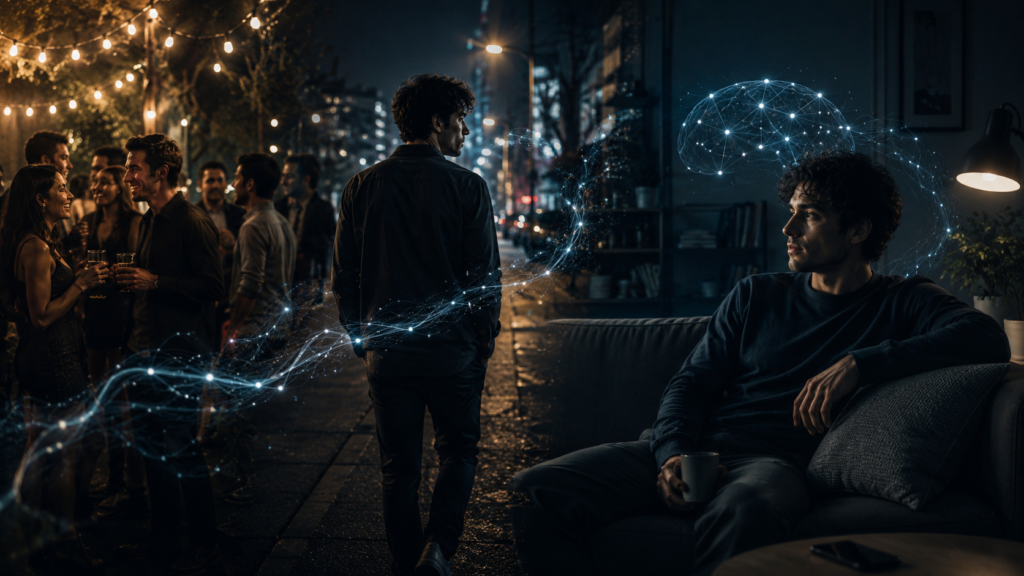
This delayed experience is particularly interesting.
You may leave a gathering feeling perfectly fine.
Then two hours later:
You suddenly feel exhausted.
Research using experience-sampling methods has found that more sociable/extraverted behavior can be followed by greater tiredness later, including fatigue reported around two to three hours afterward. This is one reason the experience may seem to “appear out of nowhere.”
You finally get home.
The stimulation stops.
Nobody needs an immediate response.
There is no conversation to follow.
And that’s when you notice how tired you actually are.
The important point is not that every person experiences a specific two- or three-hour delay. Rather, fatigue following social interaction does not necessarily appear immediately.
Social Exhaustion vs. Social Anxiety: What’s the Difference?
These experiences can overlap, but they shouldn’t be treated as identical.
| Social exhaustion | Social anxiety |
|---|---|
| Often appears after prolonged interaction | Can occur before or during social situations |
| Can happen after enjoyable events | Often involves fear of judgment or scrutiny |
| Main experience may be tiredness or overstimulation | Anxiety and fear are central |
| Solitude may feel refreshing | Avoidance may become increasingly important |
| Not itself a formal diagnosis | Can be a diagnosable mental health condition |
| May simply reflect a demanding social experience | May significantly interfere with everyday functioning |
If social situations consistently produce intense fear, avoidance, or significant interference with work, education, relationships, or everyday life, it may be worth discussing the experience with a qualified mental health professional.
Feeling tired after a party by itself doesn’t mean you have social anxiety.
How to Recover When You’re Mentally Drained After Socializing
Recovery doesn’t have to mean disappearing from everyone.
Often, it simply means giving your mind a chance to shift gears.
Give yourself a transition period
Going directly from a crowded gathering into another demanding task may make the fatigue feel worse.
A short period of quiet can provide a useful transition.
Reduce stimulation
You might prefer:
- a quiet room
- a shower
- a short walk
- reading
- calm music
- sitting without your phone
- a simple routine before bed
The specific activity matters less than whether it genuinely helps you settle.
Don’t stack every social commitment together
If possible, avoid turning every evening into another demanding event.
A little space between commitments can make social life feel more sustainable.
Protect your sleep
Sleep isn’t a special “social exhaustion treatment.” It’s simply an important part of normal mental and physical recovery.
If you’re already sleep-deprived, an intense day of work followed by several hours of social interaction may naturally feel harder.
Take short breaks when you can
A systematic review and meta-analysis of workplace micro-break research found small improvements in vigor and reductions in fatigue following brief breaks, although the evidence did not show a clear overall improvement in performance.
The lesson is useful but modest:
Short breaks can help with fatigue; they aren’t a magical reset button.
How to Find Your Own Social Exhaustion Pattern
Instead of asking:
“Why am I like this?”
Try asking:
“What exactly about that situation was tiring?”
You can observe your experience using three simple stages.
| Before | During | After |
|---|---|---|
| How well did I sleep? | Was the environment noisy? | Did I want silence? |
| Was I already stressed? | Was I monitoring myself? | How mentally tired did I feel? |
| Was I looking forward to it? | Was the conversation emotionally heavy? | How long did recovery take? |
| Did I have other commitments? | Was I with familiar people? | What actually helped me recover? |
After a few experiences, patterns may become easier to see.
Perhaps you aren’t exhausted by people.
Maybe you’re exhausted by:
large groups + noise + unfamiliar people + long conversations.
That’s a much more useful discovery.
Does Feeling Drained After Socializing Mean You Should Socialize Less?
Not necessarily.
Avoiding people completely isn’t automatically the solution.
Human connection can be meaningful, supportive, and enjoyable. The goal is not to eliminate social interaction simply because some interactions are tiring.
Instead, experiment with the variables you can control.
| Instead of asking… | Try asking… |
|---|---|
| “Why can’t I handle people?” | “Which situations drain me most?” |
| “Should I stop socializing?” | “What type of socializing suits me?” |
| “Why am I so antisocial?” | “Do I need recovery time?” |
| “Why does everyone else seem fine?” | “What affects my own capacity?” |
| “Is something wrong with me?” | “What pattern am I noticing?” |
That shift can be surprisingly reassuring.
You don’t have to compare your social capacity with somebody else’s.
When Should You Pay More Attention to Social Exhaustion?

Occasional tiredness after socializing is one thing.
It may be worth paying closer attention if exhaustion is persistent, worsening, or interfering with everyday functioning, especially if it occurs even when you haven’t been socially active.
For example, consider seeking professional guidance if you’re also experiencing significant:
- anxiety
- low mood
- sleep problems
- concentration difficulties
- avoidance of everyday activities
- difficulty functioning at work or school
These experiences can have many possible explanations, so they shouldn’t be self-diagnosed from an article about social exhaustion.
This article is educational and isn’t a substitute for professional psychological or medical advice.
Frequently Asked Questions
Why do I feel mentally drained after socializing?
Social interaction can require sustained attention, interpretation of social cues, emotional regulation, and sometimes self-monitoring. The combination can leave some people feeling mentally tired afterward, particularly following long, intense, or highly stimulating interactions.
Is it normal to feel tired after socializing?
Yes. Feeling tired after a demanding social experience can be a normal response. It doesn’t automatically mean you dislike people or have a mental health problem.
Why do introverts feel drained after socializing?
Some introverted people may prefer lower-stimulation environments or more time alone between social activities. However, introversion doesn’t automatically mean someone becomes exhausted by social interaction.
Can extroverts experience social exhaustion?
Yes. Social fatigue isn’t exclusive to introverts. The amount of interaction, emotional intensity, environment, stress, sleep, and individual circumstances can all influence how tiring an experience feels.
Why am I exhausted after socializing even when I had fun?
Enjoyment and effort can coexist. You can genuinely enjoy an experience while still spending substantial attention and emotional energy during it.
Is social exhaustion the same as social anxiety?
No. Social exhaustion generally refers to tiredness following social interaction, while social anxiety involves significant fear or anxiety related to social evaluation and can interfere with everyday life.
How can I recover after socializing?
A quiet transition period, reduced stimulation, adequate sleep, reasonable boundaries, and short breaks may help. The best recovery approach differs from person to person.
Conclusion
Feeling mentally drained after socializing doesn’t automatically mean you dislike people, lack social skills, or need to isolate yourself. A conversation can be meaningful and still require attention. A party can be fun and still be overstimulating. A deep conversation can strengthen a relationship and still leave you needing quiet afterward.
Instead of judging that reaction, get curious about it.
Notice who you were with, where you were, how long you stayed, what the interaction demanded from you, and how you felt afterward.
You may eventually discover that your problem isn’t that you have a “bad social battery.”
You simply have a better understanding of what your mind needs after being socially engaged.

