
Picture a quarterly product review. Leadership lays out an aggressive launch timeline. Near the back of the room, a senior engineer spots a flaw in the plan — something that will almost certainly break under real-world load.
The executive glances around the table. “Any concerns before we lock this in?”
The engineer starts typing a note, hesitates, deletes it, and says nothing. Heads nod. The meeting ends. Months later, the flaw surfaces exactly as predicted.

When something like this happens, the usual post-mortem question is: why didn’t anyone say something? The usual answer — the one that shows up in most management books and HR trainings — is that the person lacked confidence.
That answer is worth questioning. Research on organizational silence points somewhere else: often, silence isn’t a personal deficit at all. It’s a rational response to what a workplace has taught someone about the cost of speaking up.
Why You’re Afraid to Speak in Meetings
Researchers define employee silence as the conscious withholding of ideas, concerns, or information that could be useful to the organization. It isn’t the same as having nothing to say. It’s a decision — often made in a split second — to hold back something that could matter.
Frances Milliken and Elizabeth Wolfe Morrison, two of the most-cited researchers on this topic, describe silence as a widespread and largely invisible pattern: employees across industries and levels regularly choose not to raise concerns to the people who could act on them, even when they believe those concerns are legitimate. That’s a strikingly different picture from “some people just aren’t confident speakers.”
This article is about why that happens — the brain science behind it, the psychological patterns that sustain it, and the practical, evidence-grounded ways individuals and leaders can actually change it.
Why People Are Afraid to Speak in Meetings
To understand why a mildly awkward moment in a meeting can feel disproportionately threatening, it helps to start with biology rather than personality.
For most of human history, being excluded from the group wasn’t a social inconvenience — it was a survival threat. A person cut off from the tribe faced predators, exposure, and starvation alone. Evolutionary psychologists argue that this pressure shaped a nervous system that treats social exclusion as urgently as physical danger, because for most of our history, it effectively was physical danger.
That wiring hasn’t updated for open-plan offices and video calls. The brain doesn’t have a separate, lower-priority alarm for “your idea got ignored in the meeting” versus “you are in physical danger.” It runs the same basic threat circuitry either way.
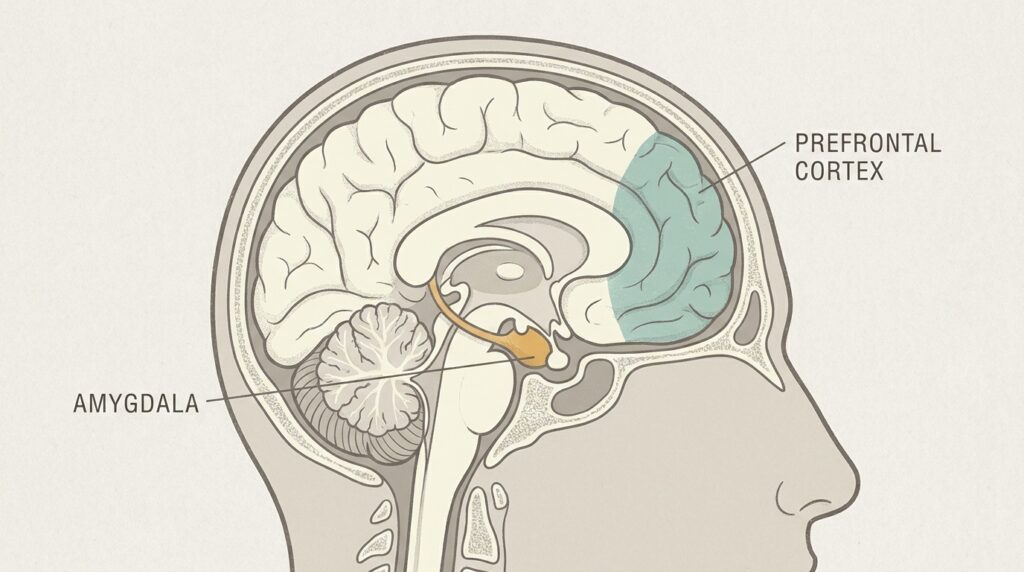
The amygdala, a small structure deep in the brain, acts as an early threat detector. When it registers a social risk — an interruption, a dismissive tone, a raised eyebrow from someone senior — it can trigger the same stress response used for physical threats: a flood of cortisol and adrenaline, a shift toward defensive alertness, and a redirection of energy away from complex thought and toward instinct.
This matters because that redirection has a cost. The prefrontal cortex, which handles reasoning, articulate speech, and weighing tradeoffs, runs on the same limited resources the stress response is busy consuming. In the middle of a perceived social threat, the part of the brain best equipped to construct a clear, persuasive objection is precisely the part getting the least support.
Social Pain Is Processed Like Physical Pain
This isn’t just metaphor. In a widely cited 2003 study published in Science, researchers Naomi Eisenberger, Matthew Lieberman, and Kipling Williams used fMRI scans to observe what happens in the brain during social exclusion. Participants were left out of a simple ball-tossing game while being scanned, and the dorsal anterior cingulate cortex — a region also active during physical pain — showed increased activity that tracked closely with how much distress people reported feeling.
Later work by Eisenberger and Lieberman built on this, proposing that social and physical pain may share a common neural alarm system, one that evolved to make disconnection from the group feel urgent and aversive precisely because disconnection used to be so costly.
None of this means every hesitation in a meeting is a full-blown threat response. But it explains why the fear of speaking up so often feels bigger than the stakes seem to warrant on paper. Biologically, it isn’t overreacting — it’s an old system doing its job in a modern setting it was never designed for.
Three Patterns That Turn Individual Fear Into Team-Wide Silence
Brain chemistry explains why one person hesitates. It doesn’t fully explain why entire teams go quiet in the same meeting, week after week. For that, three well-established patterns from organizational psychology are useful.
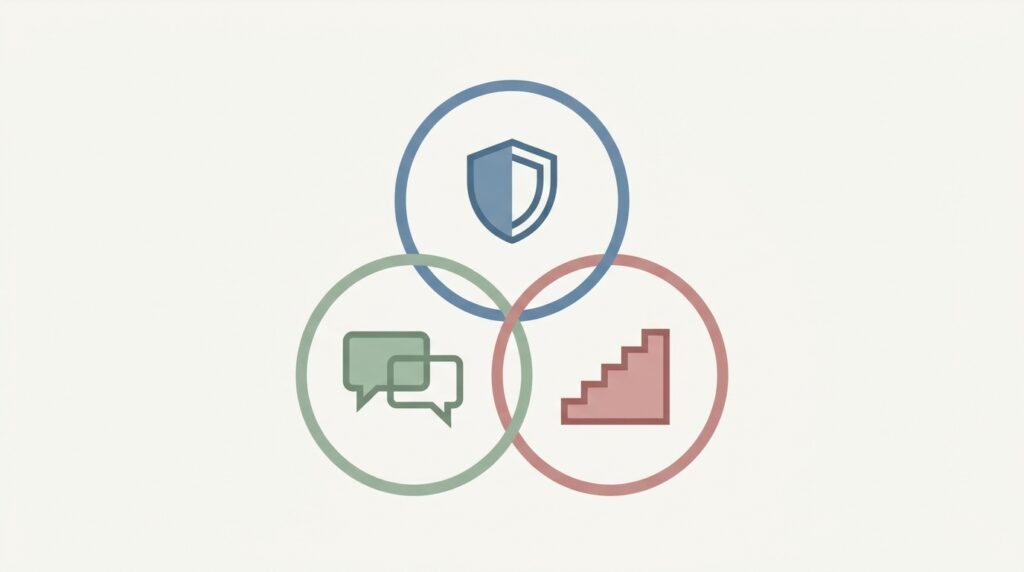
1. Psychological Safety
Harvard Business School researcher Amy Edmondson coined the term psychological safety in 1999, defining it as a shared belief among team members that the team is a safe place to take interpersonal risks. Her research — including a well-known finding from hospital teams — found that groups with higher psychological safety actually reported more errors, not fewer, because people felt able to surface problems instead of hiding them. Those same teams tended to perform better over time, precisely because visible problems are problems you can fix.
Where psychological safety is missing, a quieter and more damaging calculation takes over. Before saying anything, people run a fast, largely unconscious cost-benefit analysis: If I raise this, what happens to how I’m seen? When the perceived cost of looking wrong, difficult, or disloyal outweighs the perceived benefit of being heard, staying quiet becomes the more sensible option — not the more cowardly one.
2. Pluralistic Ignorance
The second pattern explains how a whole room can go quiet even when most people privately disagree with what’s happening. Social psychologist Floyd Allport described this in 1928 as pluralistic ignorance: a situation where most members of a group privately reject an idea or norm but publicly go along with it, each one wrongly assuming everyone else has genuinely accepted it.
In a meeting, this looks like several people independently noticing the same flaw, each one staying quiet because no one else has raised it yet, each one interpreting the silence around them as agreement rather than shared hesitation. The room reads as unanimous. It usually isn’t. This dynamic is one of the well-documented contributors to groupthink — the tendency for group cohesion and a desire for harmony to override honest appraisal of a flawed plan.
3. Hierarchy and Status Signaling
The third pattern is structural rather than psychological. Organizational behavior research has long shown that hierarchy shapes who gets heard, independent of the quality of what they have to say. Who opens the meeting, who gets interrupted without pushback, who is copied on which threads, whose framing of a problem becomes the default — these are all status signals, and lower-status employees generally read them accurately.
When a senior leader opens a discussion by spending several minutes laying out their own conclusion before anyone else has spoken, they aren’t just sharing an opinion. They’re signaling that the decision is largely settled — and that challenging it now carries a distinctly different social cost than it would have carried five minutes earlier.
The High-Performer Paradox
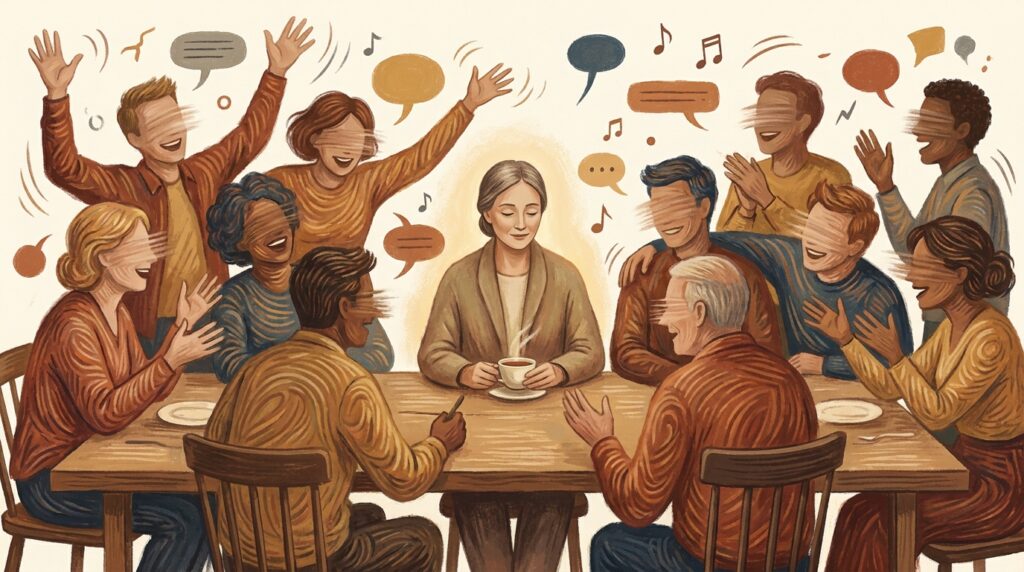
Here’s the pattern that most workplace advice misses entirely: it’s frequently the most capable, most perceptive people who stay quietest.
That sounds counterintuitive until you look at what makes someone good at their job in the first place.
They read risk accurately. People who are skilled at their work are often equally skilled at reading organizational dynamics. That skill cuts both ways — the same sharp read that helps them do good work also tells them, correctly, when objecting is unlikely to be rewarded.
They hold their own thinking to a high bar. Many capable people wait to speak until they can articulate something precisely, which means someone less careful — and sometimes less correct — fills the silence first.
They learn from what they’ve watched happen to others. Watching a colleague get sidelined or subtly punished for dissent is data. A thoughtful person updates their behavior accordingly, and staying quiet afterward isn’t disengagement — it’s a reasonable response to direct evidence.
They know how much they don’t know. True expertise tends to come with humility about its own limits, which can be mistaken — including by the expert — for a lack of certainty, while overconfident but less-informed voices sound more sure of themselves.
Put together, this paradox flips the usual diagnosis. A consistently silent team is rarely a sign that people lack ideas. More often, it’s a sign that the most capable people in the room have quietly concluded that speaking isn’t worth the cost.
Not All Silence Is a Problem
It would be a mistake to treat every quiet moment as a symptom of dysfunction. Some silence is a sign of a team working well, not badly.
| Strategic (healthy) silence | Fear-driven silence | |
|---|---|---|
| What’s happening internally | Actively processing, letting someone finish a thought | Calculating personal risk, protecting status |
| The internal read | “This is solid — I don’t need to repeat it” | “I see a problem, but it isn’t safe to name it” |
| Effect on the team | Keeps discussion focused and efficient | Leaves known risks unaddressed |
Deep thinkers who process information sequentially before speaking, people who deliberately pause before responding to something emotionally charged, and employees who defer to a colleague’s specific area of expertise are all practicing a form of silence that’s protective rather than fearful. The goal for a healthy team isn’t constant verbal participation — it’s the absence of fear-driven silence specifically.
What Actually Changes This — And What Doesn’t
The uncomfortable truth in most of the research is that individual confidence-building rarely fixes a culture problem. Telling someone to “just speak up more” without changing what happens when they do is asking them to absorb a risk that the environment hasn’t actually reduced.
That said, individuals working inside an imperfect — but not actively hostile — environment do have some low-risk options. And leaders have considerably more leverage than any individual tactic can provide.

For leaders, building the conditions for safety matters most:
- Actively moderate airtime. Naming it directly — “let’s let her finish the thought” — interrupts the pattern where the most confident voice, not the most informed one, dominates.
- Create written, asynchronous channels for input. A shared document circulated before a meeting lets people flag concerns without the social pressure of a live room.
- Run a structured “pre-mortem.” Asking a team to imagine a project has already failed, and to explain why, reframes criticism as a required exercise rather than a personal risk.
For individuals working within real constraints, smaller adjustments can lower personal exposure:
- Lead with a question instead of a statement. “What data is this timeline based on?” surfaces the same concern as “this timeline is unrealistic” with less defensiveness triggered.
- Build support before the meeting. Mentioning a concern to one or two colleagues beforehand means you’re not the lone voice when you raise it live.
- Set a low bar for the first contribution. A single comment early in a call — a data point, a clarifying question — can lower the barrier to speaking again later.
None of these individual tactics are a substitute for a workplace that actually rewards honesty over compliance. If a workplace routinely punishes dissent — through retaliation in performance reviews, exclusion, or career stalling — no amount of personal reframing changes that reality. In that specific situation, staying quiet while quietly documenting your work and looking elsewhere isn’t a failure of courage. It’s a reasonable response to an environment that has made clear what happens to people who speak.
Frequently Asked Questions
Is it normal to feel nervous about speaking up in meetings? Yes. The brain’s threat-detection systems evolved when social exclusion carried real survival stakes, and they haven’t fully adapted to distinguish that from a low-stakes modern meeting. Feeling this tension doesn’t indicate a personal flaw.
How can I speak up more without it feeling so risky? Rather than aiming for a bold, high-stakes statement, try lowering the social cost of contributing: ask a genuine question, validate a point someone else made, or share a concern with a trusted colleague before raising it in the room.
Why do I freeze up when I’m put on the spot? Being unexpectedly called on can trigger a strong stress response, temporarily reducing the cognitive resources available for clear, organized speech. It’s a physiological reaction, not a reflection of your knowledge or ability.
How can a leader tell if their team’s silence is healthy or fear-driven? Watch how it breaks. Healthy silence tends to give way to substantive, specific contributions built on what others said. Fear-driven silence tends to give way to quick agreement, minimal elaboration, and little pushback even on flawed ideas.
What if my workplace actively punishes people for speaking up? If dissent has visibly led to retaliation — in reviews, assignments, or how someone is treated socially — individual strategies are unlikely to be enough on their own. In that situation, it’s reasonable to protect yourself, document your contributions, and consider whether the environment is one worth staying in long-term.
This article is intended for educational purposes and should not be considered medical, psychological, or workplace-legal advice. If workplace stress or anxiety is significantly affecting your daily functioning, speaking with a qualified mental health professional may help.
Sources
- Eisenberger, N. I., Lieberman, M. D., & Williams, K. D. (2003). Does Rejection Hurt? An fMRI Study of Social Exclusion. Science.
- Eisenberger, N. I., & Lieberman, M. D. (2004). Why rejection hurts: a common neural alarm system for physical and social pain. Trends in Cognitive Sciences.
- Edmondson, A. C. (1999). Psychological Safety and Learning Behavior in Work Teams. Administrative Science Quarterly.
- Milliken, F. J., & Morrison, E. W. Shades of Silence: Emerging Themes and Future Directions for Research on Silence in Organizations.
- Van Dyne, L., Ang, S., & Botero, I. C. (2003). Conceptualizing Employee Silence and Employee Voice as Multidimensional Constructs.
- Allport, F. H. (1928). The concept of pluralistic ignorance.

