
What Is the Need for Validation?

The need for validation is the natural human desire to have our thoughts, emotions, choices, or identity recognized and accepted by others. At its healthiest, validation helps us feel connected, understood, and supported. However, when our sense of worth becomes overly dependent on external approval, validation can shift from a healthy social need to an exhausting psychological dependency.
In simple terms:
The need for validation becomes unhealthy when your self-worth depends more on other people’s approval than on your own values, judgment, and self-acceptance.
Nearly everyone seeks validation to some degree. Whether it’s hoping a friend appreciates our effort, wanting positive feedback at work, or feeling happy when loved ones acknowledge our achievements, these experiences are part of normal social life. Humans evolved as cooperative beings, and belonging to a group has always been important for survival.
The challenge arises when approval becomes the primary measure of personal value. Instead of asking, “Does this decision align with who I am?” a person begins asking, “Will people approve of this?” Over time, external opinions can overshadow internal values, making confidence fragile and heavily dependent on circumstances.
Research in psychology consistently suggests that social acceptance plays an important role in emotional well-being. At the same time, studies indicate that relying excessively on external approval is associated with lower psychological well-being, greater anxiety, increased perfectionism, and reduced life satisfaction. The goal, therefore, is not to eliminate validation but to build a healthier balance between external encouragement and internal self-worth.
American Psychological Association (APA)
Defining Validation
Validation is often misunderstood as praise, compliments, or admiration. In psychology, the concept is broader than that.
Validation means acknowledging that another person’s thoughts, emotions, or experiences make sense within their circumstances. It does not necessarily mean agreement. Someone can validate your feelings without believing your conclusion is correct.
For example:
- A manager says, “I understand why that deadline felt stressful.”
- A friend says, “I can see why you were disappointed.”
- A partner says, “Your feelings make sense to me.”
These responses communicate understanding rather than judgment.
Approval, on the other hand, involves positive evaluation.
Examples include:
- “Great job.”
- “You made the right decision.”
- “Everyone likes you.”
- “You’re amazing.”
While approval can feel rewarding, it is fundamentally different from emotional validation. Understanding this distinction helps explain why constant praise rarely produces lasting confidence. Praise may boost mood temporarily, but genuine emotional validation supports deeper feelings of safety and connection.
Healthy vs. Unhealthy Validation
Seeking validation is not inherently harmful. In fact, healthy relationships depend on mutual recognition and emotional support.
The difference lies in where your sense of worth ultimately comes from.
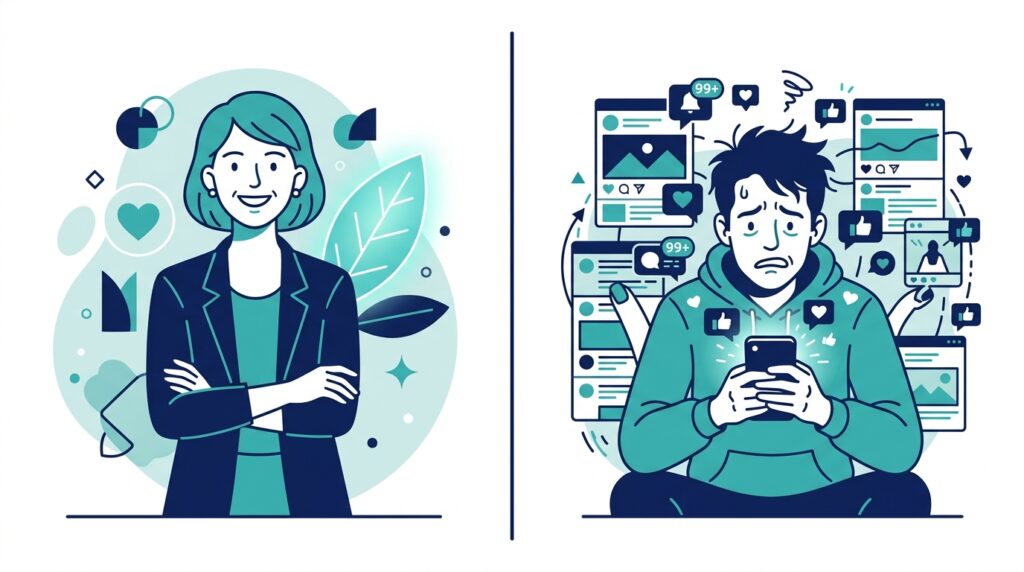
| Healthy Validation | Unhealthy Validation |
|---|---|
| Supports existing self-worth | Creates self-worth |
| Appreciated but not required | Constantly required |
| Encourages growth | Creates dependency |
| Accepts disagreement | Fears disagreement |
| Values authenticity | Prioritizes approval |
Imagine two employees receiving identical performance feedback.
The first employee appreciates positive comments but continues to feel competent even after constructive criticism. Their confidence comes largely from their own effort, learning, and values.
The second employee experiences intense anxiety if feedback is less than perfect. A single critical remark overshadows numerous successes, leading them to question their entire competence.
The difference is not intelligence or ability. It is where each person’s psychological “anchor” is located.
Healthy validation acts like a supportive hand on your shoulder.
Unhealthy validation becomes the ground beneath your feet.
One encourages.
The other determines identity.
Understanding this distinction is the foundation for everything else discussed in this article.
Why Humans Naturally Seek Validation

If you’ve ever wondered, “Why do I care so much about what people think?” the answer is more complex—and far less shameful—than many self-help articles suggest.
Humans are biologically, psychologically, and socially wired to care about other people’s opinions. The desire for acceptance is not evidence of weakness. It reflects millions of years of evolution and a lifetime of learning.
Modern psychology increasingly views validation-seeking as the result of several interacting systems rather than a single personality trait. These systems include our evolutionary history, our brain’s social reward network, our developmental experiences, and the environments we navigate every day.
Understanding these systems helps replace self-criticism with self-awareness.
Evolutionary Psychology: Why Belonging Matters
For most of human history, survival depended on cooperation.
Early humans rarely survived alone. Food gathering, protection from predators, childcare, and shelter all depended on belonging to a social group. Being rejected by one’s community could significantly reduce the chances of survival.
Although modern society looks very different, our brains evolved much more slowly than our technology.
As a result, many of the neural systems that once helped protect us from physical isolation continue to influence our emotional lives today.
This helps explain why experiences such as public embarrassment, criticism, or rejection often feel disproportionately painful. While these situations rarely threaten physical survival, the brain may still interpret them as signals of potential social exclusion.
Evolutionary psychology suggests that sensitivity to social acceptance likely provided adaptive advantages throughout human history. However, researchers also caution that modern environments—particularly social media—can amplify these ancient mechanisms in ways our brains did not evolve to handle.
In other words, the desire to belong is normal.
The challenge is learning when this ancient survival system becomes overactive in modern life.
The Brain’s Social Reward System
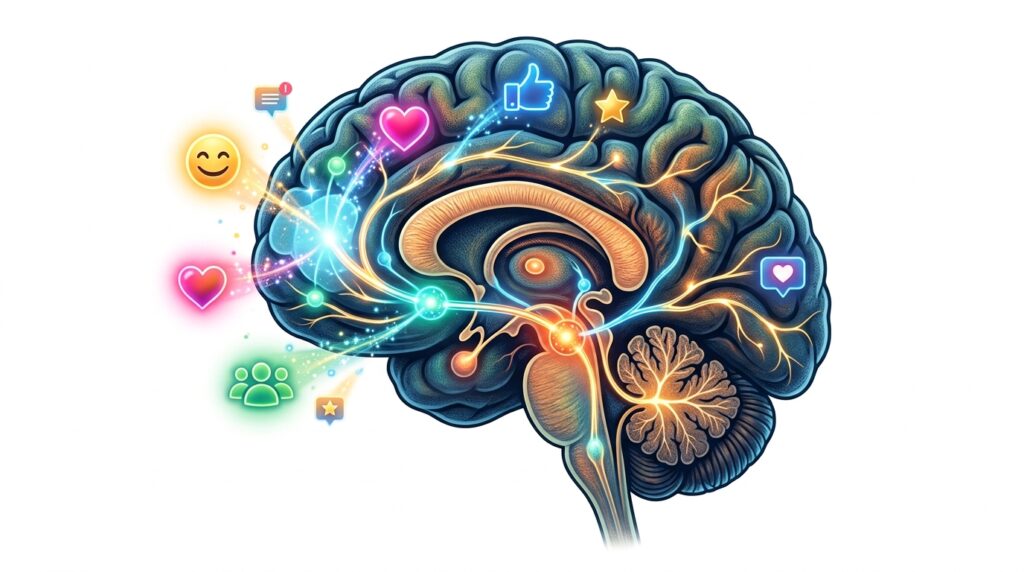
Our brains constantly evaluate social information.
Every compliment, criticism, smile, disagreement, or expression of acceptance carries emotional significance because social experiences influence several interconnected brain systems.
One of these involves dopamine.
Dopamine is frequently described as the brain’s “reward chemical,” but this description is incomplete. Contemporary neuroscience suggests dopamine plays a larger role in learning, motivation, and predicting rewards than simply creating pleasure.
When someone praises your work or appreciates your effort, your brain may register that experience as socially rewarding. Over time, repeated positive experiences strengthen expectations about future rewards.
This learning process is highly adaptive.
It motivates cooperation, strengthens relationships, and encourages behaviors that help individuals function successfully within communities.
However, problems may emerge when external approval becomes the primary source of psychological reward.
Instead of learning from meaningful achievements, the brain begins chasing praise itself.
Likes.
Comments.
Compliments.
Recognition.
Eventually, approval may become less about connection and more about emotional regulation.
Dopamine and Reward Prediction
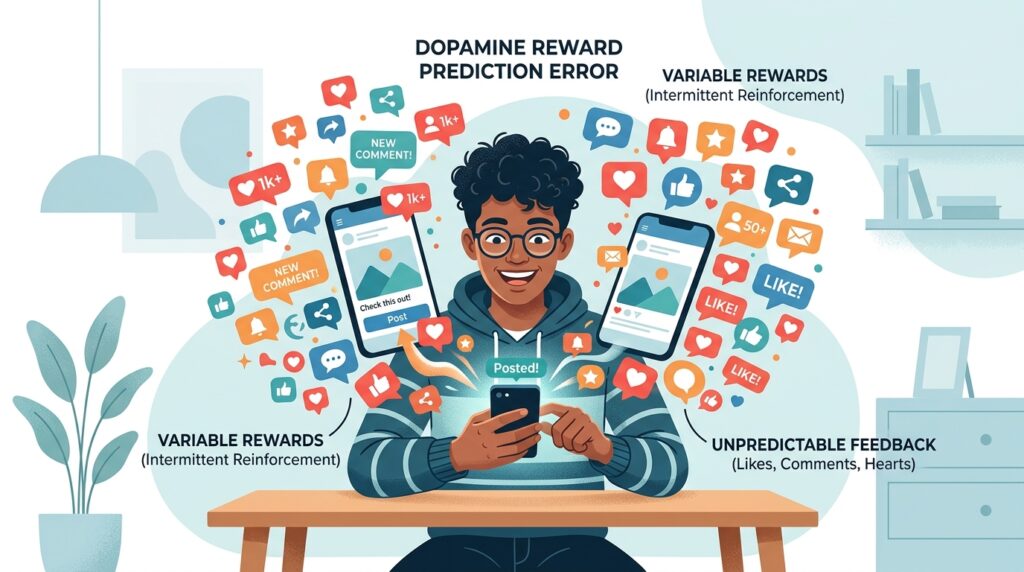
An especially interesting aspect of dopamine involves what neuroscientists call reward prediction.
Rather than responding only to rewards themselves, dopamine systems respond strongly when outcomes are better—or worse—than expected.
Imagine posting something online.
You expect twenty likes.
Instead, you receive two hundred.
The unexpected social approval produces a stronger learning signal than if two hundred likes had been expected all along.
Conversely, if you expected enthusiastic responses but received very little engagement, disappointment may feel surprisingly intense.
This mismatch between expectation and outcome—often referred to as a prediction error—helps explain why unpredictable social feedback can become psychologically compelling.
Modern digital platforms often operate on highly variable feedback schedules. Sometimes responses arrive immediately. Sometimes they don’t.
From a learning perspective, unpredictability can strengthen repetitive checking behaviors.
Importantly, this does not mean dopamine alone causes validation-seeking. Human motivation is influenced by numerous interacting biological, psychological, and environmental factors. Researchers continue investigating exactly how these systems interact.
Why Social Rejection Feels So Painful
One of the most fascinating discoveries in social neuroscience is that experiences of social rejection activate some of the same brain regions involved in processing physical pain, particularly the anterior cingulate cortex (ACC).
This does not mean emotional pain and physical pain are identical.
However, research suggests they share overlapping neural mechanisms.
This helps explain why people often describe rejection using physical language:
- “That hurt.”
- “It felt crushing.”
- “I was heartbroken.”
- “It felt like a punch in the stomach.”
These expressions are more than metaphors.
They reflect the brain’s deep integration of social and emotional experiences.
Understanding this biology can be surprisingly reassuring.
Feeling distressed after rejection does not necessarily mean you’re emotionally weak.
It means your brain is responding to an experience that humans have been biologically prepared to care about for thousands of generations.
Why Validation Is Not the Enemy
Some self-help advice encourages readers to stop caring what anyone thinks.
While emotionally appealing, this advice oversimplifies human psychology.
Healthy people still value encouragement.
Healthy people still appreciate appreciation.
Healthy people still enjoy being understood.
The goal is not emotional independence from everyone around you.
Instead, psychological well-being appears to depend on balancing two equally important needs:
- Connection with others.
- A stable internal sense of self.
External validation should complement your identity—not create it.
Imagine a tree.
Healthy validation is like sunlight.
It helps growth.
But the roots still come from within.
When those roots are strong, changing weather does not determine whether the tree survives.
Likewise, people with stable self-worth still enjoy praise, encouragement, and recognition.
The difference is that these experiences enrich their lives rather than defining their value.
How Approval Seeking Develops
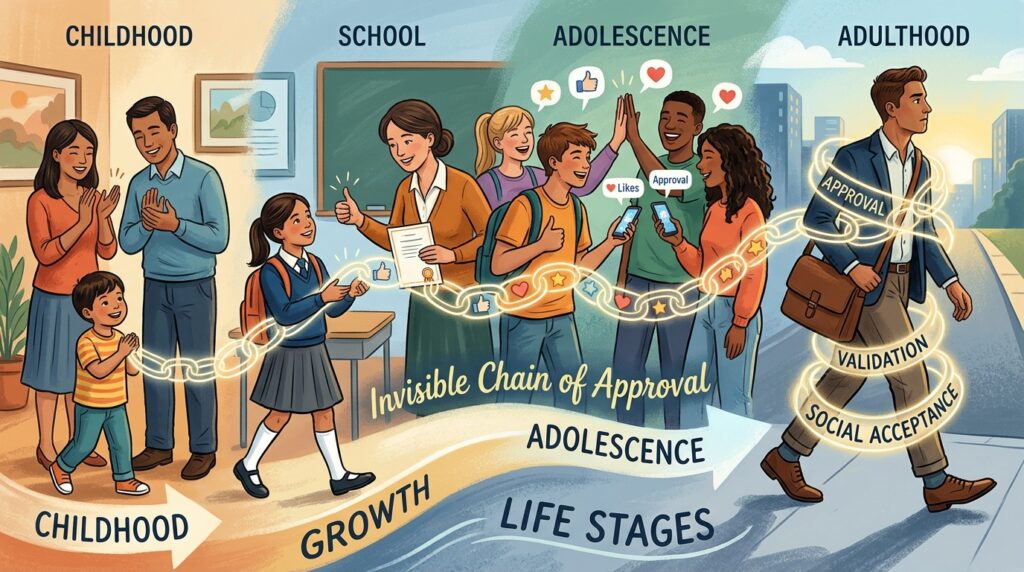
If the need for validation is partly natural, why do some people seem far more dependent on approval than others?
The answer rarely lies in a single cause.
Modern psychology suggests that approval-seeking usually develops through the interaction of early experiences, learning, personality, culture, and ongoing social environments. Rather than emerging overnight, it often forms gradually as the brain learns what appears to increase safety, acceptance, or belonging.
By adulthood, these patterns can become so familiar that they feel like personality traits rather than learned habits.
Understanding where they come from is an important step toward changing them.
Childhood Learning and Conditional Approval
One of the earliest places many people learn about approval is at home.
Children naturally look to caregivers for signals about safety, acceptance, and belonging. When caregivers respond consistently with warmth and support, children often develop a more secure foundation for exploring the world.
However, some children may gradually learn that approval seems linked to performance.
For example, praise might appear only when they:
- Get excellent grades.
- Behave perfectly.
- Avoid mistakes.
- Meet high expectations.
- Put other people’s needs before their own.
This does not mean parents intentionally create unhealthy validation patterns. Parenting is complex, and children’s experiences are shaped by temperament, culture, schools, peers, and many other influences.
Even well-intentioned families may unintentionally reinforce the idea that love feels more secure when certain standards are met.
Over time, the brain begins connecting achievement with emotional safety.
Instead of asking:
“Who am I?”
the child gradually learns to ask:
“What do I need to do so people continue accepting me?”
As adulthood arrives, this question may quietly influence career choices, friendships, romantic relationships, and personal identity.
Social Comparison: Measuring Yourself Against Others

Even if childhood lays the foundation, adulthood constantly reshapes how we evaluate ourselves. One of the strongest influences is social comparison—the tendency to judge our abilities, achievements, or worth by comparing ourselves with other people.
Psychologist Leon Festinger first proposed Social Comparison Theory, suggesting that when objective measures are unavailable, people naturally evaluate themselves by looking at others. This tendency is neither good nor bad; it is a normal cognitive process that helps us understand where we stand.
The problem arises when comparison becomes the primary source of identity.
Consider a young professional who has just started a new job. Instead of measuring progress against personal goals, they continually compare their salary, promotions, or achievements with colleagues. Every success by someone else feels like evidence of personal failure.
Social media amplifies this process dramatically.
Platforms like Instagram, TikTok, and LinkedIn present carefully curated highlights rather than everyday reality. Promotions, vacations, fitness milestones, engagements, entrepreneurial success, and luxurious lifestyles become constant reference points.
The brain rarely compares:
- Your ordinary Tuesday
with
- Someone else’s ordinary Tuesday.
Instead, it compares your complete reality—including your doubts, failures, and insecurities—with someone else’s carefully edited highlights.
This creates an unfair psychological comparison.
Research suggests frequent upward social comparison—comparing oneself to people perceived as “better off”—may contribute to lower mood, reduced self-esteem, and greater dissatisfaction, particularly when individuals already struggle with self-worth. However, comparison itself is not inherently harmful. In some contexts, it can inspire learning, motivation, and personal growth.
The key question is not:
“Do I compare myself?”
Almost everyone does.
The better question is:
“Does comparison help me grow, or does it determine my value?”
The Self-Discrepancy Trap
Another powerful explanation comes from Self-Discrepancy Theory, developed by psychologist E. Tory Higgins.
According to this theory, people hold multiple versions of themselves:
- Actual Self – who you believe you are today.
- Ideal Self – the person you hope to become.
- Ought Self – the person you believe you should be according to others’ expectations or social obligations.
These versions rarely match perfectly.
A moderate gap between them is normal and can motivate learning and growth.
Problems arise when these gaps become large and emotionally charged.
Imagine a university graduate.
Their Actual Self:
“I’m still figuring out my career.”
Their Ideal Self:
“I want to become financially independent and meaningful in my work.”
Their Ought Self:
“My family expects me to already have a prestigious career, a stable income, and complete certainty about my future.”
When the “ought self” dominates, people may begin making decisions primarily to satisfy external expectations rather than personal values.
This often appears as:
- Choosing careers for status instead of fulfillment.
- Remaining in unhealthy relationships to avoid disappointing others.
- Working excessive hours simply to appear successful.
- Constantly seeking reassurance before making decisions.
Over time, authenticity gives way to performance.
The person becomes increasingly skilled at meeting expectations while becoming less familiar with their own preferences, values, and identity.
Signs That Validation Has Become Unhealthy
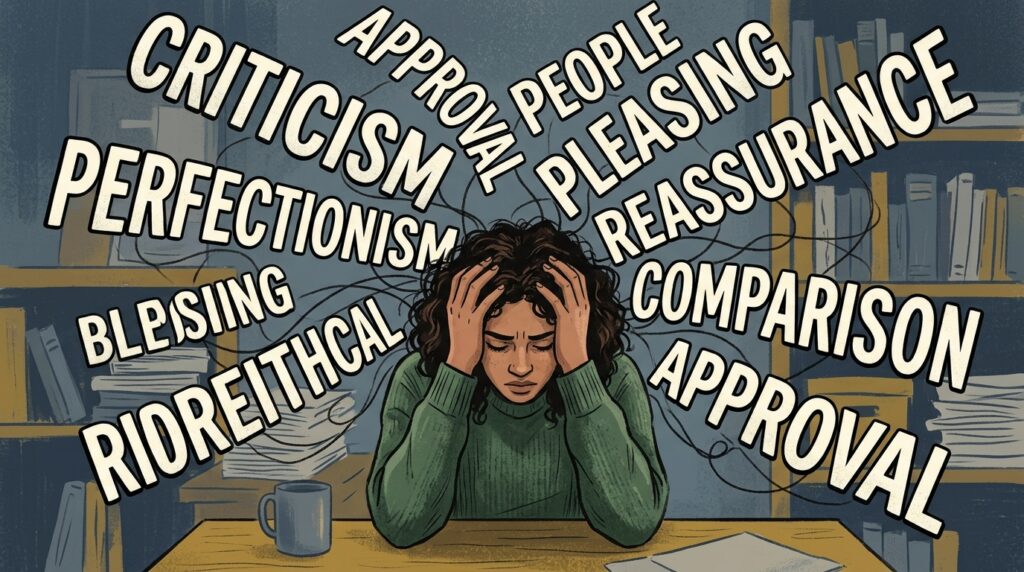
Seeking approval occasionally is part of healthy social functioning.
The question is not whether you ever enjoy praise or recognition.
The more useful question is whether external approval has become the primary source of emotional security.
Below are several signs that the need for validation may be shifting from a healthy desire for connection into an unhealthy dependency.
These patterns exist on a spectrum. Experiencing one or two occasionally does not necessarily indicate a serious problem. Instead, they become meaningful when they are persistent, inflexible, and interfere with well-being.
People-Pleasing
People often describe people-pleasing as kindness.
While kindness involves generosity and empathy, people-pleasing is usually driven by something different:
Fear.
Fear of conflict.
Fear of rejection.
Fear of disappointing someone.
Fear of losing acceptance.
This distinction matters.
A kind person chooses to help because it aligns with their values.
A people-pleaser often feels unable to say no, even when helping causes stress, resentment, or exhaustion.
For example:
A colleague asks you to take on another project.
You already have more work than you can realistically complete.
Internally, you know the answer should be “no.”
Instead, you immediately say “yes.”
Not because you genuinely want to help—
but because disappointing someone feels emotionally unbearable.
From the outside, this may appear generous.
Internally, it often feels like survival.
Perfectionism
Perfectionism is frequently mistaken for ambition.
In reality, psychologists distinguish between healthy striving for excellence and maladaptive perfectionism.
Healthy excellence asks:
“How can I improve?”
Maladaptive perfectionism asks:
“How can I avoid criticism?”
The difference is subtle but important.
Someone pursuing excellence accepts mistakes as part of learning.
Someone driven by validation sees mistakes as evidence that they are less worthy.
This often leads to behaviors such as:
- Spending excessive time on simple tasks.
- Constantly revising work.
- Fear of submitting projects.
- Avoiding opportunities unless success feels guaranteed.
- Feeling that “good enough” is never enough.
Ironically, perfectionism often reduces performance rather than improving it.
When every outcome determines personal worth, experimentation becomes risky, creativity declines, and procrastination increases.
Constant Reassurance Seeking
Everyone occasionally asks for reassurance.
Healthy reassurance strengthens relationships.
However, reassurance can become problematic when it functions like a temporary emotional bandage rather than genuine support.
Examples include:
- Repeatedly asking a partner if everything is okay.
- Constantly checking whether people are upset.
- Frequently asking whether you performed well.
- Seeking repeated confirmation before making decisions.
Initially, reassurance reduces anxiety.
Unfortunately, the relief is usually temporary.
Soon the uncertainty returns.
Another question follows.
Another confirmation is needed.
Psychologists sometimes describe this as a negative reinforcement cycle.
The reassurance removes anxiety temporarily, making reassurance-seeking more likely the next time uncertainty appears.
Over months or years, the cycle can become deeply ingrained.
Fear of Criticism
Constructive criticism helps people learn.
Yet for someone heavily dependent on external validation, criticism often feels much larger than feedback.
Instead of hearing:
“This report needs revision.”
The brain interprets:
“You are incompetent.”
This pattern is known as personalization, a common cognitive distortion in which specific events become global judgments about identity.
As a result, people may:
- Avoid challenging opportunities.
- Stay silent in meetings.
- Avoid creative work.
- Become defensive.
- Over-explain mistakes.
- Apologize excessively.
The goal shifts from learning to avoiding emotional pain.
Difficulty Setting Boundaries
Boundaries protect time, energy, emotional health, and personal values.
For someone whose self-worth depends on approval, boundaries often feel dangerous.
Saying “no” can trigger thoughts such as:
- “They’ll think I’m selfish.”
- “They won’t like me anymore.”
- “I’ll disappoint everyone.”
- “I’m letting people down.”
As a result, they may:
- Accept every request.
- Cancel personal plans.
- Work unpaid overtime.
- Ignore their own needs.
- Feel responsible for other people’s emotions.
Ironically, avoiding boundaries rarely creates healthier relationships.
Instead, it often produces resentment, burnout, and emotional distance.
Healthy relationships generally become stronger—not weaker—when boundaries are communicated respectfully.
Achievement Comparison
Validation dependency frequently shifts attention away from personal progress and toward external ranking.
Instead of asking:
“Am I becoming the person I want to be?”
the question becomes:
“Am I ahead of everyone else?”
This mindset creates a moving target.
Someone will always:
- Earn more.
- Travel more.
- Look better.
- Have more followers.
- Receive more recognition.
- Reach milestones sooner.
When identity depends on ranking, satisfaction becomes temporary.
Every achievement quickly loses its emotional impact because another comparison immediately replaces it.
Psychologists sometimes refer to this as the hedonic treadmill—the tendency to adapt to achievements and continually seek the next source of satisfaction.
External success alone rarely resolves this cycle because the standard itself keeps changing.
Quick Self-Reflection Checklist
Ask yourself:
- Do I struggle to say “no” even when I’m overwhelmed?
- Do I frequently change my opinions to fit in?
- Do compliments affect my mood more than my own judgment?
- Do I fear criticism more than I enjoy learning?
- Do I compare my progress with others every day?
- Do I apologize excessively?
- Do I need repeated reassurance before feeling calm?
- Do I feel guilty when prioritizing my own needs?
Answering “yes” to several questions does not mean something is wrong with you.
It simply suggests that external validation may be playing a larger role in your emotional life than you would like.
Awareness is not a diagnosis.
It is the beginning of meaningful change.
The Hidden Costs of Living for Approval

At first, approval-seeking can appear adaptive.
It helps people avoid conflict.
It encourages cooperation.
It may even contribute to short-term success at school or work.
But over time, relying on external validation often carries hidden psychological costs.
These costs rarely appear overnight.
Instead, they accumulate gradually, influencing decisions, relationships, emotional well-being, and personal identity in ways that are easy to overlook.
In the next section, we’ll explore how these patterns affect mental energy, relationships, career choices, identity development, and emotional resilience—and examine the neuroscience that helps explain why these patterns can become so deeply ingrained.
The Hidden Costs of Living for Approval
Living for approval rarely feels harmful at first.
In fact, it can even be rewarded.
The employee who never says “no” is praised for being dependable.
The student who constantly strives for perfect grades is admired for being disciplined.
The friend who always accommodates everyone else’s needs is often described as selfless.
From the outside, these behaviors may look admirable.
Internally, however, they can slowly erode emotional well-being if they are driven primarily by fear of rejection rather than genuine choice.
Over time, the cost is not simply emotional exhaustion. It can influence how people think, make decisions, build relationships, and understand themselves.
Mental Energy: When Every Decision Becomes a Performance
Imagine beginning each day with an invisible audience watching every move you make.
Before speaking, you wonder:
“Will this sound intelligent?”
Before sending an email:
“Will they think I’m competent?”
Before posting online:
“What if nobody responds?”
Before declining an invitation:
“Will they be disappointed?”
Each thought may seem insignificant.
Together, they create a constant stream of mental monitoring.
Psychologists sometimes describe this tendency as self-focused attention—a state in which cognitive resources are repeatedly directed inward to evaluate how one is being perceived. While occasional self-reflection is healthy, excessive self-monitoring can consume attention that could otherwise be used for creativity, learning, or enjoying the present moment.
Instead of engaging fully with life, the mind becomes occupied with managing impressions.
By evening, the person may feel mentally drained without understanding why.
Relationships: Trading Authenticity for Acceptance
Relationships thrive on trust, honesty, and emotional safety.
Ironically, excessive approval-seeking can weaken all three.
When someone constantly adapts their opinions, preferences, or personality to gain acceptance, the relationship gradually becomes centered on a version of themselves rather than their authentic identity.
For example:
A person dislikes a particular hobby but pretends to enjoy it because their partner loves it.
They agree with opinions they privately question.
They avoid expressing disappointment because they fear conflict.
Initially, this flexibility may appear to create harmony.
Over time, however, authenticity begins to disappear.
The relationship becomes built on accommodation instead of genuine connection.
This often leads to resentment.
Not because the other person demanded perfection—
but because maintaining a carefully managed identity becomes emotionally exhausting.
Healthy relationships generally allow room for disagreement, individuality, and honest communication.
Approval is welcomed.
Authenticity is essential.
Career Decisions: Success That Doesn’t Feel Like Success
Many young adults work incredibly hard to achieve professional success.
Yet some discover an unexpected feeling after reaching their goals:
“Why don’t I feel satisfied?”
One explanation involves the difference between intrinsic and extrinsic motivation.
When career decisions are guided primarily by external recognition—salary, prestige, titles, or admiration—achievement often produces only temporary satisfaction.
Soon another milestone appears.
Another promotion.
Another certification.
Another comparison.
Instead of creating lasting fulfillment, success becomes something that must constantly be defended.
By contrast, careers aligned with personal values, curiosity, and meaningful contribution tend to provide a more stable source of motivation.
This does not mean external rewards are unimportant.
Rather, they appear to be most psychologically beneficial when they support—not replace—an individual’s internal sense of purpose.
Identity Loss: Forgetting What You Actually Want
Perhaps the most subtle consequence of chronic validation-seeking is the gradual loss of personal identity.
Consider someone who has spent years making decisions based on other people’s expectations.
They chose subjects because teachers encouraged them.
They selected careers because their family approved.
They stayed in friendships to avoid disappointing others.
They pursued goals that looked impressive rather than meaningful.
Eventually, a difficult question emerges:
“What do I actually want?”
For many people, the answer is surprisingly unclear.
This uncertainty is not a sign of weakness.
It often reflects years of practicing adaptation rather than self-discovery.
Building internal self-worth therefore involves more than increasing confidence.
It involves rediscovering personal values, preferences, and aspirations that may have been overshadowed by the pursuit of approval.
Emotional Exhaustion and Burnout
Living for approval can feel like carrying an invisible emotional workload.
There is always another expectation to meet.
Another standard to satisfy.
Another opinion to manage.
Another mistake to avoid.
Over time, this constant vigilance contributes to emotional fatigue.
Research on occupational burnout consistently identifies chronic stress, perfectionistic tendencies, and reduced psychological autonomy as important contributing factors. While burnout has multiple causes—including workload, organizational culture, and limited resources—persistent pressure to maintain external approval may increase vulnerability for some individuals.
Emotional exhaustion often develops gradually.
People may notice:
- Feeling constantly “on.”
- Difficulty relaxing.
- Reduced enjoyment of achievements.
- Increased irritability.
- Feeling emotionally numb.
- Losing motivation despite continued effort.
These experiences are not inevitable outcomes of validation-seeking, but they illustrate why developing internal sources of stability can be psychologically protective.
The Neuroscience of the Validation Loop

Understanding behavior becomes much easier when we understand the systems that support it.
The need for validation is not controlled by a single “approval center” in the brain.
Instead, it emerges from the interaction of multiple neural networks involved in learning, emotion, motivation, social cognition, and decision-making.
Although neuroscience cannot fully explain the complexity of human behavior, it offers valuable insights into why approval can feel so emotionally significant—and why changing these habits often takes time.
The Cue–Routine–Reward Cycle
Many approval-seeking behaviors follow a pattern similar to other learned habits.
A simplified version looks like this:
Cue → Routine → Reward
Imagine this scenario:
Cue: Your manager sends a brief email saying, “Can we talk later?”
Immediately, uncertainty appears.
“Did I do something wrong?”
Instead of waiting calmly, you begin reviewing every recent conversation.
You replay yesterday’s meeting.
You reread old emails.
Eventually, you send a message asking:
“Is everything okay?”
That reassurance temporarily reduces anxiety.
Your brain learns something important:
“Asking for reassurance made me feel better.”
The next time uncertainty appears, the same routine becomes more likely.
This is how habits strengthen—not because they solve the underlying problem, but because they temporarily reduce discomfort.
Breaking the cycle usually requires changing the routine rather than eliminating the cue.
The goal is not to prevent uncertainty.
It is to respond to uncertainty differently.
The Default Mode Network: The Brain’s Inner Narrator
One of the most discussed discoveries in modern neuroscience is the Default Mode Network (DMN).
The DMN is a network of interconnected brain regions that tends to become more active during internally focused thinking.
This includes:
- Remembering the past.
- Imagining the future.
- Reflecting on yourself.
- Considering other people’s opinions.
- Daydreaming.
- Mentally replaying conversations.
These functions are essential for planning, learning, and understanding social relationships.
The DMN is not a “bad” network.
In fact, it plays an important role in healthy self-reflection.
Problems may arise when internally focused thinking becomes repetitive and difficult to disengage from.
Rumination
Rumination involves repeatedly thinking about the same problems without moving toward solutions.
Examples include:
“Why did I say that?”
“They probably think I’m incompetent.”
“I should have answered differently.”
“Everyone noticed my mistake.”
Instead of producing clarity, rumination often increases emotional distress.
Research has linked persistent rumination with greater vulnerability to anxiety and depression, although the relationship is complex and influenced by many individual factors.
Social Comparison
The DMN also contributes to self-referential thinking.
When scrolling through social media, the brain naturally asks:
“How do I compare?”
This comparison is automatic.
The important skill is learning not to accept every comparison as an objective measure of worth.
Mindfulness practices, values-based decision-making, and flexible attention strategies may help reduce excessive engagement with these repetitive thought patterns.
The Medial Prefrontal Cortex and Self-Evaluation
Another important brain region involved in self-referential processing is the medial prefrontal cortex (mPFC).
Among its many functions, the mPFC contributes to:
- Thinking about yourself.
- Considering your reputation.
- Understanding other people’s perspectives.
- Reflecting on personal identity.
This makes it highly relevant to validation-seeking.
Whenever you wonder:
“What do they think of me?”
the mPFC is likely participating in that process.
Again, this is entirely normal.
Problems emerge when self-evaluation becomes excessive.
Instead of occasionally reflecting on social interactions, the mind becomes trapped in continuous reputation management.
Every conversation becomes an evaluation.
Every silence becomes rejection.
Every criticism becomes a threat to identity.
Healthy psychological functioning involves flexibility—the ability to reflect when useful and let go when reflection no longer serves a purpose.
Prediction Errors: Why Praise Can Feel Addictive
Earlier, we discussed dopamine and reward prediction.
Let’s examine this idea more closely.
Suppose you publish an article.
You hope readers appreciate it.
If the response exceeds expectations, your brain registers a positive prediction error.
Unexpected praise feels especially rewarding because the outcome was better than anticipated.
Now imagine repeating this process dozens or hundreds of times.
Without realizing it, expectations begin to rise.
Yesterday’s success becomes today’s baseline.
The same praise no longer produces the same emotional impact.
This is one reason external validation often feels temporary.
The standard keeps moving.
It is important to emphasize that this process does not mean people become “addicted” to compliments in the same way substances create addiction.
The comparison is metaphorical rather than clinical.
Human motivation involves multiple interacting neural systems, personality traits, and environmental influences.
Still, understanding reward prediction helps explain why external approval often loses its ability to produce lasting satisfaction.
Can the Brain Change?
Fortunately, neuroscience also provides encouraging news.
The brain remains capable of change throughout life.
This ability, known as neuroplasticity, allows neural connections to strengthen, weaken, and reorganize in response to experience.
Every time you respond differently to an old trigger, you provide the brain with new information.
Every time you tolerate uncertainty instead of immediately seeking reassurance…
Every time you set a healthy boundary…
Every time you choose authenticity over approval…
…you are reinforcing a different behavioral pathway.
Change is rarely immediate.
Old habits developed over years are unlikely to disappear after a single insight.
But repeated experiences gradually teach the brain that safety, belonging, and self-worth do not have to depend exclusively on external approval.
That realization marks the beginning of lasting psychological change.
How to Build Internal Self-Worth

Understanding why approval seeking develops is valuable, but insight alone rarely changes behavior. Lasting change comes from repeatedly practicing new ways of thinking, feeling, and acting.
The goal is not to stop caring what anyone thinks. Humans are social creatures, and healthy relationships naturally involve mutual care and appreciation.
Instead, the goal is to make external validation a bonus rather than a requirement.
Think of self-worth as the foundation of a house.
Compliments, promotions, likes, and praise can decorate the house beautifully.
But they should never become the foundation holding it together.
Shift from External Validation to Internal Validation
One of the most important ideas in Self-Determination Theory (SDT) is that psychological well-being is supported by three basic needs:
- Autonomy – feeling that your choices reflect your own values.
- Competence – feeling capable of learning and growing.
- Relatedness – feeling connected to other people.
When approval becomes the primary goal, autonomy often weakens. Decisions become driven by anticipated reactions instead of personal values.
A helpful daily question is:
“If nobody praised or criticized this decision, would I still choose it?”
This question encourages reflection on intrinsic motivation rather than external reward.
Try creating two simple lists.
External Scorecard
- Number of likes
- Praise from others
- Promotions
- Recognition
- Approval
- Popularity
Internal Scorecard
- Stayed true to my values
- Kept my promises
- Learned something new
- Practiced courage
- Treated people respectfully
- Maintained healthy boundaries
External achievements still matter.
The difference is that they become outcomes—not the definition—of your worth.
Clarify Your Values
Approval seeking often causes people to lose sight of what genuinely matters to them.
One practical exercise from Acceptance and Commitment Therapy (ACT) is values clarification.
Take a sheet of paper and write down answers to these questions.
Who do I want to be?
Not:
“What do people expect?”
But:
“What kind of person do I hope to become?”
Then identify your five most important values.
Examples include:
- Curiosity
- Kindness
- Creativity
- Honesty
- Growth
- Family
- Health
- Courage
- Integrity
- Learning
Now compare those values with your recent decisions.
Ask yourself:
- Which decisions reflected my values?
- Which decisions were mainly attempts to gain approval?
- Where do these two overlap?
- Where do they conflict?
This exercise helps shift attention from performance toward purpose.
Practice Healthy Boundaries

For many approval seekers, saying “no” feels emotionally uncomfortable.
That discomfort is normal.
Remember, your brain may interpret disagreement as a threat because belonging has long been associated with safety.
The objective is not to eliminate discomfort immediately.
The objective is to prove, through repeated experience, that respectful boundaries rarely produce the catastrophic outcomes our anxious predictions imagine.
Try using clear, respectful statements such as:
- “I appreciate you asking, but I can’t commit right now.”
- “I need some time to think before deciding.”
- “I’m not available this weekend.”
- “That doesn’t work for me.”
Notice that these responses are:
- Honest
- Respectful
- Brief
- Non-defensive
You do not need a lengthy explanation for every boundary.
Healthy people generally respect reasonable limits.
If someone repeatedly ignores your boundaries, the issue may not be your communication—it may be the relationship itself.
Reduce Reassurance Seeking
If you frequently seek reassurance, the goal is not to stop asking for support altogether.
Instead, gradually increase your tolerance for uncertainty.
Try this behavioral experiment.
Step 1
Notice the urge to ask for reassurance.
For example:
“Is my boss upset?”
“Does my partner still love me?”
Step 2
Rate your anxiety from 1 to 10.
Step 3
Delay asking for reassurance by 15 minutes.
Eventually increase the delay to:
- 30 minutes
- 1 hour
- 2 hours
During the waiting period, observe what happens.
Often, anxiety rises before naturally decreasing.
This teaches the brain an important lesson:
“I can tolerate uncertainty without immediately seeking confirmation.”
Over time, this weakens the habit loop discussed earlier.
Develop Self-Compassion

Many people believe self-compassion means lowering standards.
Research suggests something different.
Self-compassion involves responding to personal setbacks with the same understanding you would offer a good friend.
Imagine making an embarrassing mistake at work.
Your inner critic says:
“You’re incompetent.”
Instead, try asking:
“If someone I cared about made this mistake, what would I say to them?”
Perhaps:
“Mistakes happen. One error doesn’t define your ability. What can you learn from this?”
This shift is not about pretending mistakes don’t matter.
It is about separating behavior from identity.
You made a mistake.
You are not a mistake.
Redefine Success
Many people unknowingly define success using comparison.
Examples include:
- Being ahead of peers.
- Earning more money.
- Receiving more recognition.
- Having a larger audience.
These goals can motivate achievement, but they are difficult to sustain because someone will almost always appear further ahead.
Instead, consider measuring success by questions such as:
- Did I act according to my values today?
- Did I learn something new?
- Did I treat others with respect?
- Did I keep an important promise to myself?
- Did I make progress, even if it was small?
Progress becomes much more stable when measured against your own growth rather than someone else’s highlight reel.
Create an Internal Scorecard
One practical MOSU MIND framework is the Internal Scorecard.
At the end of each day, rate yourself from 1–5 on these five questions.
| Question | Score (1–5) |
|---|---|
| Did I act according to my values? | |
| Did I make one courageous decision? | |
| Did I respect my boundaries? | |
| Did I learn from a mistake instead of fearing it? | |
| Did I treat myself with compassion? |
Notice what is missing.
There are no questions about:
- Followers
- Likes
- Salary
- Praise
- Popularity
Those outcomes may still matter.
They simply stop being the primary measure of your worth.
Real-Life Examples
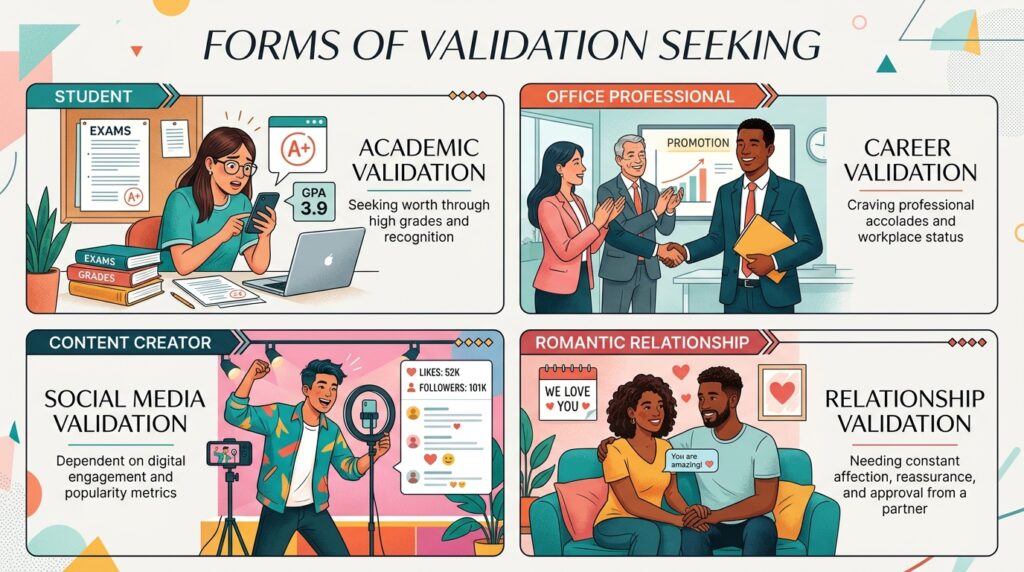
University Student
A 20-year-old student constantly compares exam scores with classmates.
One disappointing grade convinces them they are “not smart enough.”
Instead of interpreting one result as feedback, they interpret it as evidence of personal inadequacy.
By shifting attention toward consistent learning rather than ranking, academic confidence gradually becomes more resilient.
Young Professional
A 28-year-old employee accepts every additional project because they fear disappointing their manager.
After months of exhaustion, they begin setting respectful boundaries and communicating workload honestly.
Rather than damaging professional relationships, this often improves clarity, reliability, and long-term performance.
Social Media Creator
A content creator refreshes analytics every hour.
A successful post produces excitement.
A slower post produces self-doubt.
Eventually, they begin evaluating success by consistency, creativity, and audience value instead of daily engagement numbers.
Analytics remain useful.
Identity no longer depends on them.
Romantic Relationship
One partner repeatedly asks:
“Are you sure you’re not upset?”
“Do you still love me?”
Initially, these questions provide relief.
Over time, they increase dependence on reassurance.
Learning to tolerate uncertainty while communicating openly allows trust to grow more naturally.
Common Myths About Validation

Myth: Validation Is Always Bad
Reality:
Seeking understanding, encouragement, and emotional support is a normal part of healthy relationships.
The problem arises when approval becomes essential for feeling worthy.
Myth: Confident People Never Need Approval
Reality:
Confident people also appreciate praise.
The difference is that criticism informs them rather than defines them.
Myth: Self-Esteem Solves Everything
Reality:
Self-esteem can fluctuate with success and failure.
Developing stable self-worth often involves values, self-compassion, psychological flexibility, and meaningful relationships—not simply “thinking positively.”
Myth: Social Media Created Validation Seeking
Reality:
Humans sought acceptance long before smartphones existed.
Digital platforms can amplify comparison and approval-seeking, but they did not create the underlying psychological need.
Myth: People-Pleasing Equals Kindness
Reality:
Kindness is freely chosen.
People-pleasing is often driven by fear.
Healthy kindness includes caring for others without abandoning yourself.
Frequently Asked Questions
Why do I always need validation?
Everyone seeks validation to some degree because humans are social beings. If the need feels overwhelming, it may reflect a combination of personality, early experiences, social learning, and current environments. The encouraging news is that these patterns can change with awareness and practice.
Can childhood experiences affect validation seeking?
Yes. Early experiences may influence how people relate to approval and self-worth later in life. However, childhood is only one factor among many. Personality, culture, relationships, and adult experiences also shape these patterns.
How do I stop needing constant reassurance?
Start by noticing reassurance-seeking habits, delaying the urge to ask for confirmation, practicing self-compassion, strengthening personal values, and gradually tolerating uncertainty. If reassurance-seeking causes significant distress or interferes with daily functioning, speaking with a qualified mental health professional may also be helpful.
What’s the difference between validation seeking and attention seeking?
Validation seeking is usually motivated by a desire to feel accepted, safe, or emotionally secure.
Attention seeking focuses more on gaining notice or recognition.
Although the two can overlap, they are not the same psychological process.
Can therapy help?
Yes.
Evidence-based approaches such as Cognitive Behavioral Therapy (CBT) and Acceptance and Commitment Therapy (ACT) may help people understand unhelpful thinking patterns, develop psychological flexibility, strengthen self-worth, and reduce excessive reliance on external approval.
Key Takeaways

The need for validation is not a character flaw.
It is part of being human.
The challenge begins when approval becomes the foundation of identity instead of a meaningful addition to it.
Throughout this article, we’ve seen that validation-seeking is influenced by evolution, learning, relationships, motivation, and brain processes—not by a single cause. Understanding these influences allows us to respond with curiosity rather than self-criticism.
Building real self-worth does not happen overnight.
It develops gradually through repeated choices:
- Choosing authenticity over performance.
- Choosing values over approval.
- Choosing boundaries over guilt.
- Choosing learning over perfection.
- Choosing self-compassion over harsh self-judgment.
External encouragement will always feel good.
But the strongest form of confidence grows quietly from knowing who you are—even when nobody is watching.
Educational Disclaimer
This article is intended for educational purposes only and should not be considered medical, psychological, or mental health advice. If concerns about validation-seeking, anxiety, self-worth, or emotional well-being significantly affect your daily life, consulting a qualified healthcare or licensed mental health professional may be helpful.

