
The Multitasking Myth: Why Multitasking Often Feels More Effective Than It Is
The multitasking myth is one of the biggest lies in modern productivity.
You have 20 tabs open.
Your phone is buzzing.
Slack is blinking.
You’re replying to emails… while listening to a meeting… while trying to finish that “important” report.
And somehow, it feels like you’re being productive.
But here’s the uncomfortable truth:
You’re not multitasking.
You’re switching.
And that switch is gradually reducing your ability to sustain focus, your performance, and your brain’s ability to think deeply.
The “Busy but Broken” Workday
Modern professionals don’t struggle because they lack discipline.
They struggle because they’re trapped in a system that rewards constant activity instead of meaningful output.
- Reply fast = you look productive
- Stay online = you look committed
- Do everything = you feel important
But at the end of the day?
You’re exhausted… and your most important work is still unfinished.
This is the Multitasking Myth.
This is how the multitasking myth quietly destroys your focus, productivity, and long-term cognitive performance.
The Truth: Multitasking Is Actually Task Switching
Your brain is not a multi-core processor.
It’s a single-threaded system.
That means:
- You can only process one complex task at a time
- Every “switch” requires energy
- Every interruption resets your focus
So when you think you’re multitasking…
You’re actually doing this:
Task A → Task B → Task A → Task C → Task A
Over and over again.
This creates what scientists call:
Task Switching Cost
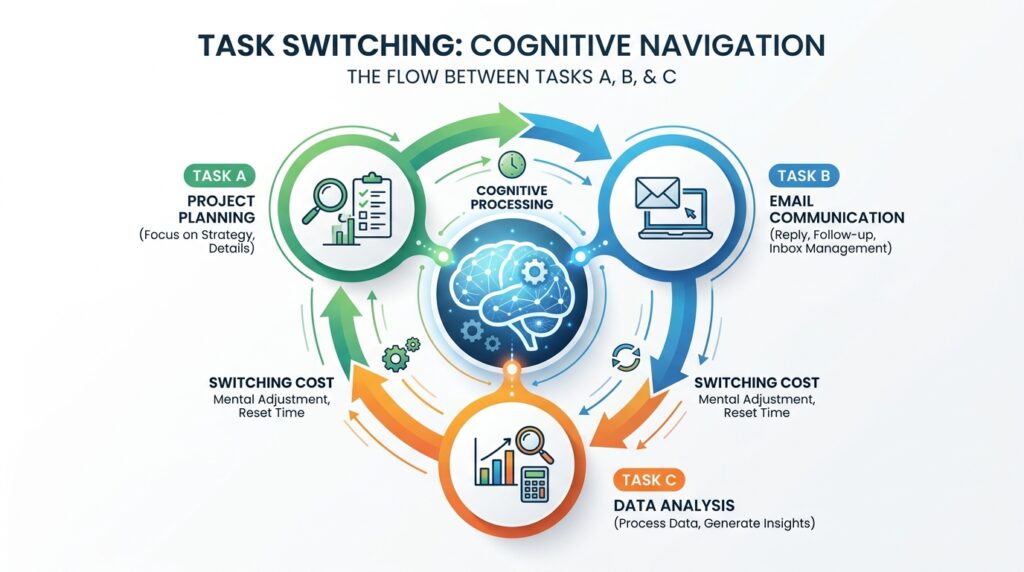
This is the core of the multitasking myth—what feels like efficiency is actually repeated task switching.
The 40% Productivity Loss Nobody Talks About
According to research from Stanford University, multitasking significantly reduces focus and cognitive performance.
Research shows that multitasking can reduce productivity by up to 40%.
Even worse?
After a single interruption, it takes an average of 23 minutes to fully regain focus.
Let that sink in.
That “quick check” of your phone?
It didn’t cost you 10 seconds.
It cost you nearly half an hour of deep thinking.
This is not a time problem.
This is a brain problem.
The Neuroscience Behind the Multitasking Myth
If multitasking feels real… why is it so damaging?
Because your brain is physically not designed for it.
To understand this, we need to go deeper—into the actual biology of your mind.
The Prefrontal Cortex: Your Brain’s Bottleneck
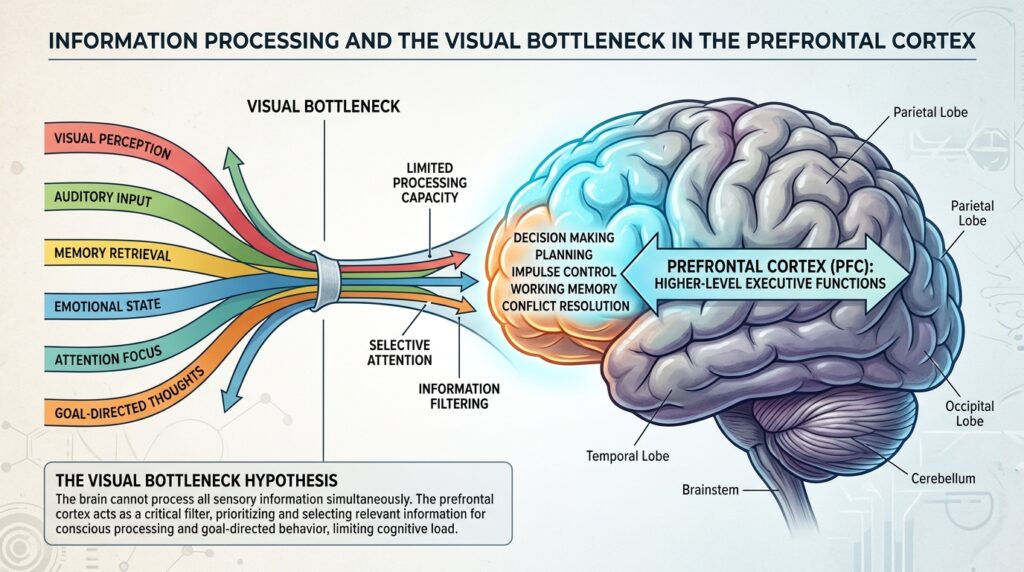
Your Prefrontal Cortex (PFC) is responsible for:
- Decision-making
- Planning
- Focus
- Complex thinking
Think of it as the CEO of your brain.
This neurological limitation is one of the strongest scientific proofs behind the multitasking myth.
Why You Can Only Focus on One Complex Task at a Time
The PFC has a strict limitation:
It can only process one high-level task at a time.
When you try to multitask:
- It stops Task A
- Loads Task B
- Then reloads Task A again
This creates a “bottleneck effect.”
And every switch burns mental energy (glucose).
This is why you feel mentally drained… even if you’ve been sitting all day.
The Anterior Cingulate Cortex: Your Overloaded Filter
Your Anterior Cingulate Cortex (ACC) is your brain’s:
- Error detector
- Focus filter
- Distraction manager
How Multitasking Weakens Your Focus System
When you constantly multitask:
- The ACC becomes overloaded
- Your ability to filter distractions drops
- You become more reactive
Studies show that heavy multitaskers actually have:
Lower grey matter density in the ACC
Meaning?
The more you multitask… the worse you become at focusing.
The Basal Ganglia Trap: Why You Forget Everything
Your brain has two main learning systems:
- Hippocampus → Deep learning & memory
- Basal Ganglia → Habits & shallow patterns
Shallow Processing vs Deep Learning
When you focus deeply:
➡ Information goes to the Hippocampus
When you multitask:
➡ Information gets misrouted to the Basal Ganglia
The result?
- Poor memory retention
- Surface-level understanding
- “I just read this but forgot everything” feeling
This is why multitasking doesn’t just reduce productivity…
It reduces intelligence in the moment.
Dopamine & the “Productivity Illusion” (Why Multitasking Feels Good)
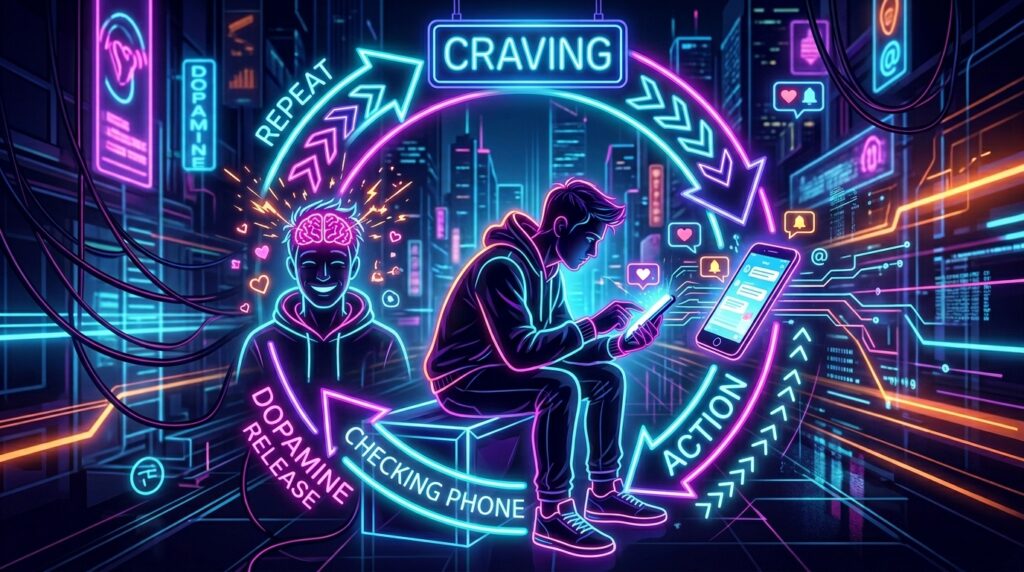
If multitasking is so harmful… why does it feel so productive?
The answer lies in one powerful chemical:
Dopamine.
The “Novelty Hit” That Hooks Your Brain
Every time you:
- Check a notification
- Switch tabs
- Open a new message
Your brain releases a small burst of dopamine.
This creates a feeling of:
- Progress
- Excitement
- Momentum
But here’s the truth:
You’re not being productive.
You’re being rewarded for switching.
The Digital Slot Machine Effect
Multitasking works exactly like a casino slot machine.
You don’t know when the next “reward” is coming…
So you keep pulling the lever.
👉 Refresh inbox
👉 Check Slack
👉 Open another tab
This creates a loop:
Switch → Dopamine → Craving → Switch again
Over time, your brain becomes increasingly accustomed to:
- New information
- Constant stimulation
- Instant rewards
And deep work?
Starts to feel boring… even painful.
The Dopamine Crash (Why You Feel Drained)
After repeated dopamine spikes, your brain crashes.
This leads to:
- Mental fatigue
- Low motivation
- Brain fog
Now you need even more stimulation…
Just to feel normal.
This is how multitasking turns into a cognitive addiction.
The multitasking myth survives because your brain rewards switching, not actual progress.
Cognitive Load Theory: Why Your Brain Has a Hard Limit
Your brain is powerful.
But it’s not unlimited.
And multitasking pushes it beyond its limits.
Your Brain’s RAM: Working Memory Explained
Think of your working memory as your brain’s RAM.
It holds information temporarily so you can:
- Solve problems
- Think critically
- Make decisions
The 4-Item Rule (The Real Limit)
Modern research shows your brain can only hold:
3 to 5 pieces of information at once
That’s it.
So when you multitask:
- Tasks compete for limited space
- Information gets dropped
- Errors increase
You’re not doing more.
You’re overloading your system.
This overload is a direct result of the multitasking myth pushing your brain beyond its limits.
The Three Types of Cognitive Load
Multitasking increases what scientists call cognitive load.
1. Intrinsic Load
The natural difficulty of a task (e.g., writing a report).
2. Extraneous Load
Distractions and interruptions (multitasking lives here).
3. Germane Load
The effort used for learning and understanding.
When you multitask:
- Extraneous load spikes
- Germane load drops
Meaning:
You learn less… and struggle more.
The Hidden Cost of the Multitasking Myth on Productivity
This is the concept most people don’t know.
And it’s the most dangerous one.
What Is Attention Residue?
When you switch from Task A to Task B…
A part of your attention stays stuck on Task A.
This leftover focus is called:
Attention Residue
The 20-Minute Cognitive Drag
Even a quick interruption can leave residue behind.
And it can take up to:
20–25 minutes to fully refocus
So when you “quickly check” something:
- You don’t return at full capacity
- Your thinking becomes shallow
- Your output quality drops
You’re not just switching tasks.
You’re dragging mental weight behind you.
Why This Kills Deep Work
Deep work requires:
- Full attention
- Continuous focus
- Mental clarity
Attention residue destroys all three.
This is why:
You can’t do deep work while multitasking.
Neural Fatigue, Stress & Cortisol Overload
Multitasking doesn’t just affect focus.
It affects your entire nervous system.
The “Mental Battery Drain” Effect
Every decision you make uses energy.
Every switch = a decision.
So when you multitask:
- Your brain burns glucose faster
- Your energy drains quickly
- You feel exhausted without doing real work
This is called:
Neural Fatigue
Cortisol: The Stress Hormone Trap
Multitasking signals your brain that:
“Something is wrong.”
This activates your stress system.
And releases:
- Cortisol
- Adrenaline
The Hidden Effects of Chronic Stress
- Reduced focus
- Increased anxiety
- Poor decision-making
- Burnout
Your brain enters a constant state of:
“Fight or Flight”
Even when you’re just sitting at your desk.
Why You Feel “Wired but Tired”
This is the multitasker’s signature state:
- Mentally overstimulated
- Physically exhausted
- Emotionally drained
You’re doing everything…
But accomplishing nothing meaningful.
The Hidden Cost of the Multitasking Myth on Productivity
By now, one thing is clear:
The multitasking myth is not harmless.
It’s expensive.
Not just in time…
But in performance, intelligence, and long-term success.
Task Switching Cost: The 23-Minute Rule
Every time you switch tasks, your brain pays a price.
This is called:
Task Switching Cost
And it’s far bigger than most people think.
- A “quick check” isn’t quick
- A small distraction isn’t small
On average, it takes:
23 minutes and 15 seconds
to fully regain deep focus after an interruption.
So if you switch tasks 10 times a day?
You’ve just lost hours of real productivity.
The 40% Productivity Drop
Studies show multitasking can reduce productivity by up to:
40%
That means:
- 10 hours of work → only 6 hours of real output
And the worst part?
You still feel busy.
This is the illusion that keeps the multitasking myth alive.
The IQ Drop Effect
Multitasking doesn’t just slow you down.
It makes you think worse.
Research has shown that constant task switching can temporarily reduce your IQ by:
Up to 10 points
That’s equivalent to:
- Losing a full night of sleep
- Or being under mild intoxication
So when you multitask…
You’re not just distracted.
You’re cognitively impaired.
Decision Fatigue & Mental Burnout
Every switch is a decision.
And decisions cost energy.
Over time, this leads to:
- Poor judgment
- Slower thinking
- Low-quality work
This is called:
Decision Fatigue
And it’s one of the highest hidden costs of multitasking.
Why Multitasking Destroys Deep Work
Deep work is where real value is created.
It requires:
- Focus
- Time
- Uninterrupted thinking
But multitasking creates:
- Fragmented attention
- Constant interruptions
- Shallow output
Which means:
You stay busy… but never produce meaningful results.
Why Smart People Fall Into the Multitasking Myth
Here’s the paradox:
The smarter you are…
The more likely you are to multitask.
Not because you lack discipline.
But because you’re trapped in powerful psychological loops.
The “Busy = Productive” Illusion
Modern work culture rewards activity.
Not output.
So we start believing:
- More tasks = more productivity
- More movement = more progress
But in reality:
Activity is not achievement.
This is called Activity Bias.
And it keeps you stuck in the multitasking loop.
Social Validation: Looking Busy at Work
Let’s be honest.
A big part of multitasking is not about work.
It’s about perception.
In many workplaces:
- Fast replies = “hardworking”
- Always online = “committed”
- Busy schedule = “important”
This creates a behavior pattern:
Performative Productivity
You’re not optimizing for results.
You’re optimizing for visibility.
Dopamine Addiction & Digital Distraction
Your tools are not neutral.
They are designed to capture your attention.
- Notifications
- Emails
- Social media
Each one is a trigger.
Each one pulls you into switching.
Over time, your brain becomes:
Conditioned for distraction
And focus starts to feel unnatural.
The “Always-On” Workplace Trap
Many professionals multitask because they feel they have no choice.
The expectation is clear:
- Respond fast
- Stay available
- Be reachable 24/7
This creates:
Continuous Partial Attention
You’re never fully focused…
But never fully disconnected either.
Multitasking as a Coping Mechanism
Multitasking is often not a strategy.
It’s an escape.
When a task feels:
- Hard
- Boring
- Overwhelming
Your brain looks for relief.
And switching tasks provides it.
This creates a loop:
Discomfort → Switch → Relief → Repeat
This is why multitasking is so hard to break.
The Status Signal: Why We Pretend to Be Busy
In modern culture, being busy is a badge of honor.
It signals:
- Importance
- Ambition
- Success
So we unconsciously adopt behaviors that reinforce it.
Even if those behaviors hurt us.
This is the final trap of the multitasking myth:
We don’t just do it… We identify with it.
Deep Work vs Shallow Work: The Real Productivity Divide
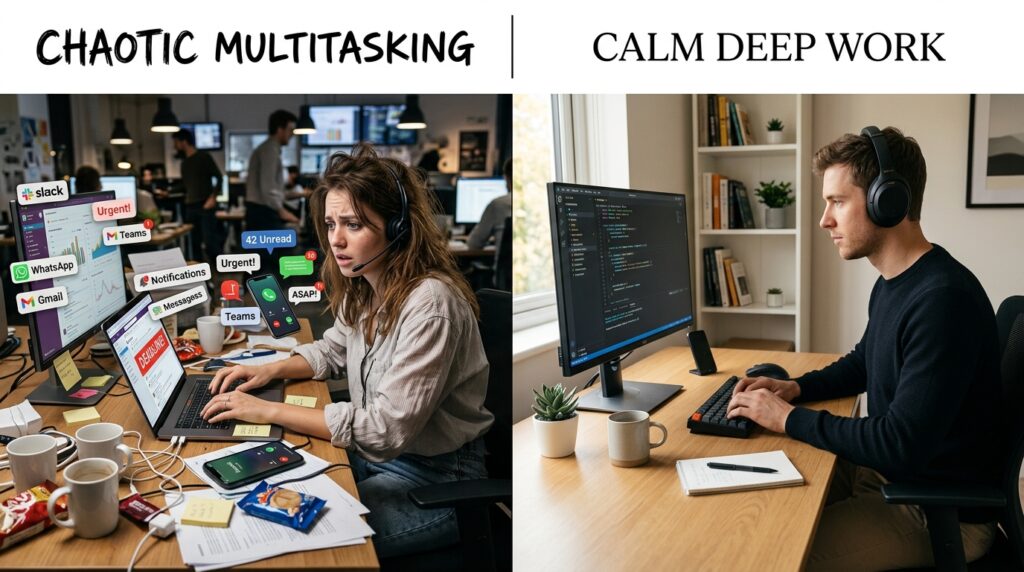
At the heart of the multitasking myth lies one critical misunderstanding:
Not all work is equal.
Some work creates value.
Some work just creates noise.
What Is Deep Work?
Deep work is the ability to focus without distraction on cognitively demanding tasks.
It involves:
- Problem-solving
- Creative thinking
- Strategy and decision-making
This is where:
Real results are created.
What Is Shallow Work?
Shallow work includes tasks that are:
- Easy to replicate
- Low cognitive effort
- Often done while distracted
Examples:
- Emails
- Notifications
- Status updates
These tasks feel productive…
But rarely move your life forward.
Why Multitasking Traps You in Shallow Work
Multitasking automatically pushes you into shallow work mode.
Because:
- Deep work requires uninterrupted focus
- Multitasking creates constant interruptions
So instead of creating value…
You spend your day maintaining activity.
The Competitive Advantage of Focus
Here’s the reality:
Focus is rare.
And anything rare becomes valuable.
If you can:
- Eliminate distractions
- Work deeply for 1–2 hours daily
You will outperform 90% of people.
Not because you work harder…
But because you work smarter.
Why Most Productivity Advice Fails (And Keeps You Stuck)
If multitasking is so harmful…
Why do most people fail to fix it?
Because the advice they follow is broken.
If you also struggle with performance breakdowns, read our guide on self-sabotage at work.
The Willpower Myth
Most advice says:
“Just focus.”
But focus is not a decision.
It’s a biological state.
Your brain is fighting:
- Dopamine cravings
- Attention residue
- Cognitive overload
Willpower alone can’t win that battle.
The Hustle Culture Trap
Traditional productivity promotes:
- Doing more
- Working faster
- Staying busy
This leads to:
More multitasking.
Which leads to:
Less meaningful output.
Ignoring the Biology of Focus
Most advice treats productivity as a habit problem.
But it’s actually a:
Brain problem.
If your environment triggers distraction…
No habit will save you.
Emotional Resistance & the Boredom Barrier
Here’s something most people don’t realize:
Focus feels uncomfortable at first.
When you sit with one task:
- Boredom appears
- Anxiety rises
- Urge to switch increases
This is the Resistance Point.
And most people escape it…
By multitasking.
Dopamine Withdrawal & Focus Fatigue
When you stop multitasking:
Your brain goes through withdrawal.
You may feel:
- Restless
- Irritated
- Unmotivated
This is normal.
Your brain is recalibrating.
The Real Problem: Environment, Not Discipline
You don’t have a focus problem.
You have an environmental problem.
If distractions are always present…
Your brain will always switch.
The solution is not trying harder.
It’s designing smarter.
How to Escape the Multitasking Myth Using the MOSU Protocol
This is where everything changes.
You don’t need more motivation.
You need a system.
Introducing:
To break free from the multitasking myth, you need a system—not willpower.
The MOSU Focus Protocol
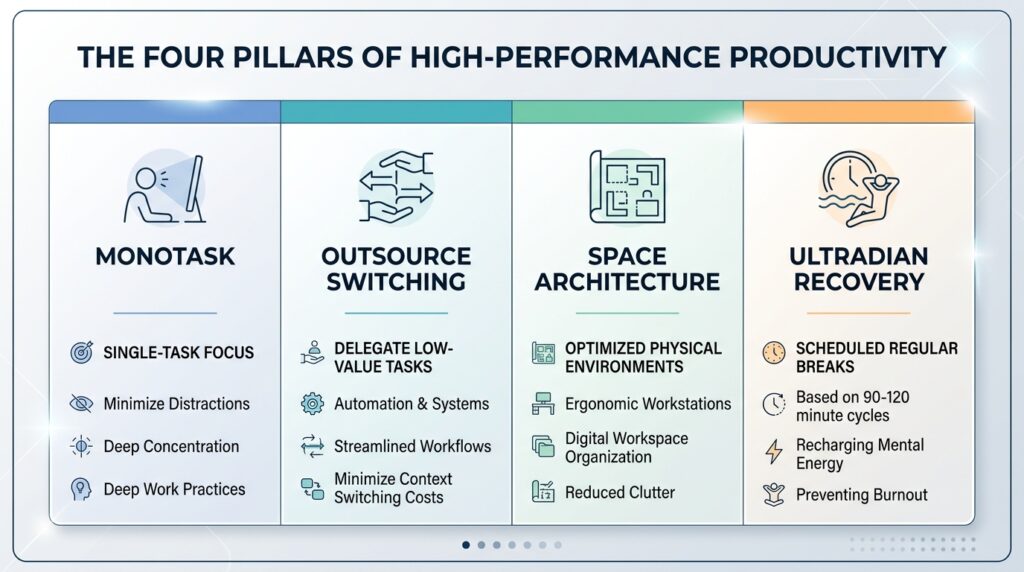
A neuroscience-based framework designed to:
- Eliminate task switching
- Protect your attention
- Maximize deep work output
M — Monotask by Design
Focus on one task.
One tab.
One goal.
No switching.
Neuro Benefit: Eliminates attention residue and protects working memory.
O — Outsource the Switching (Batching Firewall)
Schedule specific times for:
- Messages
- Admin tasks
Do not check them randomly.
Neuro Benefit: Reduces dopamine spikes and protects the Prefrontal Cortex.
S — Space Architecture (Environment Control)
Change your environment to remove triggers:
- Phone in another room
- Notifications off
- Clean workspace
Neuro Benefit: Reduces cognitive load and distraction cues.
U — Ultradian Recovery (90-Minute Sprints)
Work in focused blocks:
- 60–90 minutes of deep work
- 10–20 minutes break
No screens during breaks.
Neuro Benefit: Prevents neural fatigue and restores brain energy.
The Practical Toolkit: Systems That Replace Multitasking
To implement the MOSU Protocol, use these frameworks:
Time Blocking (Cognitive Budgeting)
Plan your day.
Assign time slots for each task.
This removes decision fatigue.
Monotasking (Single-Threading Work)
Commit fully to one task until completion.
No switching allowed.
This creates deep focus.
Attention Batching
Group similar tasks together:
- All emails at once
- All messages at once
This reduces switching cost.
Pomodoro / 50-10 Rule
Work in intervals:
- 50 minutes of work
- 10-minute break
This maintains energy and focus.
The 90-Minute Focus Blueprint: A Workday System That Replaces Multitasking
Understanding the multitasking myth is powerful.
But real transformation comes from execution.
Here’s a practical daily system based on the MOSU Protocol:
08:00 – 08:30 | The Cognitive Warm-Up
No email. No phone. No notifications.
This protects your brain from early dopamine spikes.
08:30 – 10:00 | Deep Work Sprint #1
Monotask your most important project.
This is your highest-energy window.
10:00 – 10:15 | Ultradian Recovery
Take a break without screens.
Walk, stretch, or sit quietly.
10:15 – 11:45 | Deep Work Sprint #2
Continue focused work or strategic thinking.
11:45 – 12:30 | Batching Firewall
Check emails, Slack, and messages.
Handle all communication in one block.
12:30 – 13:30 | Midday Reset
Eat, move, and relax.
13:30 – 15:00 | Collaboration / Meetings
Use this time for lower-intensity work.
15:00 – 15:15 | Recovery Break
Reset your attention again.
15:15 – 16:30 | Light Work / Wrap-Up Sprint
Finish remaining tasks or plan.
16:30 – 17:00 | Final Batch & Shutdown
Clear messages and prepare tomorrow’s priorities.
This system ensures:
- Maximum deep work output
- Minimum task switching
- Sustained mental energy
Case Study: From Multitasking Burnout to Focus Mastery
The Before: Constant Switching
Ali, a mid-level manager, believed multitasking made him efficient.
His day looked like this:
- Emails during meetings
- Slack messages every 5 minutes
- Switching between 10+ tasks daily
Result:
- Exhaustion by the afternoon
- Unfinished high-priority work
- Constant stress
The After: Applying the MOSU Protocol
Ali implemented:
- 90-minute deep work blocks
- Batching communication
- Phone removal (environment control)
Within 3 weeks:
- Completed major projects faster
- Reduced stress significantly
- Regained mental clarity
Key Insight:
He didn’t work anymore.
He stopped switching.
Multitasking vs MOSU Protocol: A Clear Comparison
| Factor | Multitasking Myth | MOSU Protocol |
|---|---|---|
| Brain Function | Overloaded & fragmented | Focused & optimized |
| Energy Usage | Rapid depletion | Sustained energy cycles |
| Productivity | Busy but ineffective | High-value output |
| Stress Level | High (cortisol spikes) | Low (controlled focus) |
| Memory Retention | Poor | Strong |
FAQs – Multitasking Myth & Focus
1. Is multitasking real?
No. The brain cannot perform two complex tasks simultaneously. It switches between them.
2. Why does multitasking feel productive?
Because of dopamine release when switching tasks, creating a false sense of achievement.
3. How long does it take to recover focus after switching?
Research shows it can take up to 20–25 minutes to regain full focus.
4. Can some people multitask better?
Only a very small percentage (~2–3%) can handle it effectively. Most people cannot.
5. What is the biggest problem with multitasking?
It reduces productivity, increases stress, and weakens attention control over time.
6. What is the best alternative to multitasking?
Monotasking combined with structured work systems like the MOSU Protocol.
Conclusion: Stop Multitasking. Start Thinking Clearly.
The multitasking myth has fooled millions of professionals.
It promises productivity…
But delivers distraction, fatigue, and burnout.
The truth is simple:
You are not a multitasker.
You are a task switcher.
And the moment you break the multitasking myth, your productivity and clarity transform instantly.
And every switch is costing you:
- Time
- Energy
- Focus
But now, you have a different path.
With the MOSU Focus Protocol, you can:
- Reclaim your attention
- Increase your output
- Work with your brain—not against it
Start small.
One task.
One focus block.
No switching.
Because real productivity is not about doing more.
It’s about doing what matters…
without distraction.
Final Thought:
Multitasking is not a skill.
It’s a cognitive illusion.
And the moment you see through it…
Your performance changes forever.

