
It’s a Friday night. You’re on the couch, half-watching something, scrolling with the other half of your attention. A former classmate posts a promotion. Someone you follow shares a sun-drenched trip with their partner. A stranger’s fitness transformation autoplays next. None of it is dramatic. And yet, somewhere in the space of five minutes, a quiet thought settles in: I’m behind.
If that sounds familiar, it’s worth naming what’s actually happening: social comparison psychology has a well-documented explanation for this, and it isn’t about a lack of discipline or gratitude. It’s one of the most well-documented patterns in psychology, and it has a name — social comparison. Some research suggests a striking amount of our mental life is spent this way; one commonly cited estimate puts the figure at around 12 percent of daily thoughts involving some form of comparison. Whether the exact number holds up perfectly across contexts almost doesn’t matter. The behavior is common enough to warrant a real explanation, not just a warning to stop doing it.
So this isn’t going to be another article telling you to log off and be grateful. It’s an attempt to explain what’s actually happening when you compare yourself to someone else, why the instinct is so hard to switch off, and what tends to help — according to the evidence, not according to a slogan.

What Social Comparison Psychology Actually Explains
Social comparison is the process of evaluating your own abilities, circumstances, or worth by measuring and comparing yourself with those of others. Psychologist Leon Festinger described this in 1954: when we don’t have an objective way to judge ourselves — no ruler, no scoreboard — we borrow other people as the measuring stick. Am I doing okay at my job? Compared to whom? Am I attractive, successful, likeable, behind schedule? All of those questions are, quietly, comparative questions.
This is different from simple curiosity about other people’s lives. Comparison specifically involves judgment — a “better than,” “worse than,” or “about the same as” running in the background, often without much conscious effort. Festinger’s insight was that this isn’t an occasional glitch. It’s a built-in method the mind uses to answer questions it can’t answer any other way.
Why the Brain Keeps Doing This
Festinger’s theory explains the what. Newer research helps explain the why it feels so automatic.
One line of research on reward and social comparison has found that the brain’s response to an outcome isn’t just about the outcome itself — it’s shaped by how that outcome stacks up against someone else’s. In other words, a win can feel different depending on whether a peer did better or worse in the same moment. This kind of relative-reward effect, studied through neuroimaging of reward-related brain regions, suggests that “how am I doing” is processed, at least partly, as “how am I doing relative to them” — not as an isolated number.
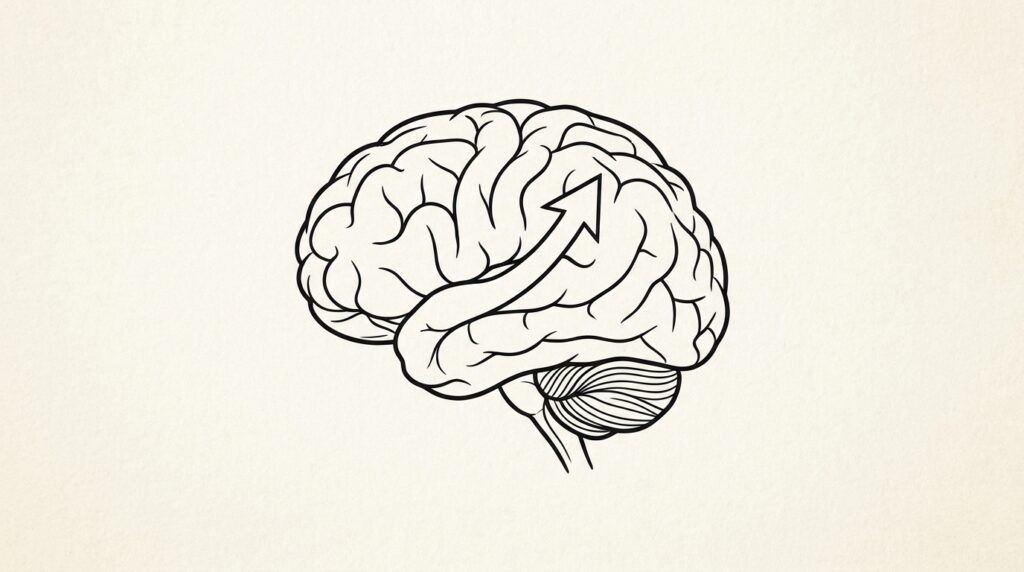
There’s also a well-established idea in social psychology called the self-evaluation maintenance model, developed by Abraham Tesser. It explains something most people have felt but rarely named: why a close friend’s success can feel wonderful in one moment and strangely threatening in another. Tesser’s research suggests the difference comes down to relevance. If a friend excels at something that isn’t central to your own identity, you tend to bask in their success. If they excel at something you care deeply about being good at yourself, the same success can sting — not because you’re a bad friend, but because it touches a nerve tied to your own self-image.
Then there’s the evolutionary angle, which is more interpretive than proven, but worth naming as a lens rather than a fact: for most of human history, people lived in small, tightly knit groups. Being able to track your standing within that group — who had more resources, more allies, more respect — wasn’t vanity. In a group of roughly 150 people, which is close to what researcher Robin Dunbar proposed as a rough ceiling for stable human social relationships, that kind of tracking was practically useful information.
Today, that same instinct is fed an entirely different diet. Instead of comparing yourself to a few dozen people you actually know, you’re scrolling past a curated cross-section of millions of strangers, many of them presenting an edited, best-case version of their lives. The mechanism itself hasn’t changed much. The environment around it has changed enormously. That mismatch — an old system operating in a new setting — is a useful way to think about why comparison can feel so relentless now, even if it’s hard to prove definitively.
Upward and Downward: Comparison Has a Direction
Most comparisons fall into two categories: upward (comparing yourself to someone who seems better off) and downward (comparing yourself to someone who seems worse off). Upward comparison tends to get more attention, and for good reason — it’s the one most tied to modern self-esteem struggles.
But upward comparison isn’t a single experience. It splits into two very different paths depending on the target and the framing:
- The discouraging path happens when the comparison target feels impossibly distant — a celebrity, an influencer, someone whose life looks nothing like a realistic next step from where you stand. This version of upward comparison is more strongly associated with envy and diminished self-esteem.
- The motivating path happens when the target feels close enough to be instructive — a colleague slightly ahead of you in a specific skill, a peer whose progress feels like a plausible blueprint rather than a fantasy. Comparison here can function more like a benchmark than a wound.
Downward comparison — noticing someone worse off — tends to show up as a kind of psychological shortcut for feeling better in the moment. It’s not inherently malicious, but leaning on it too often creates a fragile version of self-esteem, one that quietly depends on someone else struggling to feel intact. It’s worth naming honestly rather than pretending it doesn’t happen; most people do it more than they’d admit.
The Modern Amplifier: Why Social Media Changes the Math
Comparison existed long before smartphones — in classrooms, workplaces, and families. But social media doesn’t just add one more place to compare yourself. It changes the structure of comparison itself, in a few specific ways.
First, it attaches numbers to social standing. Likes, followers, and views turn something that used to be a vague feeling into a visible scoreboard, which plugs directly into the same reward-tracking process described earlier.
Second, it creates a fundamental asymmetry. In daily life, you see people’s full range — good days, bad days, boredom, failure. On a feed, you’re mostly seeing a highlight reel, edited and re-shot until it looks effortless. Comparing your unfiltered, in-progress life to someone else’s final cut isn’t a fair fight, even when neither side intends to deceive the other.
Third, the content that spreads widest is often the most extreme — the most polished, most dramatic, most aspirational. That’s not necessarily anyone’s fault; it’s simply what tends to perform well. But it means the sample of people you’re comparing yourself to is quietly skewed toward the exceptional, not the typical.
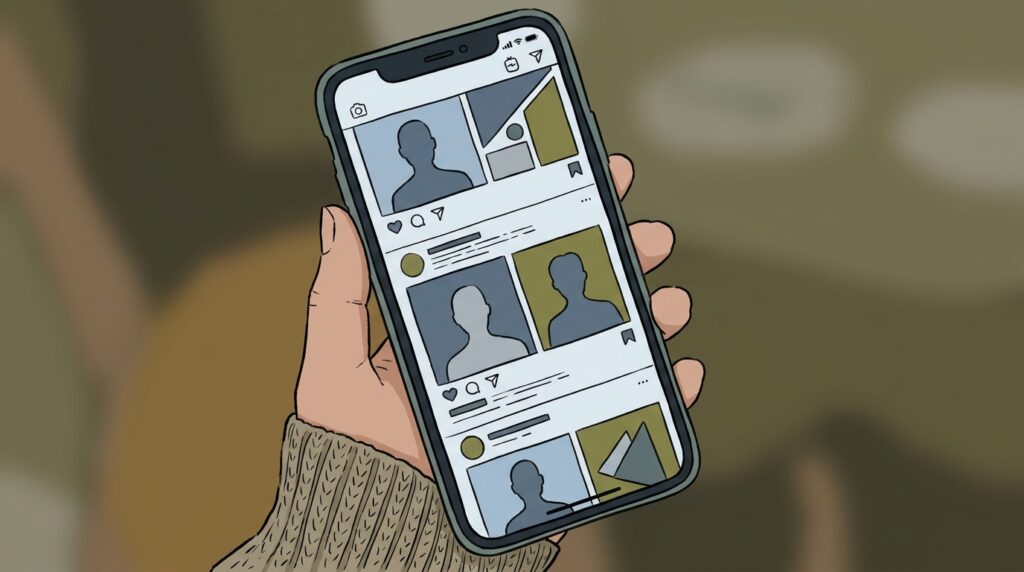
A few everyday examples make this concrete:
- Career and income: A former classmate’s “excited to announce” post about a new role can trigger a disproportionate wave of financial anxiety, especially in an economy where traditional milestones already feel delayed for a lot of young adults.
- Relationships: Curated glimpses of someone else’s relationship — trips, anniversaries, soft-focus photos — can make an ordinary, imperfect, very normal relationship (or an ordinary single Friday night) feel like evidence of falling behind, even though what’s visible online is rarely the whole picture.
- Appearance and fitness: A heavily edited transformation video can quietly reset what “normal” looks like, making an average, healthy body feel inadequate by comparison.
Comparison, Self-Esteem, and Mental Health
It’s fair to ask directly: is this actually connected to anxiety and low self-esteem, or is that overstated? The honest answer is that research generally supports a real association — frequent, unfavorable upward comparison, especially the social-media-driven kind, has been linked in multiple studies to lower self-esteem and higher rates of anxious or depressive symptoms. That’s a correlation worth taking seriously, not a guarantee about any individual’s experience, and it doesn’t mean comparison causes a mental health condition in every case, or that everyone who compares themselves to others will struggle in this way.
It’s also worth being clear about where the line sits. Comparing yourself to others sometimes, even uncomfortably, is a normal part of being a social creature. If comparison-driven distress is significantly interfering with daily functioning, mood, sleep, or relationships over time, that’s a reasonable point to bring it to a therapist or counselor rather than trying to self-diagnose from an article. This piece is educational, not a substitute for that kind of support.
Why “Just Stop Comparing Yourself” Doesn’t Work
This is probably the most repeated piece of advice on the subject, and it deserves a direct response: it’s not particularly useful advice, and here’s why.
Telling someone to simply stop comparing is a bit like telling them to stop noticing hunger. The comparative instinct, as the research above suggests, seems to operate largely below conscious control — it’s not a habit you’re failing to break through insufficient willpower so much as a background process that runs whether you want it to or not.
There’s also a case that eliminating comparison wouldn’t even be desirable. Comparison, in moderate and realistic doses, helps people learn social norms, calibrate their own skills honestly, and find genuine sources of inspiration. Someone with zero interest in how they measure up against others would lose a real source of feedback and motivation.
A more workable goal isn’t elimination — it’s regulation. Not stopping the instinct, but changing what you feed it and how you respond when it shows up.
What Actually Seems to Help
None of the following will switch off the instinct to compare. But they can change its frequency, its intensity, and how much power it has over your mood.
Notice the pattern before trying to fix it. For a few days, simply pay attention to when the comparison feeling shows up — which platform, which person, which topic. Most people find their triggers cluster around two or three specific areas rather than being spread evenly across everything.
Add friction to passive scrolling. The comparisons that sting the most tend to happen during unfocused, passive consumption rather than active engagement with people you know. Small changes — muting specific accounts that consistently trigger the feeling, or simply making the habit slightly less automatic — can meaningfully reduce how often the comparison switch gets flipped.
Reappraise the visible success. When an upward comparison lands hard, it can help to briefly write out what’s not shown in that one polished image or post — the setbacks, the boring effort, the unrelated struggles most people don’t post about. This isn’t about dismissing someone else’s achievement; it’s about restoring the context that got edited out.
Choose realistic comparison targets on purpose. Rather than fighting the instinct to compare, it can help to redirect it — deliberately looking to someone whose position feels like a plausible next step, rather than an unreachable outlier. This shifts comparison from a source of shame into something closer to a usable blueprint.
Compare across time, not just across people. Self-compassion researcher Kristin Neff’s work suggests that treating yourself with the same warmth you’d offer a friend — rather than harsh self-criticism — supports greater resilience over time. One practical version of this: occasionally measure yourself against where you were a year or two ago, not only against where someone else currently stands. This doesn’t replace comparing yourself to others; it simply adds a second, often kinder, reference point.
A Few Questions Worth Sitting With

Rather than closing with a checklist, it might be more honest to leave you with a few questions instead — not to answer quickly, but to actually sit with.
Whose life or timeline are you measuring yourself against right now, and did you ever really choose to play that particular comparison — or did it just arrive on your feed?
If you had the exact thing you’re currently envying, what would you likely be trading away to get it — and would that trade actually be worth it, given what you value?
And when you think honestly about where you were a few years ago, what has actually changed for the better — the kind of progress your comparing mind tends to skip right past?
This article is intended for educational purposes and should not be considered medical, psychological, or mental health advice. If comparison-related distress is significantly affecting your daily functioning, consulting a qualified mental health professional may be helpful.
Frequently Asked Questions
What is social comparison theory? Social comparison theory, introduced by psychologist Leon Festinger in 1954, describes the tendency to evaluate our own opinions, abilities, and worth by comparing ourselves to other people, especially when no objective standard is available.
Why do I constantly compare myself to others? Comparison appears to be a largely automatic mental process rather than a conscious choice. Some research estimates that a notable share of daily thoughts — around 12 percent by one commonly cited figure — involve some form of comparison, which helps explain why it can feel so persistent.
Is social comparison linked to anxiety and depression? Research generally supports an association between frequent, unfavorable upward comparison — particularly the kind driven by social media — and lower self-esteem, anxiety, and depressive symptoms. This is a correlation, not a guarantee for any individual, and normal comparison is different from a clinical concern.
What are the benefits of social comparison? When directed at realistic, relatable targets rather than distant outliers, comparison can provide useful benchmarks, motivate self-improvement, and help people calibrate their skills against real-world standards.
How do I stop comparing myself to others on social media? Complete elimination isn’t realistic or necessarily desirable. More effective approaches include noticing personal triggers, reducing passive scrolling, muting specific accounts that consistently provoke the feeling, reappraising what’s missing from a curated post, and deliberately choosing realistic comparison targets over unreachable ones.

