
Relationships often become more emotionally rewarding as they grow deeper. Yet for many couples, this is also the point when one partner unexpectedly becomes quieter, less expressive, or emotionally distant. A person who once seemed eager to connect may suddenly take longer to reply to messages, avoid meaningful conversations, or appear emotionally unavailable.
If you’ve experienced this, it’s understandable to wonder whether the relationship is falling apart. Questions like “Did I do something wrong?”, “Have they stopped loving me?”, or “Is this the beginning of the end?” are common reactions.
The reality is often more complex.
Research in relationship psychology suggests that emotional withdrawal can have many causes. Sometimes it reflects external stress, difficulty coping with vulnerability, fear of commitment, or learned relationship patterns rather than a loss of love. That does not mean every relationship will recover, nor does it mean distance should always be ignored. Instead, understanding why people pull away in relationships provides a more balanced starting point for deciding how to respond.
This article explores what psychological research currently suggests about emotional withdrawal, why it happens when relationships become more serious, and practical ways to respond without making an already difficult situation worse.
Educational Note: This article is intended for educational purposes only. It should not be considered medical, psychological, or relationship counseling. Every relationship is unique, and persistent concerns may benefit from guidance from a qualified mental health or relationship professional.
Quick Answer
People often pull away in relationships because emotional closeness can activate stress, vulnerability, fear of commitment, or long-standing coping patterns. In many cases, emotional distance reflects an attempt to manage internal discomfort rather than a sudden loss of love. Looking at the overall pattern of the relationship—not a single period of withdrawal—provides a more accurate picture of what may be happening.
When Someone Pulls Away, Does It Mean They Don’t Love You?
For many people, emotional distance feels deeply personal.
When a partner suddenly becomes less affectionate or less communicative, the mind naturally searches for an explanation. Unfortunately, it often settles on the most painful one first: “They don’t love me anymore.”
Although this conclusion feels convincing in the moment, it is not always supported by evidence.
Human behavior is influenced by many overlapping factors. Work pressure, family responsibilities, financial uncertainty, emotional exhaustion, physical health, previous relationship experiences, and individual coping styles can all influence how someone behaves in a close relationship.
Someone who withdraws emotionally may still care deeply about their partner while struggling to process overwhelming emotions. Others may temporarily reduce communication because they believe they need to solve problems independently before reconnecting.
Of course, emotional withdrawal can sometimes indicate declining relationship satisfaction. It may also signal unresolved conflict or incompatible expectations. This is why it is important to avoid interpreting a single behavior as proof of a single explanation.
Instead of asking:
“Does distance always mean love is gone?”
A more helpful question is:
“What broader pattern does this relationship show over time?”
Looking at consistent behavior across weeks or months usually provides much more reliable insight than reacting to one stressful period.
Why Emotional Distance Feels So Painful
Humans are naturally social.
Close relationships provide emotional support, predictability, and a sense of security. When those signals suddenly change, many people experience uncertainty before they experience clarity.
That uncertainty often creates emotional discomfort because our brains dislike unanswered questions.
Instead of waiting for more information, the mind frequently fills in the gaps with worst-case assumptions:
- “They’re losing interest.”
- “They’re about to leave me.”
- “I must have done something wrong.”
- “I’m not enough.”
These thoughts feel real because they attempt to explain an uncertain situation quickly.
However, uncertainty is not evidence.
Learning to distinguish facts from assumptions is one of the most valuable psychological skills for navigating relationship stress.

Why People Pull Away When Relationships Become Serious
Relationships become more emotionally meaningful over time.
Ironically, this deeper connection can also increase emotional pressure.
For some people, greater intimacy creates feelings of comfort and security.
For others, it activates fears they never realized they carried.
Understanding these psychological processes helps explain why someone may become emotionally distant even while continuing to care about the relationship.
Emotional Closeness Increases Vulnerability
Loving someone also means becoming emotionally exposed.
The more important a relationship becomes, the more someone has to lose.
For individuals who have experienced painful rejection, betrayal, unstable relationships, or emotional disappointment in the past, greater closeness may unconsciously increase fear rather than comfort.
Instead of consciously deciding to create distance, they may instinctively reduce emotional exposure because it feels psychologically safer.
This reaction is not necessarily logical.
It is often automatic.
Fear of Commitment Is Not Always Fear of Love
The phrase fear of commitment is commonly misunderstood.
Many people imagine someone who simply dislikes serious relationships.
Reality is often more nuanced.
Some individuals genuinely want long-term relationships while simultaneously feeling anxious about the responsibilities, expectations, or permanence that deeper commitment represents.
Questions such as these may quietly emerge:
- “What if I disappoint them?”
- “What if I lose my independence?”
- “What if this relationship eventually ends and I get hurt?”
- “Am I ready for this level of responsibility?”
These internal conflicts can create emotional hesitation that appears as distance from the outside.
The Pressure of Emotional Intimacy
Emotional intimacy means allowing another person to see thoughts, fears, hopes, disappointments, and insecurities that are rarely shared with others.
For many people, this is rewarding.
For others, it feels unfamiliar.
If someone grew up believing emotions should remain private or that vulnerability leads to criticism, deeper intimacy may feel uncomfortable rather than reassuring.
As emotional closeness increases, withdrawing can become a familiar coping strategy that temporarily reduces emotional discomfort.
The person is not necessarily rejecting their partner.
They may simply be trying to reduce emotional intensity in the only way they have learned.
External Stress Can Change Relationship Behavior
Not every relationship problem begins inside the relationship.
Major life events can dramatically affect emotional availability.
Examples include:
- Increasing workload
- Financial pressure
- Caring for family members
- Health concerns
- Academic stress
- Career uncertainty
- Major life transitions
When emotional resources become limited, people often prioritize immediate survival tasks before emotional connection.
To the partner experiencing the distance, this may feel like rejection.
To the overwhelmed individual, it may simply feel like trying to make it through the week.
Recognizing this difference helps prevent unnecessary misunderstandings while still acknowledging that both partners’ emotional needs matter.
What Happens Inside the Brain During Emotional Withdrawal?
When someone becomes emotionally distant, it’s easy to assume they have consciously decided to disconnect from the relationship. In reality, human behavior is often influenced by automatic brain processes that operate long before we fully understand what we’re feeling.
This doesn’t mean the brain “forces” someone to pull away or that every instance of withdrawal is purely biological. Instead, psychological research suggests that stress, emotional overload, and learned coping patterns can temporarily change how people think, communicate, and connect with others.
Understanding these processes can help replace self-blame with curiosity.
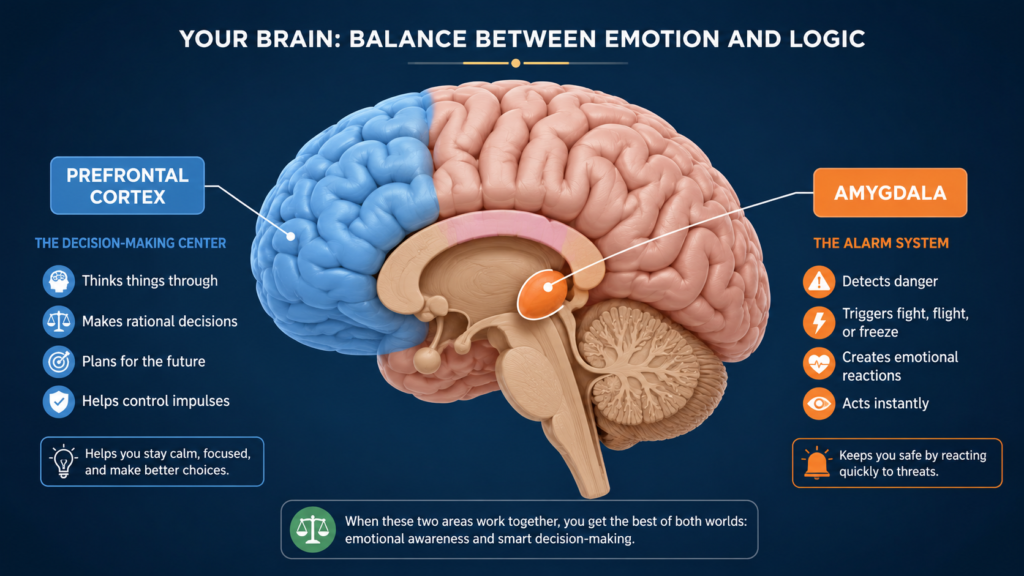
The Brain’s Built-In Alarm System
Imagine your brain as a house with a sophisticated security system.
When everything feels safe, the house remains open. Conversations flow naturally, emotions are easier to express, and connecting with loved ones requires little effort.
When the brain detects a possible threat—whether it’s a genuine danger or an emotionally stressful situation—that security system becomes more alert.
One of the brain structures involved in processing emotionally significant events is the amygdala. It helps identify situations that may require extra attention or caution.
Importantly, emotional vulnerability can sometimes feel threatening even when no physical danger exists.
For example:
- A difficult conversation about the future.
- Moving in together.
- Discussing marriage.
- Sharing painful childhood experiences.
- Fear of disappointing someone you deeply love.
For some people, these moments strengthen connection.
For others, they activate an internal sense of uncertainty that encourages withdrawal until they feel emotionally safer.
Stress Reduces Emotional Bandwidth
Think of emotional energy as a phone battery.
When the battery is nearly full, it’s easier to be patient, affectionate, and emotionally available.
When the battery is almost empty after days or weeks of chronic stress, even simple conversations may feel overwhelming.
Research suggests that prolonged stress can reduce the mental resources people use for planning, emotional regulation, decision-making, and thoughtful communication.
This doesn’t excuse hurtful behavior.
However, it helps explain why someone under significant pressure may become quieter, forgetful, emotionally flat, or less responsive than usual.
Sometimes the relationship hasn’t become less important.
The person’s emotional capacity has temporarily become smaller.
Why Some People Stop Talking Instead of Explaining
One of the most frustrating experiences in a relationship is hearing:
“I don’t know what’s wrong.”
To the listener, this can sound dishonest or dismissive.
Yet many people genuinely struggle to identify and describe complicated emotions while they are experiencing them.
When stress levels are high, organizing thoughts into clear explanations becomes more difficult.
Instead of saying:
“I’m overwhelmed, scared about the future, emotionally exhausted, and worried I can’t meet your expectations,”
someone might simply become quieter.
Silence is not always intended to punish another person.
Sometimes it reflects difficulty finding the words needed to explain what’s happening internally.
That said, healthy relationships still require communication over time. Temporary withdrawal becomes more manageable when both partners eventually return to the conversation with openness and honesty.
Attachment Styles Explained Simply
Why do two people experience the same relationship differently?
One partner may see emotional closeness as comforting.
Another may experience the same closeness as overwhelming.
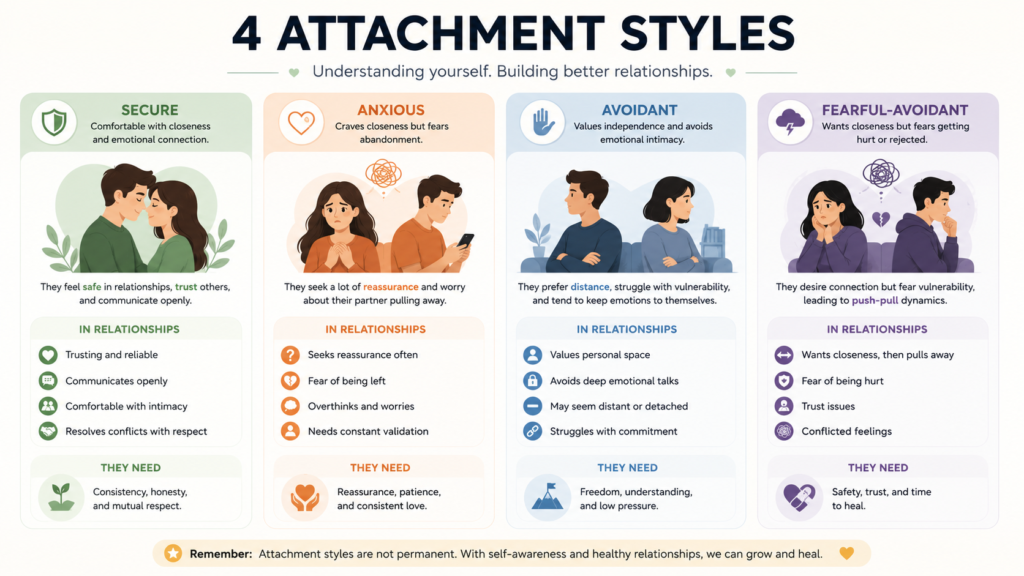
Attachment theory offers one evidence-based framework for understanding these differences.
According to decades of psychological research, our earliest caregiving experiences may influence how we approach trust, closeness, conflict, and emotional dependence in adulthood. These patterns are not permanent labels or diagnoses. They simply describe common ways people relate to others.
Many people also show characteristics from more than one attachment style depending on the relationship or stage of life.
Secure Attachment
People with relatively secure attachment generally feel comfortable balancing closeness with independence.
They are more likely to:
- Communicate openly.
- Express emotions respectfully.
- Ask for support when needed.
- Give their partner healthy space without assuming rejection.
- Recover more effectively after disagreements.
Secure attachment doesn’t mean relationships are conflict-free.
It means conflict is less likely to threaten the foundation of the relationship.
Anxious Attachment
People with anxious attachment often place a high value on emotional connection.
When a partner suddenly becomes distant, uncertainty can feel extremely uncomfortable.
Common reactions may include:
- Seeking reassurance repeatedly.
- Overanalyzing messages.
- Assuming the worst.
- Feeling responsible for fixing the relationship immediately.
- Becoming highly sensitive to changes in communication.
These reactions usually come from fear rather than manipulation.
The goal is often to restore closeness as quickly as possible.
Avoidant Attachment
Avoidant attachment is frequently misunderstood.
It does not automatically mean someone dislikes relationships or lacks empathy.
Instead, some people have learned that relying heavily on others feels emotionally risky.
When relationships become more serious or emotionally intense, their first instinct may be to create distance while they regain a sense of emotional control.
This can appear as:
- Wanting more personal space.
- Avoiding emotionally intense conversations.
- Focusing heavily on work or hobbies.
- Becoming less expressive during stressful periods.
- Processing emotions privately before discussing them.
Many avoidant individuals genuinely care about their partners.
Their challenge often lies in expressing that care while feeling emotionally overwhelmed.
Fearful-Avoidant Attachment
Some people experience a mixture of both anxious and avoidant tendencies.
They want closeness but also fear it.
They may move toward emotional intimacy one day and withdraw the next.
This pattern can feel confusing for both partners because their behavior appears inconsistent.
Again, attachment styles describe patterns—not fixed identities.
Awareness creates opportunities for healthier communication and personal growth.
The Pursue-Withdraw Cycle
One of the most common relationship patterns is sometimes called the pursue-withdraw cycle.
It often develops unintentionally.
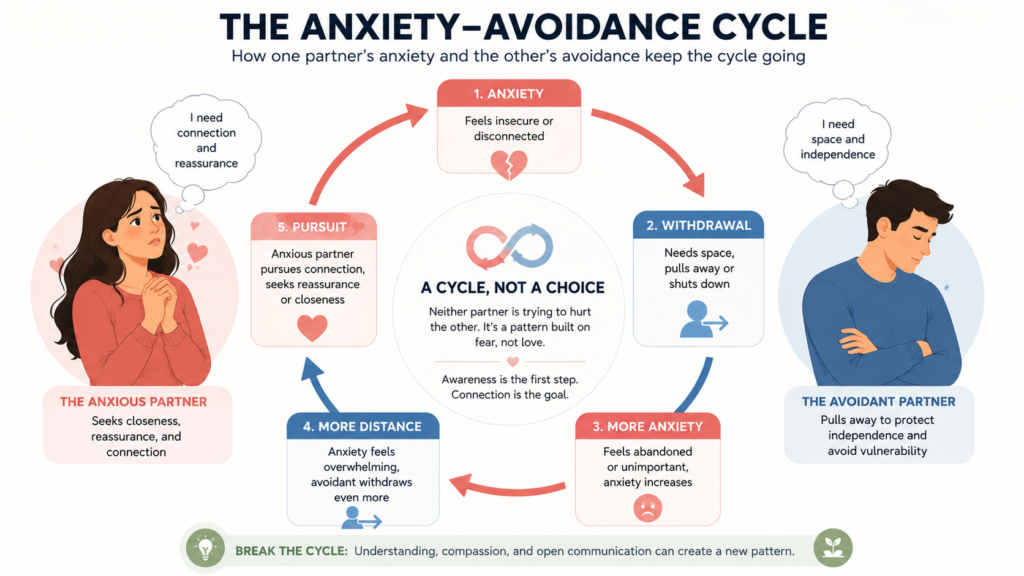
Here’s how it typically unfolds:
- One partner becomes emotionally distant.
- The other partner notices the change.
- Anxiety increases.
- They reach out more frequently, ask repeated questions, or seek reassurance.
- The withdrawn partner feels pressured or overwhelmed.
- They create even more distance.
- The first partner becomes even more anxious.
Neither person usually intends to hurt the other.
Both are trying to reduce their own emotional discomfort.
One seeks connection.
The other seeks emotional breathing room.
Without understanding this cycle, each person’s attempt to solve the problem accidentally strengthens it.
Recognizing the pattern is often the first step toward changing it.
How Childhood Experiences Can Shape Adult Relationships
No childhood perfectly predicts adult relationships.
Many people build healthy, secure relationships despite difficult early experiences.
Likewise, people raised in supportive environments can still struggle with intimacy later in life.
Even so, psychologists have found that early relationship experiences may influence the coping strategies people carry into adulthood.
The important word is may.
Human development is shaped by many factors throughout life.
Learning That Emotions Were Unsafe
Some people grow up in homes where expressing emotions led to criticism, punishment, or dismissal.
Over time, they may learn that keeping feelings private feels safer than expressing them openly.
As adults, they may still care deeply about their partners while instinctively withdrawing during emotionally intense moments.
The behavior is less about rejecting another person and more about repeating a familiar coping strategy.
Becoming Hyper-Independent
Children who repeatedly experience unreliable emotional support sometimes learn to depend primarily on themselves.
This self-reliance can become a strength in many areas of life.
However, in close relationships, extreme independence may make accepting emotional support feel unfamiliar or uncomfortable.
When stress increases, these individuals may instinctively solve problems alone instead of leaning on their partner.
From the outside, this can look like emotional distance.
Internally, it may feel like the safest way they know to cope.
Why Awareness Matters More Than Blame
Understanding childhood influences is not about blaming parents or searching for someone at fault.
Instead, it helps explain why certain relationship patterns feel automatic.
The encouraging news is that learned behaviors can change.
With self-awareness, healthy relationships, supportive environments, and in some cases professional guidance, many people gradually develop more secure ways of communicating, trusting, and responding to emotional closeness.
Recognizing these patterns allows couples to move from asking:
“What’s wrong with you?”
to asking:
“What experiences might have shaped how each of us responds when relationships become emotionally challenging?”
That shift alone can transform conflict into understanding and create a stronger foundation for future conversations.
Stress Outside the Relationship Can Look Like Relationship Problems
Not every relationship challenge begins within the relationship itself.
Sometimes the emotional distance you notice is connected to pressures your partner is facing elsewhere. Work deadlines, financial uncertainty, family responsibilities, health concerns, or major life transitions can consume emotional energy that would otherwise be available for connection.
This doesn’t mean the relationship should be ignored or that your emotional needs are unimportant. Instead, it highlights an important psychological principle: people often bring the emotional effects of external stress into their closest relationships.
For example, imagine someone who has spent the entire day making difficult decisions at work, worrying about job security, and caring for an aging parent. By the time they come home, they may have very little emotional energy left for meaningful conversation.
Their silence may feel personal.
To them, it may simply feel like exhaustion.
Understanding this distinction can reduce unnecessary conflict while creating space for healthier communication.
If you’re interested in how chronic stress affects thinking and emotional well-being, you can also explore Evidence-Based Stress Management: Practical Strategies for Greater Mental Well-Being on MOSU MIND.
Myths vs. Reality
Relationship advice on social media often relies on absolute statements.
Real relationships are rarely that simple.
Separating myths from evidence can help you respond more thoughtfully instead of reacting from fear.
Myth: If They Pull Away, They Must Be Falling Out of Love
Reality
Emotional distance has many possible explanations. Stress, emotional overload, uncertainty, fear of vulnerability, unresolved conflict, or changing relationship expectations may all contribute. Looking at one behavior without considering the broader context can lead to inaccurate conclusions.
Myth: Sending More Messages Will Bring Them Back
Reality
When someone feels emotionally overwhelmed, repeated attempts to force communication may increase pressure instead of connection.
A calm, respectful check-in is usually more effective than sending multiple messages driven by anxiety.
Myth: Healthy Couples Never Need Space
Reality
Healthy relationships balance closeness with individuality.
Many people benefit from occasional personal space to process emotions, pursue hobbies, or recover from stressful experiences.
Needing space is not automatically a sign that something is wrong.
Myth: Love Should Always Feel Easy
Reality
Long-term relationships naturally move through periods of closeness, stress, adjustment, and growth.
Temporary challenges do not automatically mean a relationship is failing.
What matters more is how both partners respond to those challenges over time.
How to Respond Without Making Things Worse
When someone you care about becomes emotionally distant, your first instinct may be to fix the problem immediately.
That instinct is understandable.
Unfortunately, acting from panic rather than clarity can sometimes intensify the very pattern you’re hoping to change.
The following strategies are supported by psychological principles related to emotional regulation, healthy communication, and relationship resilience.
Regulate Your Own Emotions First
Before starting a difficult conversation, pause long enough to notice your emotional state.
Ask yourself:
- Am I reacting to facts or assumptions?
- Am I looking for understanding or immediate reassurance?
- Would I communicate differently if I felt calmer?
Taking a short walk, practicing slow breathing, or writing down your thoughts before reaching out can reduce impulsive reactions.
Calming yourself first increases the likelihood of having a productive conversation later.
Stay Curious Instead of Accusatory
Questions invite conversation.
Accusations often trigger defensiveness.
Instead of saying:
“Why are you ignoring me?”
Try:
“I’ve noticed you’ve seemed quieter recently. Is there anything you’ve been carrying that you’d like to talk about when you’re ready?”
This approach communicates concern without assuming harmful intent.
Respect Healthy Space Without Disappearing
Giving someone space does not mean pretending the relationship no longer exists.
Healthy space includes clear communication and mutual respect.
For example:
“I understand you may need some time to process things. I care about you, and I’m here whenever you’re ready to talk.”
This reassures your partner while also protecting your own dignity.
Focus on Patterns Instead of One Difficult Week
Everyone has emotionally difficult days.
Instead of evaluating the relationship based on one stressful period, ask yourself:
- Has this pattern existed for months?
- Does my partner reconnect after stressful periods?
- Are they withdrawing from everyone or only from me?
- Have we talked openly about what’s happening?
Looking for long-term patterns provides a more accurate understanding than reacting to isolated events.
Healthy Conversation Examples
Knowing what to say during emotionally sensitive moments can reduce anxiety for both partners.
The goal isn’t to memorize scripts but to understand the tone behind effective communication.
Scenario: Your Partner Has Become Quiet
Reactive Approach
“You’ve been ignoring me all week. If you don’t care anymore, just tell me.”
This statement assumes the worst before gathering information.
It may increase defensiveness and reduce the likelihood of honest conversation.
Constructive Approach
“I’ve noticed you’ve seemed more distant lately. I care about you and wanted to check in. If something is weighing on you, I’m here whenever you’re ready to talk.”
This communicates concern while leaving room for openness.
Scenario: They Ask for Space
Reactive Approach
“Fine. Clearly I’m not important anymore.”
This turns a request for space into a personal accusation.
Constructive Approach
“I understand you may need some time. Let’s reconnect in a couple of days and see how we’re both feeling.”
This sets a healthy expectation while respecting both people’s needs.
Reflection Exercises
Understanding relationship patterns begins with understanding your own reactions.
These exercises are designed to encourage thoughtful self-reflection rather than self-criticism.

Exercise 1: Facts vs. Assumptions
Draw two columns in a journal.
Facts
- They replied less often this week.
- They said work has been stressful.
- We haven’t argued recently.
Assumptions
- They don’t love me anymore.
- They’re planning to leave.
- Everything is my fault.
Separating observable facts from interpretations can reduce anxious thinking.
Exercise 2: Emotional Trigger Journal
After feeling upset, write down:
- What happened?
- What emotion did I experience?
- What story did my mind create?
- What evidence supports that story?
- What evidence challenges it?
- How else could I interpret the situation?
Repeating this exercise over time can help identify recurring thinking patterns.
Exercise 3: Relationship Boundary Check
Reflect on the following questions:
- Am I respecting my partner’s request for reasonable space?
- Am I also respecting my own emotional needs?
- Am I communicating honestly instead of expecting my partner to read my mind?
- Are my actions motivated by connection or fear?
There are no perfect answers.
The goal is greater self-awareness.
Exercise 4: A Low-Pressure Check-In Message
If you decide to reach out, keep your message calm, supportive, and free from pressure.
For example:
“I’ve been thinking about you. I know you’ve had a lot going on lately. I hope you’re doing okay. Whenever you feel ready, I’d love to catch up.”
Notice what this message avoids.
It doesn’t demand an immediate reply.
It doesn’t assign blame.
It doesn’t pressure the other person to solve everything at once.
Instead, it communicates care while leaving space for a healthier conversation to develop naturally.
When Pulling Away May Signal a More Serious Problem
Most periods of emotional distance are temporary and influenced by factors such as stress, emotional overwhelm, or difficulty expressing vulnerable feelings. However, there are situations where ongoing withdrawal may point to deeper relationship concerns.
This doesn’t mean you should immediately assume the worst. Instead, it means paying attention to patterns rather than isolated incidents.
You may benefit from taking a closer look at the relationship if emotional distance is accompanied by:
- Months of complete emotional disengagement with little or no effort to reconnect.
- Repeated refusal to communicate despite respectful attempts to talk.
- Persistent contempt, ridicule, or humiliation.
- Emotional withdrawal used to punish, control, or manipulate.
- Repeated dishonesty or broken trust.
- Major changes in daily functioning, such as neglecting work, relationships, or personal care.
- Feeling consistently unsafe, intimidated, or emotionally controlled.
None of these signs automatically identify a specific psychological condition, nor do they prove a relationship cannot improve. They simply suggest the situation may require a different approach than patiently waiting for things to change on their own.
If relationship difficulties are causing significant distress or affecting daily life, speaking with a qualified mental health professional or relationship counselor may provide valuable support.
What Healthy Reconnection Looks Like
Healthy reconnection is rarely dramatic.
Instead, it often begins with small, consistent actions.
A partner who is working through emotional distance may gradually begin to:
- Respond more consistently.
- Initiate conversations again.
- Show curiosity about your thoughts and feelings.
- Take responsibility for misunderstandings.
- Express appreciation more often.
- Discuss future plans together.
- Show willingness to solve problems as a team.
Progress is usually measured by consistency rather than perfection.
Every relationship experiences moments of stress. What matters is whether both people continue moving toward understanding instead of remaining stuck in emotional distance.
Key Takeaways
If you remember only a few ideas from this article, let them be these:
- Emotional withdrawal does not automatically mean someone has stopped loving you.
- Stress, emotional overload, fear of vulnerability, and attachment patterns can all contribute to temporary distance.
- Looking at long-term relationship patterns is more helpful than reacting to one difficult week.
- Chasing a distant partner out of panic often increases pressure rather than connection.
- Healthy communication begins with emotional regulation, curiosity, and respect.
- Childhood experiences may influence adult relationship patterns, but they do not determine someone’s future.
- Lasting relationships are strengthened through understanding, honest communication, and mutual effort rather than mind reading or assumptions.
Final Thoughts
When someone you love becomes emotionally distant, uncertainty can feel overwhelming.
The mind naturally wants immediate answers.
Unfortunately, relationships rarely offer simple explanations.
Sometimes distance reflects stress.
Sometimes it reflects fear.
Sometimes it reflects unresolved relationship challenges.
And sometimes it reflects the natural ups and downs that every long-term relationship experiences.
The most helpful response is neither blind optimism nor immediate pessimism.
It is thoughtful curiosity.
Instead of asking only:
“Why are they pulling away?”
consider asking:
“What might be happening beneath the surface—for both of us?”
That single shift in perspective creates space for empathy, healthier conversations, and wiser decisions.
Understanding another person’s behavior does not mean ignoring your own emotional needs. Healthy relationships require both compassion and healthy boundaries.
When those two qualities work together, emotional distance often becomes an opportunity for deeper understanding rather than a permanent ending.

Frequently Asked Questions
Why do people pull away when they fall in love?
For some people, deeper emotional closeness increases feelings of vulnerability. Research suggests that stress, fear of commitment, attachment patterns, and previous relationship experiences may contribute to temporary emotional withdrawal. Falling in love and feeling uncertain can exist at the same time.
Does pulling away always mean someone wants to end the relationship?
No.
Emotional distance can have many causes, including external stress, emotional exhaustion, or difficulty expressing feelings. Looking at long-term patterns and open communication provides a more accurate picture than assuming the relationship is ending.
Can relationships recover after emotional withdrawal?
Many relationships do recover when both partners are willing to communicate honestly, understand each other’s experiences, and work toward healthier patterns. Recovery depends on the unique circumstances of each relationship.
Should I give my partner space?
Healthy space can be helpful when it is communicated respectfully and does not become long-term avoidance. Giving someone space does not mean ignoring your own emotional needs or accepting unhealthy treatment.
How long should emotional distance last?
There is no universal timeline.
A few days or weeks during periods of unusual stress may be very different from months of complete emotional disengagement without explanation or effort to reconnect.
Is fear of commitment the same as avoidant attachment?
Not necessarily.
Fear of commitment describes anxiety about long-term commitment, while avoidant attachment refers to a broader pattern of managing emotional closeness. Although they can overlap, they are different concepts.
Can work stress make someone emotionally distant?
Yes.
High levels of chronic stress can reduce emotional energy and make meaningful communication more difficult. That said, healthy relationships still benefit from discussing stress openly whenever possible.
What if my partner never talks about their feelings?
Some people find emotional conversations difficult because of personality, upbringing, or learned coping strategies. If communication remains consistently limited despite respectful efforts, relationship counseling may help both partners develop healthier ways to communicate.
Can attachment styles change?
Research suggests attachment patterns are not fixed for life. Positive relationships, increased self-awareness, and, when appropriate, professional support can help people develop more secure relationship behaviors over time.
When should I consider seeking professional help?
If emotional distance becomes persistent, causes significant distress, involves repeated emotional harm, or begins affecting everyday functioning, speaking with a qualified mental health or relationship professional may be beneficial.
Suggested Internal Links for MOSU MIND
To help readers continue learning, consider linking naturally to these related articles:
- The Psychology of Building Meaningful Relationships and Emotional Connection — when discussing emotional intimacy.
- Emotional Safety in Relationships: Building Trust, Connection, and Long-Term Relationship Health — during the section on healthy communication.
- How to Stop Overthinking: Psychology-Based Strategies for Clearer Thinking — for readers caught in cycles of anxious rumination.
- Evidence-Based Stress Management: Practical Strategies for Greater Mental Well-Being — while discussing external stress.
- How Social Media Affects Relationships in 2026: Research, Risks, and Solutions — when exploring modern relationship pressures.
- Communication Distortion Explained: Cognitive Friction, Self-Doubt, and Psychological Awareness — alongside communication challenges.
Educational Disclaimer:
This article is intended for educational and informational purposes only. It should not be used to diagnose mental health conditions or replace professional medical, psychological, or relationship advice. If relationship difficulties are causing significant distress or affecting your daily life, consider consulting a qualified healthcare or mental health professional.

